Rural Health Training Centre Najafgarh Infrastructure and Progress
Source:PIB ↗
Why It Matters
Provides insights into government initiatives for strengthening grassroots primary healthcare infrastructure, medical education, and public health service delivery systems in India.
Summary
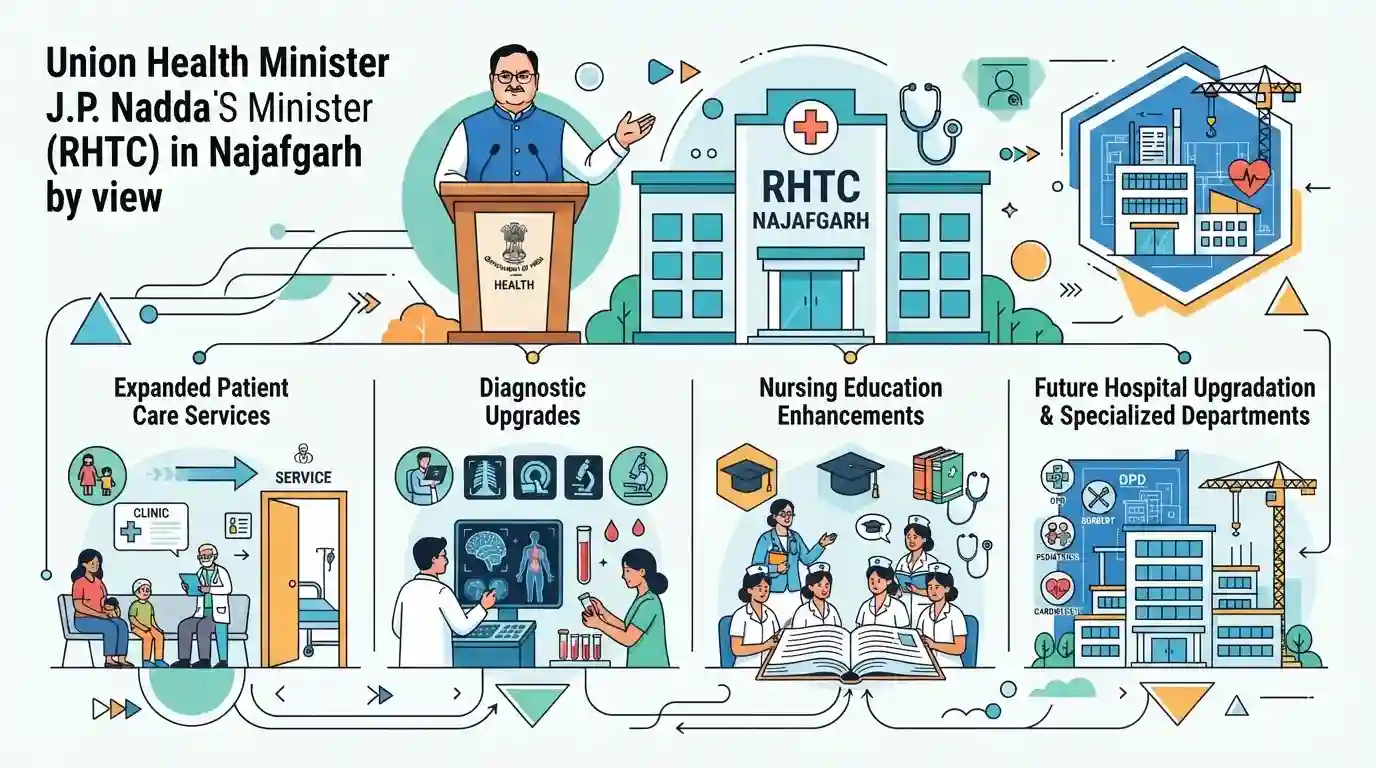
Union Health Minister J.P. Nadda reviewed the institutional progress of the Rural Health Training Centre (RHTC) in Najafgarh, highlighting its expanded patient care services, diagnostic upgrades, nursing education enhancements, and future plans for hospital upgradation and specialized medical departments.
Key Points
- Union Health Minister reviewed the institutional progress and infrastructure development of the Rural Health Training Centre (RHTC) in Najafgarh, New Delhi.
- RHTC provides primary healthcare through three Urban Primary Health Centres (UPHCs) at Najafgarh, Ujwa, and Palam along with sub-centres.
- Future roadmap includes upgrading RHTC into a 230-bedded hospital and establishing teaching departments in Family Medicine and Emergency Medicine.
- Focus on quality assurance under National Quality Assurance Standards (NQAS) and upgrading nursing and paramedical education infrastructure.
Important Terms
Rural Health Training Centre Najafgarh

A premier public healthcare institution in Delhi functioning under the Directorate General of Health Services, providing rural and peri-urban primary healthcare, emergency care, and community-based medical training.
UPSC context
Mains GS Paper II: Social Sector (Health) - Testing awareness of primary healthcare infrastructure and public health delivery systems in rural India.
National Quality Assurance Standards
Benchmarks instituted by the Ministry of Health and Family Welfare to assess and certify the quality, safety, and patient-centricity of public health facilities across India.
UPSC context
Mains GS Paper II: Social Sector (Health) - Important for questions on health sector reforms, quality accreditation, and public healthcare delivery.
Directorate General of Health Services
The apex technical advisory organization under the Ministry of Health and Family Welfare, responsible for implementing public health policies and overseeing central health institutions.
UPSC context
Prelims/Mains GS Paper II: Governance and Health Administration - Important for understanding the administrative architecture of India's health sector.
Ministry of Health and Family Welfare
The central government ministry responsible for formulating national health policies, family welfare programs, and overseeing medical education and public health infrastructure in India.
UPSC context
Mains GS Paper II: Governance - Essential for questions related to policy formulation, implementation, and management of social sector services.
Static Concepts Connected
What are the key certification benchmarks under the National Quality Assurance Standards (NQAS) for public health facilities?
- Core Objective:: NQAS is institutionalized to assess and improve quality of care in public health facilities based on clinical quality, patient satisfaction, and safety.
- Applicable Tiers:: It covers District Hospitals, Community Health Centres (CHCs), Primary Health Centres (PHCs), and Urban PHCs.
- Validity:: Certification involves rigorous external evaluation against department-specific checklists, valid for three years upon meeting compliance thresholds.
Cross-Topic Patterns
Primary Health Infrastructure + Medical Education Reforms
Primary health training centres like Najafgarh serve as critical field practice areas for medical undergraduates, bridging the gap between clinical theory and decentralized public health delivery under the National Health Mission.

Expect a match-the-following or statement-based question on NQAS certification benchmarks and the tiers of rural health infrastructure.
Linked PYQs · 3
Linked PYQs · 3
- 2024MainsGS2
In a crucial domain like the public healthcare system the Indian State should play a vital role to contain the adverse impact of marketisation of the system. Suggest some measures through which the State can enhance the reach of public healthcare at the grassroots level.
- 2021MainsGS2
“Besides being a moral imperative of a Welfare State, primary health structure is a necessary precondition for sustainable development.” Analyze.
- 2018MainsGS2
Appropriate local community-level healthcare intervention is a prerequisite to achieve 'Health for All' in India. Explain.
