India Creative Economy Convention and Cultural Growth Strategy
Source:PIB ↗
Why It Matters
This initiative reflects a policy shift toward formalizing and scaling India's creative economy as a major engine for employment, innovation, and sustainable GDP growth, highly relevant for GS3 economic development and GS1 cultural heritage.
Summary
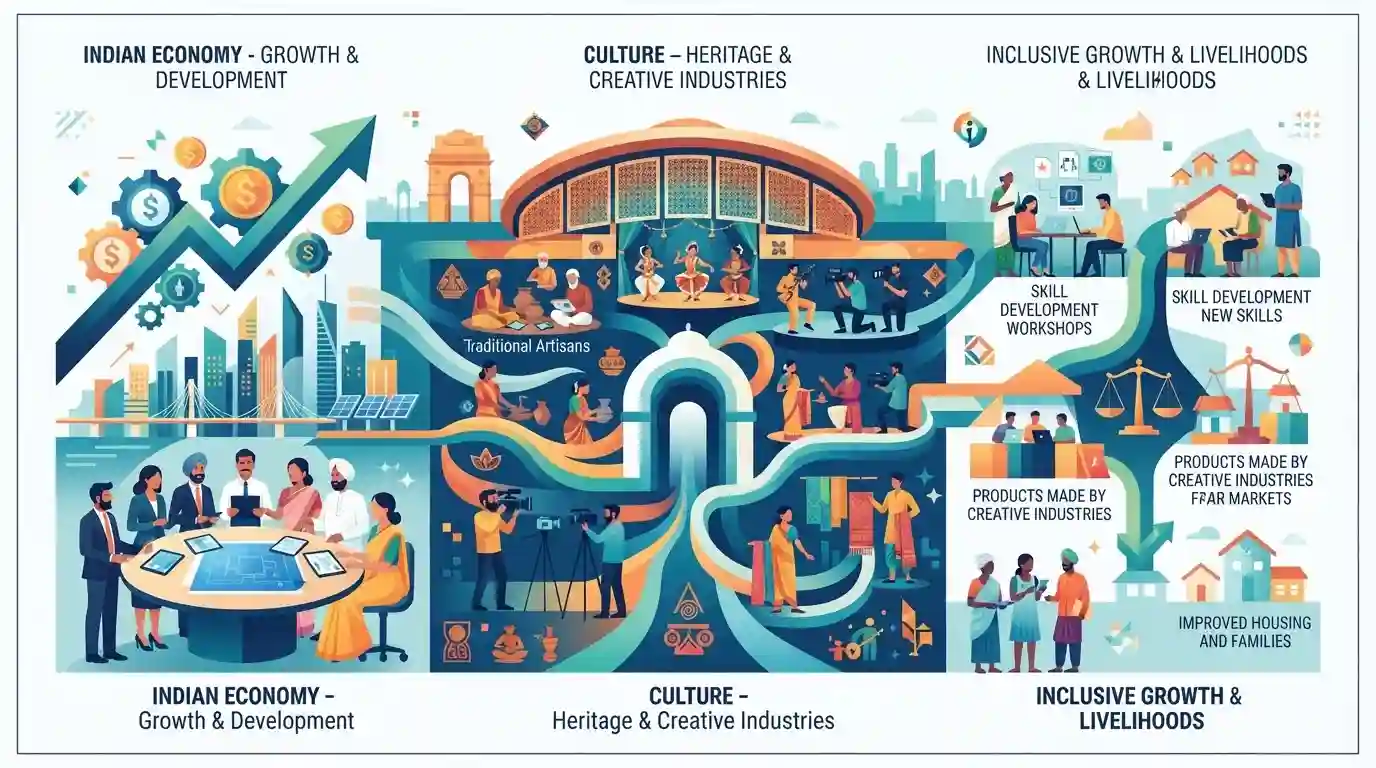
The Ministry of Culture organized the 'Creative India: Collective Possibilities' event at Bharat Mandapam, New Delhi, aiming to harness India's creative economy through strategic partnerships, driving employment and sustainable development in cultural and creative sectors.
Key Points
- The Ministry of Culture convened 'Creative India: Collective Possibilities' at Bharat Mandapam, New Delhi, focusing on building India's creative economy.
- The initiative invites public-private partnerships, stakeholders, and industry partners to foster growth in cultural and creative industries.
- Emphasizes leveraging India's rich cultural heritage, arts, and crafts to generate livelihoods, boost tourism, and drive economic growth.
- Highlights the transition from traditional heritage conservation to dynamic economic participation through creative sectors.
Important Terms
Ministry of Culture

The nodal ministry under the Government of India charged with preservation, promotion, and dissemination of Indian art, culture, and heritage, and managing policies related to the creative economy.
UPSC context
Important for GS Paper I (Indian Culture and Heritage) and GS Paper II (Government Ministries and Governance).
Bharat Mandapam
A premier international convention and exhibition center located in New Delhi, designed to host major global and national events, summits, and exhibitions.
UPSC context
Relevant for GS Paper I (Modern Indian Architecture and Urban Infrastructure) and current affairs regarding major national summits.
Prelims Trap
Repositioning protected monuments, museums, and archives as vibrant economic hubs rather than mere conservation sites.
Aspirants often assume heritage conservation is solely the mandate of ASI under strict archaeological rules without economic monetization roles.
Static Concepts Connected
What are the key institutional mechanisms and bodies governing India's tangible and intangible cultural heritage?
- ASI Mandate: Archaeological Survey of India (ASI) protects monuments of national importance under the Ancient Monuments and Archaeological Sites and Remains (AMASR) Act.
- National Academies: Sangeet Natak Akademi, Lalit Kala Akademi, and Sahitya Akademi foster performing, visual, and literary arts under the Ministry of Culture.
- UNESCO UCCN: UNESCO Creative Cities Network (UCCN) includes Indian cities like Jaipur (Crafts), Varanasi (Music), and Chennai (Music) to promote creative economies.
Cross-Topic Patterns
Cultural Heritage Meets National Monetization Pipeline
The shift toward monetizing heritage sites mirrors the National Monetization Pipeline (NMP), transitioning public cultural infrastructure into dynamic economic assets.
Creative Economy + ODOP & Vocal for Local
Integrating grassroots artisans with global markets directly aligns with One District One Product (ODOP) and vocal for local initiatives.

Viksit Bharat-2047 creative economy strategy is a prime candidate for an institutional/policy-based Mains question on cultural diplomacy.
Linked PYQs · 2
Linked PYQs · 2
- 2022MainsGS3
Economic growth in the recent past has been led by increase in labour productivity." Explain this statement. Suggest the growth pattern that will lead to creation of more jobs without compromising labour productivity.
- 2018MainsGS1
Safeguarding the Indian art heritage is the need of the moment. Discuss.
