Rent a Cab reforms for transport sector growth
Source:PIB ↗
Why It Matters
This article is important for UPSC GS-3 as it addresses regulatory reforms in India's transport sector, ease of doing business, and government initiatives aimed at boosting service industries and MSME-led growth.
Summary
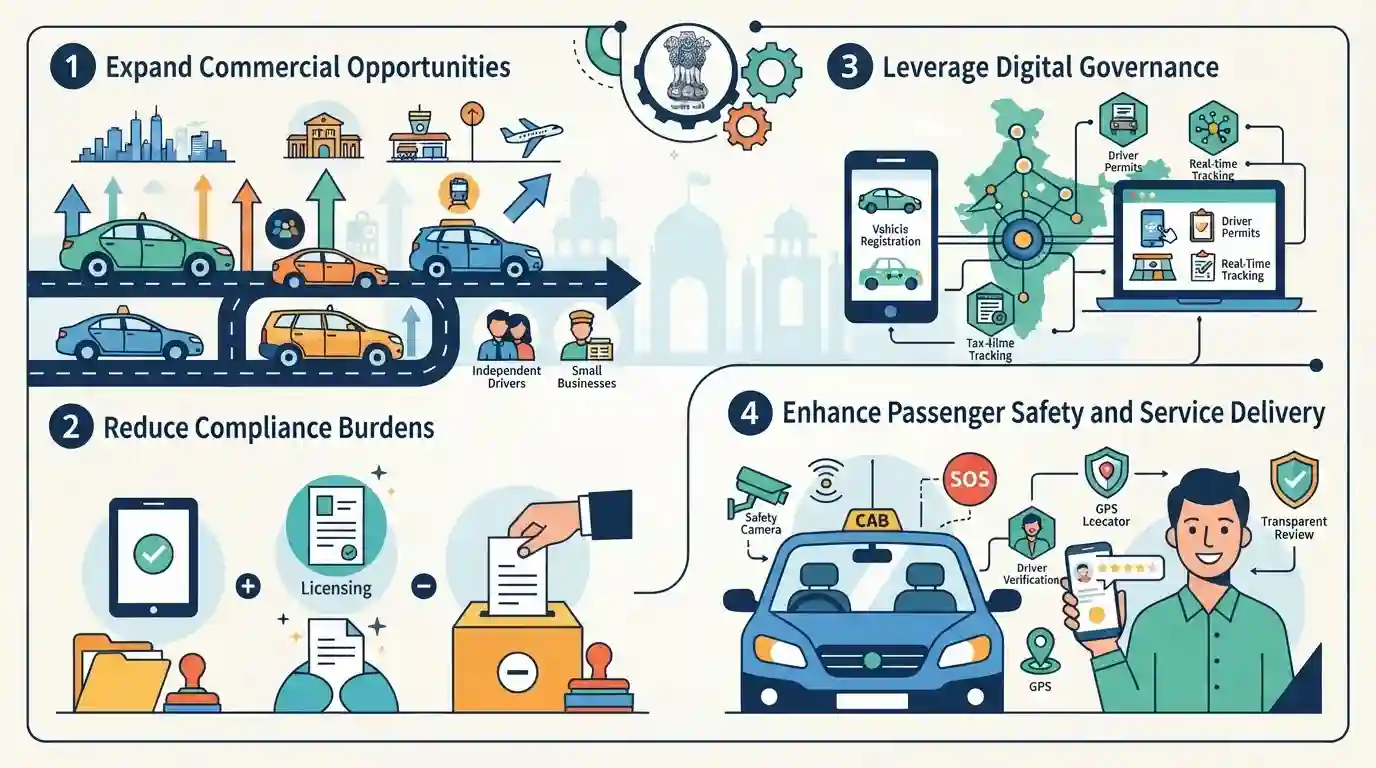
The Ministry of Road Transport and Highways has proposed key reforms to the Rent a Cab scheme and regulations to expand commercial opportunities, reduce compliance burdens for operators, leverage digital governance, and enhance passenger safety and service delivery across India.
Key Points
- The Ministry of Road Transport and Highways has proposed comprehensive reforms to the Rent a Cab guidelines to ease compliance burdens and foster business growth.
- The proposed changes aim to streamline licensing, reduce red tape, and integrate digital platforms for transparent operations.
- Measures are designed to boost passenger safety, improve service quality, and promote entrepreneurship in the transport sector.
- The reforms support the broader goal of modernizing commercial passenger transport and improving the ease of doing business.
Important Terms
Rent a Cab Scheme

A regulatory framework proposed by the Ministry of Road Transport and Highways to modernize and streamline commercial cab rental operations, reduce fleet entry barriers, and leverage digital governance for passenger safety.
UPSC context
UPSC GS Paper III (Economy - Infrastructure and Transport, Ease of Doing Business). Tests understanding of regulatory reforms in the transport sector.
Motor Vehicles Act
The principal legislative enactment governing road transport, vehicle registration, driver licensing, and traffic rules across India, providing the legal foundation for transport schemes.
UPSC context
UPSC GS Paper II / III (Governance / Infrastructure). Tests knowledge of statutory frameworks governing road safety and public transport.
Ministry of Road Transport and Highways
The central government ministry responsible for formulating and administering policies, schemes, and laws related to road transport, national highways, and transport infrastructure in India.
UPSC context
UPSC GS Paper II (Government Policies and Interventions). Important for questions relating to ministerial mandates and transport administration.
Prelims Trap
A single central license under the Rent-a-Cab Scheme automatically grants pan-India operating rights without requiring state-specific permits or approvals.
Aspirants often assume central transport schemes are operated directly by central PSUs, whereas the Rent-a-Cab Scheme is implemented via state transport authorities with decentralized state-level licensing.
Static Concepts Connected
What are the statutory powers of the Central Government under the Motor Vehicles Act, 1988?
- Statutory Power: Rule-making power: Section 211 empowers the Central Government to make rules for carrying out the purposes of the Motor Vehicles Act, including national transport schemes.
- Interstate Permits: National permits: Section 88 empowers the Centre to issue national permits for commercial transport vehicles to facilitate seamless interstate movement of goods and passengers.
- Safety Standards: Vehicle standards: The Centre sets mandatory safety, emission, and construction standards for all motor vehicles manufactured or imported into India under Section 110.
Cross-Topic Patterns
Rent-a-Cab Reforms + PM GatiShakti Master Plan
Regulatory liberalisation of the Rent-a-Cab Scheme directly complements the PM GatiShakti National Master Plan by creating agile, tech-enabled last-mile multi-modal passenger connectivity nodes.
Mobility Startups + MSME Credit Schemes
Lowering the minimum fleet size to five vehicles leverages the MUDRA scheme and Stand-Up India to foster MSME entrepreneurship in the mobility sector.

Expect a statement-based prelims question on the Motor Vehicles Act rule-making powers and the Rent-a-Cab Scheme liberalisation thresholds.
Linked PYQs · 2
Linked PYQs · 2
- 2023MainsGS3
Faster economic growth requires increased share of the manufacturing sector in GDP, particularly of MSMEs. Comment on the present policies of the Government in this regard.
- 2020MainsGS3
What are the main constraints in transport and marketing of agricultural produce in India?
