India Records Major Strides in Tuberculosis Elimination and Treatment
Source:PIB ↗
Why It Matters
A major public health milestone reflecting India's progress on Sustainable Development Goal (SDG) health targets, showcasing effective convergence of digital governance, grassroots community mobilisation, and targeted healthcare interventions under national health missions.
Summary
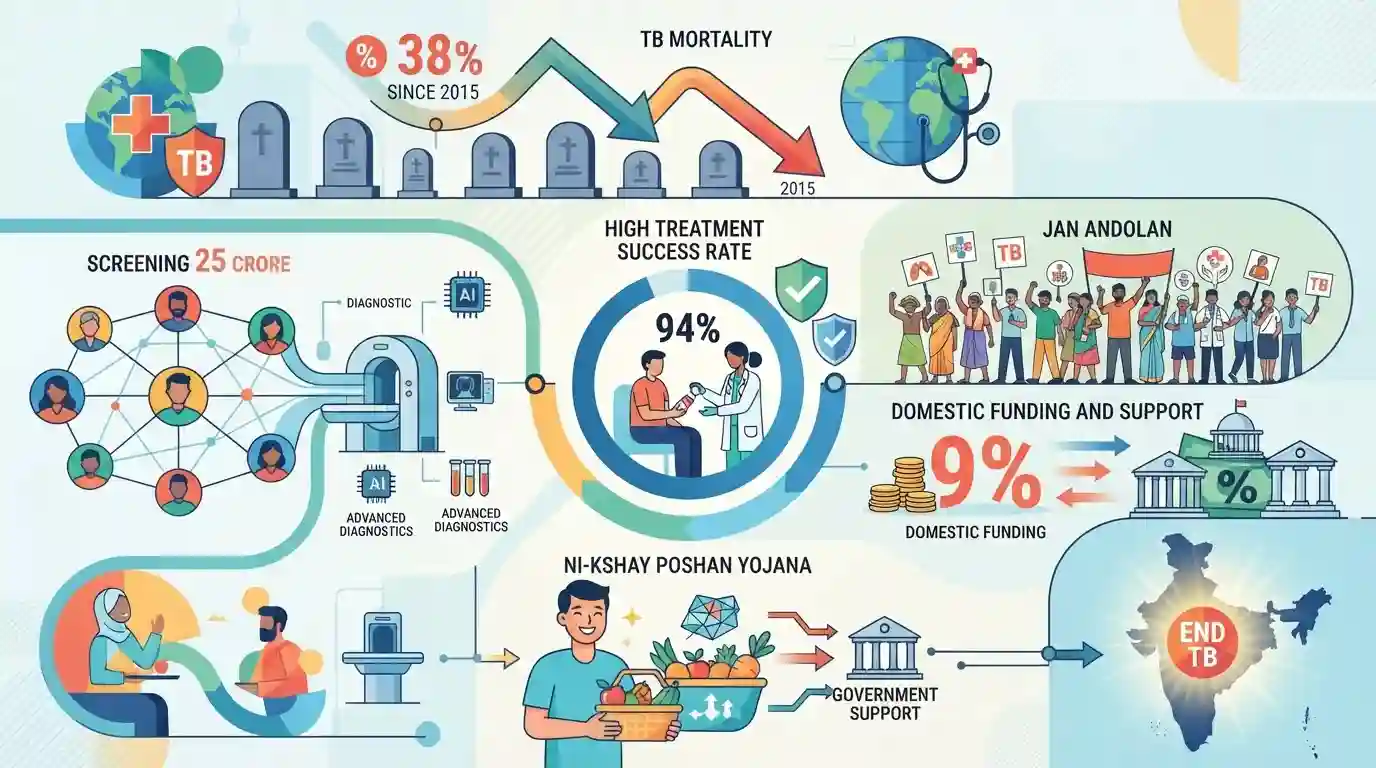
According to the WHO Global Tuberculosis Report 2026, India recorded a historic 38% decline in TB mortality since 2015 and achieved a 94% treatment success rate. Driven by the National TB Elimination Programme (NTEP) and the Jan Andolan approach of the TB Mukt Bharat Abhiyaan, the country has screened over 25 crore individuals using advanced diagnostics like AI-enabled X-rays and molecular tests. Supported by domestic funding meeting 96% of programme needs and initiatives like Ni-kshay Poshan Yojana, India is making robust strides toward eliminating tuberculosis.
Key Points
- WHO Global Tuberculosis Report 2026 highlights a 38% decline in India's TB mortality since 2015, outperforming the global average decline of 35%.
- India achieved a 94% treatment success rate among patients with drug-susceptible tuberculosis.
- Over 25 crore people were screened under the TB Mukt Bharat Abhiyaan, utilizing 11 crore chest X-rays and 3 crore molecular tests (NAAT), detecting nearly 15 lakh asymptomatic cases.
- 96% of TB programme funding requirements were met through domestic resources, showcasing strong national commitment and self-reliance.
- Integration of advanced technologies such as AI-enabled portable digital X-rays, Ni-kshay portal, and grassroots mobilization through Jan Bhagidari and JOSH Teams.
Important Terms
TB Mukt Bharat Abhiyaan

India's comprehensive national campaign under the NTEP aimed at mobilizing communities, scaling up screening using AI-enabled diagnostics, and completely eradicating tuberculosis from the country well ahead of global targets.
UPSC context
GS Paper II (Health Sector & Social Development): Tests knowledge of government flagship health missions and public welfare interventions.
Ni-kshay Poshan Yojana
A direct benefit transfer scheme under India's national health program providing financial assistance for nutritional support to registered tuberculosis patients throughout their treatment cycle.
UPSC context
GS Paper II (Welfare Schemes for Vulnerable Sections): Evaluates understanding of nutritional support mechanisms and social safety nets for disease elimination.
National TB Elimination Programme
The flagship public health program of the Government of India designed to systematically diagnose, treat, and eliminate tuberculosis nationwide through decentralized care and advanced molecular tools.
UPSC context
GS Paper II (Issues Relating to Development and Management of Health Services): Important for tracking India's institutional strategies against major communicable diseases.
Prelims Trap
India's national TB elimination program is primarily dependent on international donor funding and multilateral grants.
Aspirants often assume India is heavily reliant on external funding or international grants for its national disease control programs, whereas domestic resources fund 96% of NTEP.
Static Concepts Connected
What are the key pillars and nutritional support mechanisms under India's National TB Elimination Programme (NTEP)?
- Digital Tracking: Ni-kshay Portal serves as the national web-based patient management system for tuberculosis tracking, notifications, and treatment adherence monitoring.
- Nutritional Support: Ni-kshay Poshan Yojana provides a direct benefit transfer (DBT) of financial support to TB patients for nutritional needs throughout their treatment duration.
- Advanced Diagnostics: Active Case Finding deploys AI-enabled X-rays and molecular diagnostic tests (like NAAT/CBNAAT) in vulnerable communities to detect asymptomatic cases early.
Cross-Topic Patterns
TB Elimination + Direct Benefit Transfers
Nutritional support schemes like Ni-kshay Poshan Yojana link infectious disease outcomes directly to Direct Benefit Transfer (DBT) architecture and social safety nets.
Public Health + Indigenous Med-Tech Innovation
The shift toward AI-enabled portable diagnostics and indigenous molecular testing under NTEP highlights self-reliance in public health infrastructure and med-tech manufacturing.

Expect a multi-statement Prelims question pairing WHO TB Report targets with India's domestic financing share (96%) and DBT nutrition schemes.
Linked PYQs · 2
Linked PYQs · 2
- 2024MainsGS2
In a crucial domain like the public healthcare system the Indian State should play a vital role to contain the adverse impact of marketisation of the system. Suggest some measures through which the State can enhance the reach of public healthcare at the grassroots level.
- 2018MainsGS2
Appropriate local community-level healthcare intervention is a prerequisite to achieve 'Health for All' in India. Explain.
