Jal Jeevan Mission 2.0 Regional Conference Focuses on Sustainability
Source:PIB ↗
Why It Matters
The article highlights the policy shift in India's flagship rural drinking water initiative from mere infrastructure rollout to long-term functionality, source sustainability, and grassroots governance via Panchayati Raj Institutions, which is crucial for GS2 governance and GS3 resource management.
Summary
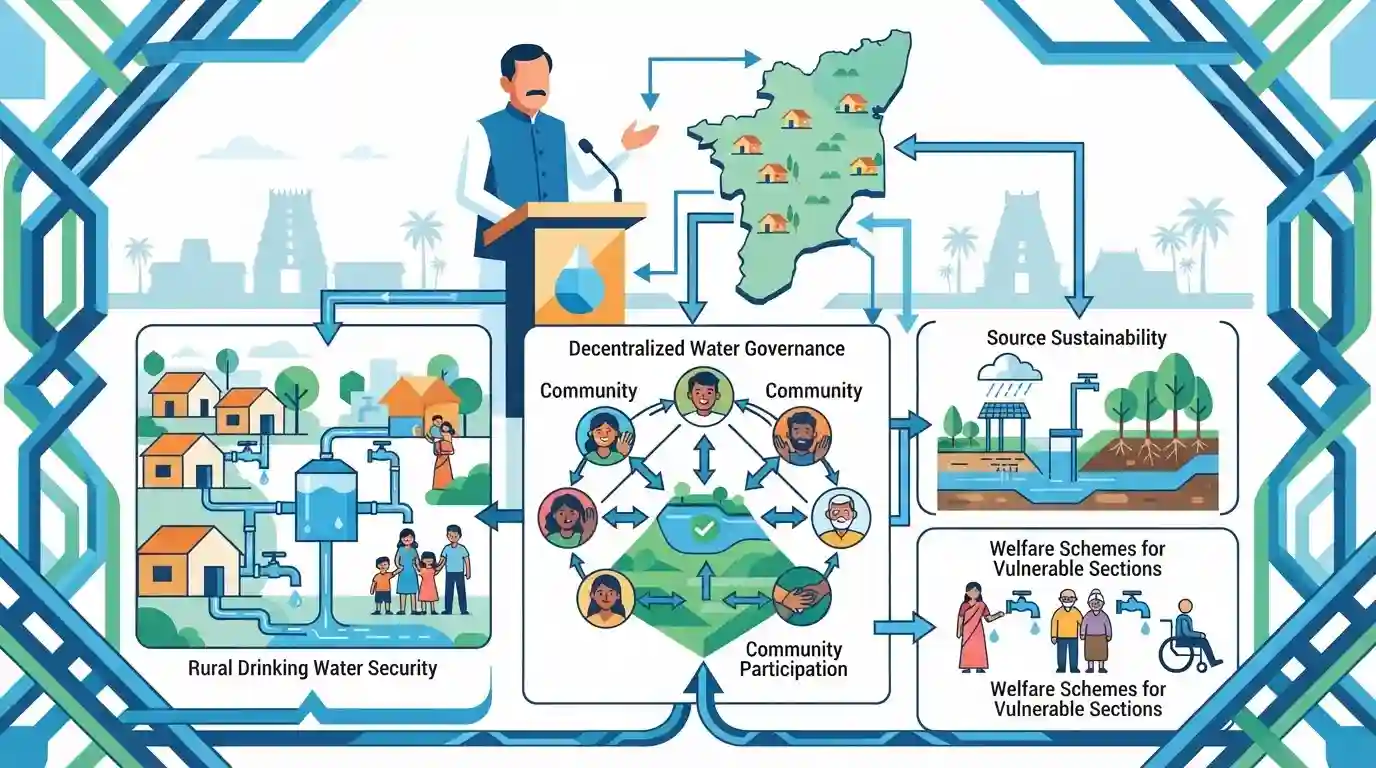
Union Jal Shakti Minister C. R. Paatil addressed the first Regional Conference on Jal Jeevan Mission (JJM) 2.0 in Tiruchirappalli, focusing on rural drinking water security, functionality of tap water connections, source sustainability, and decentralized water governance through community participation.
Key Points
- Union Jal Shakti Minister addressed the first Regional Conference on Jal Jeevan Mission (JJM) 2.0 at Tiruchirappalli.
- Discussions focused on transitioning from infrastructure creation to long-term functionality, operation, and maintenance (O&M) of rural water supply schemes.
- Emphasized source sustainability, water quality monitoring, greywater management, and community participation through Jal Sahayaks and Village Water and Sanitation Committees (VWSCs).
- Stressed cooperative federalism and peer learning among southern and neighboring states/UTs to achieve universal safe drinking water coverage.
Important Terms
Jal Jeevan Mission

A flagship central scheme aiming to provide safe and adequate drinking water through individual household tap connections to all rural households in India, emphasizing community participation and source sustainability.
UPSC context
Important for GS Paper II (Government Policies & Interventions, Welfare Schemes for Vulnerable Sections). Tests understanding of rural infrastructure and public health.
JJM 2.0
The restructured, extended phase of the rural drinking water program focusing on long-term service delivery, functionality, source sustainability, and decentralized water governance.
UPSC context
Important for GS Paper II (Government Policies & Interventions, Devolution of Powers). Evaluates administrative updates and capacity building in local governance.
Ministry of Jal Shakti
The Union Ministry responsible for the formulation and administration of policies and programs for the development and regulation of India's water resources.
UPSC context
Important for GS Paper II (Structure and Function of Ministries/Departments). Tests knowledge of institutional frameworks governing water resource management.
Prelims Trap
Jal Jeevan Mission 2.0 focuses primarily on expanding new Functional Household Tap Connections across unconnected rural habitations.
JJM 2.0 is not solely about laying new pipeline infrastructure; its primary focus under phase 2 is long-term functionality, source sustainability, and community-led O&M.
Static Concepts Connected
What are the key institutional mechanisms and decentralized bodies under the Jal Jeevan Mission for rural water governance?
- VWSCs Role:: Mandated under Gram Panchayats, VWSCs prepare Village Action Plans (VAPs) covering drinking water supply, greywater management, and source sustainability.
- Jal Sahayaks:: Local community volunteers trained for water quality testing, chlorine dosing, and field testing kit (FTK) monitoring at the habitation level.
- Gender Inclusion:: At least 50% members in VWSCs are women, institutionalizing gender-inclusive local water management and operations.
Cross-Topic Patterns
JJM 2.0 and Panchayati Raj Devolution
JJM 2.0 connects rural infrastructure targets directly with 73rd Constitutional Amendment devolution of powers to Panchayats, particularly through Village Water and Sanitation Committees.
Infrastructure Creation vs. Long-term O&M Lifecycle
Shifting focus from capital infrastructure creation to Operation and Maintenance (O&M) mirrors asset-management challenges seen across PMGSY and Ayushman Bharat digital health networks.

Expect a multi-statement Prelims question on institutional roles under JJM 2.0, specifically VWSCs, Jal Sahayaks, and women's local governance.
Linked PYQs · 3
Linked PYQs · 3
- 2026PrelimsGS1
Which of the following statements with respect to the Revamped Rashtriya Gram Swaraj Abhiyan (RGSA) is/are correct? 1. The period of its implementation is 1st April, 2021 to 31st March, 2026. 2. The key objective of the Revamped RGSA is to develop the governance capabilities of the Panchayati Raj Institutions to deliver on the Sustainable Development Goals. 3. The share of the Central funding for the Revamped RGSA is 100% for all States and Union Territories. Select the answer using the code given below:
- 2020MainsGS2
The strength and sustenance of local institutions in India has shifted from their formative phase of 'Functions, Functionaries and Funds' to the contemporary stage of 'Functionality'. Highlight the critical challenges faced by local institutions in terms of their functionality in recent times.
- 2020MainsGS3
What are the salient features of the Jal Shakti Abhiyan launched by the Government of India for water conservation and water security?
