Impact Assessment Report on Production Linked Incentive Schemes
Source:PIB ↗
Why It Matters
Directly relevant to GS3 syllabus regarding Indian Economy, manufacturing sector, industrial policy, and employment generation through government interventions like the PLI scheme.
Summary
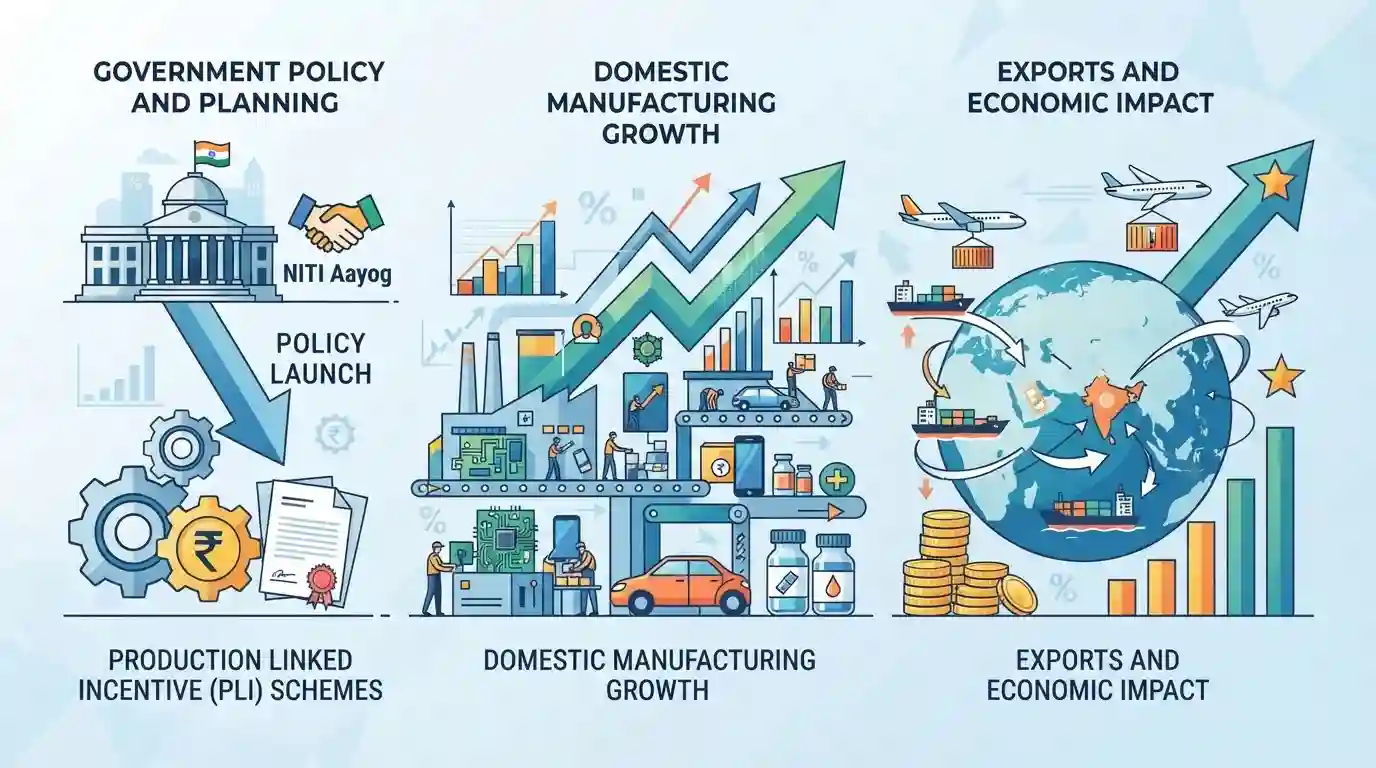
NITI Aayog launched a report evaluating the impact of Production Linked Incentive (PLI) schemes, assessing their role in driving domestic manufacturing, exports, and economic growth in India.
Key Points
- NITI Aayog released a comprehensive report on the Impact Assessment of Production Linked Incentive (PLI) Schemes.
- The report evaluates the economic outcomes, manufacturing growth, employment generation, and export competitiveness fostered by the PLI framework across key sectors.
- PLI schemes aim to boost domestic manufacturing capacity, reduce import dependence, and integrate India into global supply chains.
Important Terms
Production Linked Incentive (PLI) Schemes

A flagship government policy providing financial incentives to companies based on incremental production and sales, designed to boost domestic manufacturing, attract investments, and enhance export competitiveness across 14 key sectors.
UPSC context
UPSC Prelims and Mains (GS Paper III - Indian Economy, Industrial Policy, Manufacturing Growth). Evaluates government interventions for export promotion and Make in India.
NITI Aayog
India's apex public policy think tank and advisory body replacing the Planning Commission, dedicated to fostering cooperative federalism and evidence-based governance through a bottom-up approach.
UPSC context
UPSC Prelims and Mains (GS Paper II - Governance, Government Policies & Interventions). Focuses on institutional frameworks, think-tanks, and developmental planning.
Prelims Trap
Employment generation under the PLI framework matched capital investments, successfully achieving over 75% of targeted job creation goals across all sectors.
Aspirants often assume that high capital investment in capital-intensive sectors automatically translates to proportional job creation, missing the reality of lower employment generation ratios in high-tech PLI verticals.
Static Concepts Connected
What are the core objectives and structural features of Production Linked Incentive (PLI) schemes in India?
- Primary Goal: To boost domestic manufacturing capacity, scale up production, and enhance India's export competitiveness.
- Incentive Structure: Provides financial incentives (calculated as a percentage of incremental sales over base year) to eligible companies across targeted sectors.
- Strategic Aim: Seeks to reduce import dependence and deeply integrate Indian manufacturing into Global Value Chains (GVCs).
Cross-Topic Patterns
PLI Manufacturing vs. Employment Elasticity of Growth
While PLI incentivizes output, capital-intensive schemes often suffer from low employment elasticity of growth, contrasting with labor-intensive sectors like apparel or footwear under PM-MITRA.
PLI Schemes and WTO SCM Agreement Rules
Export-boosting subsidies through PLI must navigate WTO's Subsidies and Countervailing Measures (SCM) agreement, especially export-contingent conditions challenged by trade partners.

PLI scheme performance metrics (investment vs. employment targets) are ripe for UPSC statement-based Prelims or Mains critical evaluation.
Linked PYQs · 3
Linked PYQs · 3
- 2025MainsGS3
Discuss the rationale of the Production Linked Incentive (PLI) scheme. What are its achievements? In what way can the functioning and outcomes of the scheme be improved?
- 2023MainsGS3
Faster economic growth requires increased share of the manufacturing sector in GDP, particularly of MSMEs. Comment on the present policies of the Government in this regard.
- 2018MainsGS3
How are the principles followed by the NITI Aayog different from those followed by the erstwhile Planning Commission in India?
