Nutrient Based Subsidy Rates for Rabi Fertilizers
Source:PIB ↗
Why It Matters
Understanding agricultural subsidies, fertilizer pricing policies, and fiscal management is crucial for Mains GS3 (Agriculture and Economic Development).
Summary
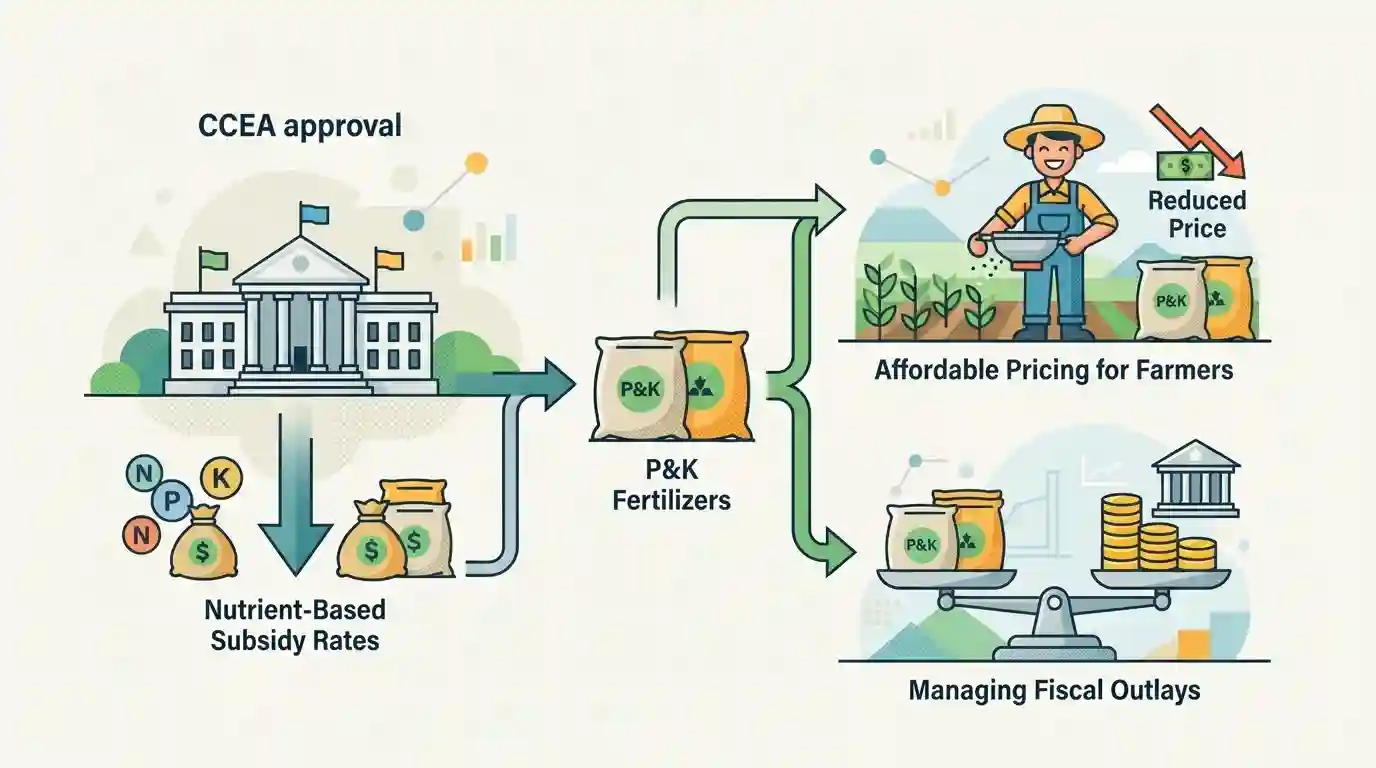
The CCEA approved Nutrient-Based Subsidy rates for P&K fertilizers for the Rabi season, ensuring affordable pricing for farmers while managing fiscal outlays on agricultural support.
Key Points
- The Cabinet Committee on Economic Affairs approved the Nutrient-Based Subsidy (NBS) rates for phosphatic and potassic (P&K) fertilizers for the Rabi season.
- NBS policy aims to ensure adequate availability of fertilizers to farmers at subsidized and affordable prices.
- Subsidy is determined based on the nutrient content (Nitrogen, Phosphorus, Potassium, and Sulphur) present in the fertilizers.
Important Terms
Nutrient Based Subsidy Scheme

A central sector scheme providing fixed subsidies per kilogram of nutrient content for P&K fertilizers, aiming to ensure affordability and balanced soil application.
UPSC context
GS Paper III (Agriculture - Subsidies and Food Security). Tests understanding of fertilizer pricing policies, fiscal outlays, and agricultural support mechanisms.
Cabinet Committee on Economic Affairs
A cabinet committee chaired by the Prime Minister that reviews economic policies, prices, and financial support measures, including major agricultural fertilizer subsidies.
UPSC context
GS Paper II/III (Governance / Economy). Tests institutional frameworks for economic decision-making and government policy implementation.
Ministry of Chemicals and Fertilizers
The Union ministry responsible for formulating and administering policies related to chemicals, petrochemicals, and the production, distribution, and pricing of fertilizers in India.
UPSC context
GS Paper II (Government Ministries and Functions). Tests role of nodal ministries in managing agricultural inputs and industrial sectors.
Prelims Trap
All major chemical fertilizers including Urea receive fixed subsidies under the Nutrient-Based Subsidy (NBS) framework based on their nutrient content.
Urea is NOT covered under the Nutrient-Based Subsidy (NBS) regime; it is statutorily controlled under the Fertilizer Control Order (FCO) at a fixed MRP, unlike P&K fertilizers which have decontrolled prices.
Static Concepts Connected
What are the key features and coverage of the Nutrient-Based Subsidy (NBS) scheme in India?
- Launch & Scope: Launched in April 2010 to provide fixed subsidies on P&K fertilizers based on nutrient content (N, P, K, S).
- Exclusion of Urea: Urea is explicitly kept outside the NBS regime and remains under statutory price control.
- Market-Aligned MRP: Manufacturers fix maximum retail prices (MRPs) of P&K fertilizers at reasonable levels, while the government provides a fixed subsidy.
- Digital Disbursement: Subsidy disbursement is routed through electronic Point-of-Sale (PoS) devices installed at retail shops, linking sales to actual beneficiaries.
Cross-Topic Patterns
Fertilizer Subsidies and NPK Ratio Distortion
While P&K fertilizers are under the market-driven NBS regime, Urea remains under statutory price control, creating a persistent NPK consumption imbalance that tests fiscal and agricultural policy coordination.
Digital Public Infrastructure in Agricultural Subsidies
The shift to electronic PoS-linked fertilizer disbursement mirrors public financial management reforms across food and petroleum sectors, linking subsidies to biometric/digital verification.

Expect a statement-based prelims question distinguishing between Urea pricing (statutory) and P&K pricing (NBS regime) along with covered nutrients.
Linked PYQs · 2
Linked PYQs · 2
- 2023MainsGS3
What are the direct and indirect subsidies provided to farm sector in India? Discuss the issues raised by the World Trade Organization (WTO) in relation to agricultural subsidies.
- 2017MainsGS3
How do subsidies affect the cropping pattern, crop diversity and economy of farmers? What is the significance of crop insurance, minimum support price and food processing for small and marginal farmers?
