Tribal medicinal plants conservation and livelihood initiative
Source:PIB ↗
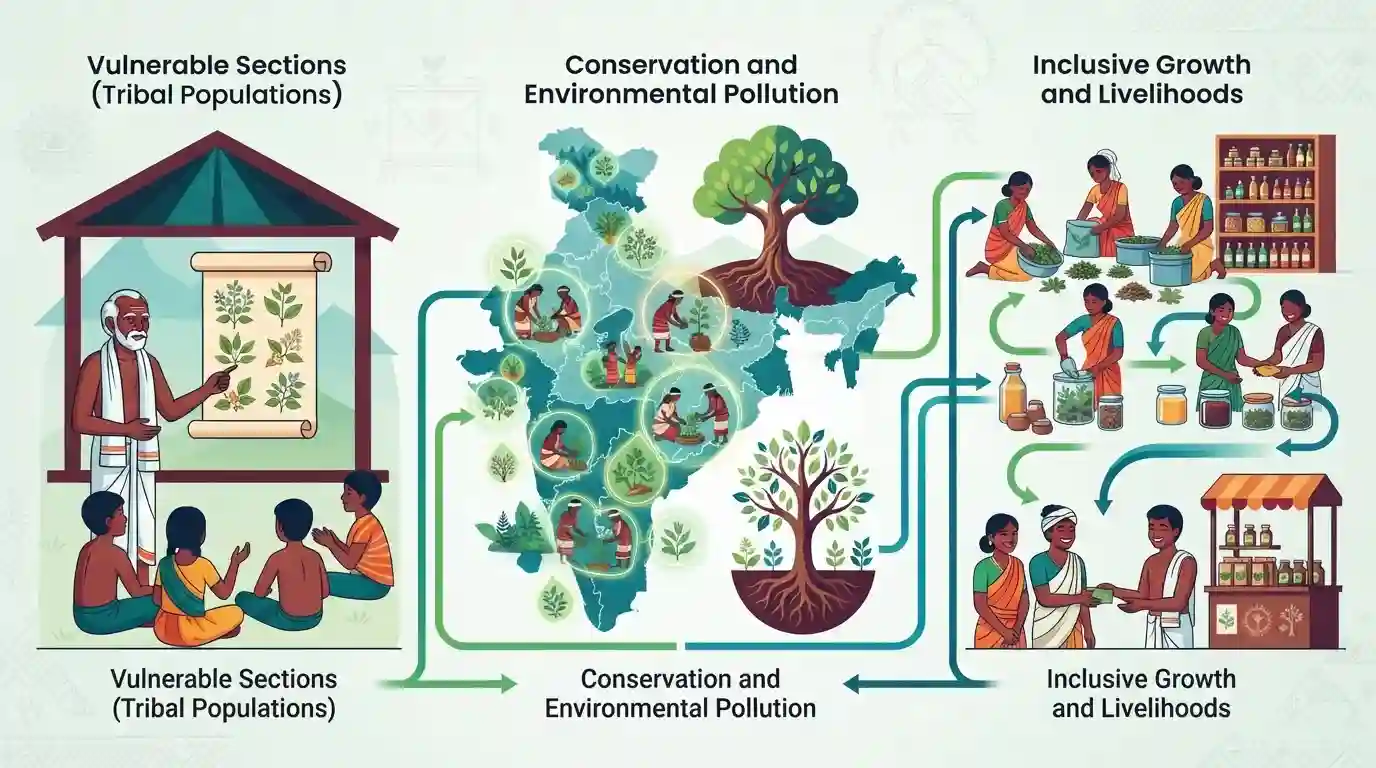
Why It Matters
This initiative directly intersects with biodiversity conservation, protection of traditional knowledge systems, and inclusive economic development for vulnerable tribal communities through sustainable resource management.
Summary
The Ministry of Tribal Affairs has launched a national initiative focused on the conservation of medicinal plants and the promotion of sustainable livelihoods across 16 tribal hotspots in 13 States/UTs. This program aims to protect rich biodiversity hotspots, preserve indigenous traditional knowledge related to healthcare, and enhance economic opportunities for tribal populations through sustainable harvesting and value addition of medicinal and minor forest produce.
Key Points
- The Ministry of Tribal Affairs launched a national initiative for the conservation of medicinal plants and promotion of sustainable livelihoods.
- The initiative covers 16 tribal hotspots across 13 States and Union Territories.
- Aims to leverage indigenous knowledge systems, empower tribal communities economically through minor forest produce value chains, and ensure biodiversity conservation.
Important Terms
Ministry of Tribal Affairs

The nodal central government ministry in India responsible for policy formulation, planning, and coordination of programs for the socio-economic development of Scheduled Tribes.
UPSC context
UPSC CSE Prelims and Mains (GS Paper II - Social Justice / Governance): Tests knowledge of institutional frameworks and welfare policies for vulnerable sections.
Scheduled Tribes and Other Traditional Forest Dwellers (Recognition of Forest Rights) Act, 2006
A landmark 2006 legislation that corrects historical injustices by recognizing land and resource rights, including minor forest produce, of forest-dwelling Scheduled Tribes and traditional forest dwellers.
UPSC context
UPSC CSE Prelims and Mains (GS Paper II & III - Polity and Environment): Tests understanding of tribal rights, forest governance, and conservation laws.
Static Concepts Connected
What are the key provisions of the Scheduled Tribes and Other Traditional Forest Dwellers (FRA), 2006 regarding Minor Forest Produce (MFP)?
- Ownership Rights: Ownership rights: FRA 2006 grants forest-dwelling scheduled tribes ownership, access to collect, use, and dispose of minor forest produce.
- MFP Definition: Definition: MFP includes all non-timber forest produce of plant origin, including bamboo, brush wood, stumps, canes, tussar, cocoons, honey, wax, lac, tendu leaves.
- Gram Sabha Role: Empowerment: Gram Sabha is empowered to manage, protect, and regulate minor forest produce within the village forest boundaries.
Cross-Topic Patterns
Forest Rights Act & Minor Forest Produce
FRA 2006 empowers Gram Sabhas to manage community forest resources, serving as the legal bedrock for sustainable harvesting initiatives launched by the Ministry of Tribal Affairs.
S&T Integration with Tribal Welfare
Integrating CSIR-NBRI research with indigenous knowledge bridges scientific ex-situ/in-situ conservation goals with traditional tribal healthcare systems and GI tagging.

Expect a statement-based prelims question pairing FRA 2006 community rights over MFP with Ministry of Tribal Affairs conservation initiatives.
Linked PYQs · 3
Linked PYQs · 3
- 2019MainsGS3
How is the Government of India protecting traditional knowledge of medicine from patenting by pharmaceutical companies?
- 2021PrelimsGS1
At the national level, which ministry is the nodal agency to ensure effective implementation of the Scheduled Tribes and Other Traditional Forest Dwellers (Recognition of Forest Rights) Act, 2006?
- 2019PrelimsGS1
Consider the following statements: 1. As per recent amendment to the Indian Forest Act, 1927, forest dwellers have the right to fell the bamboos grown on forest areas. 2. As per the Scheduled Tribes and Other Traditional Forest Dwellers (Recognition of Forest Rights) Act, 2006, bamboo is a minor forest produce. 3. The Scheduled Tribes and Other Traditional Forest Dwellers (Recognition of Forest Rights) Act, 2006 allows ownership of minor forest produce to forest dwellers. Which of the statements given above is/are correct?
