LeadIT and Decarbonization of Heavy Industries
Source:PIB ↗
Why It Matters
LeadIT is a vital global initiative for decarbonizing heavy industries. UPSC frequently asks about international climate groups, India's role in global climate negotiations, and transition pathways for hard-to-abate sectors.
Summary
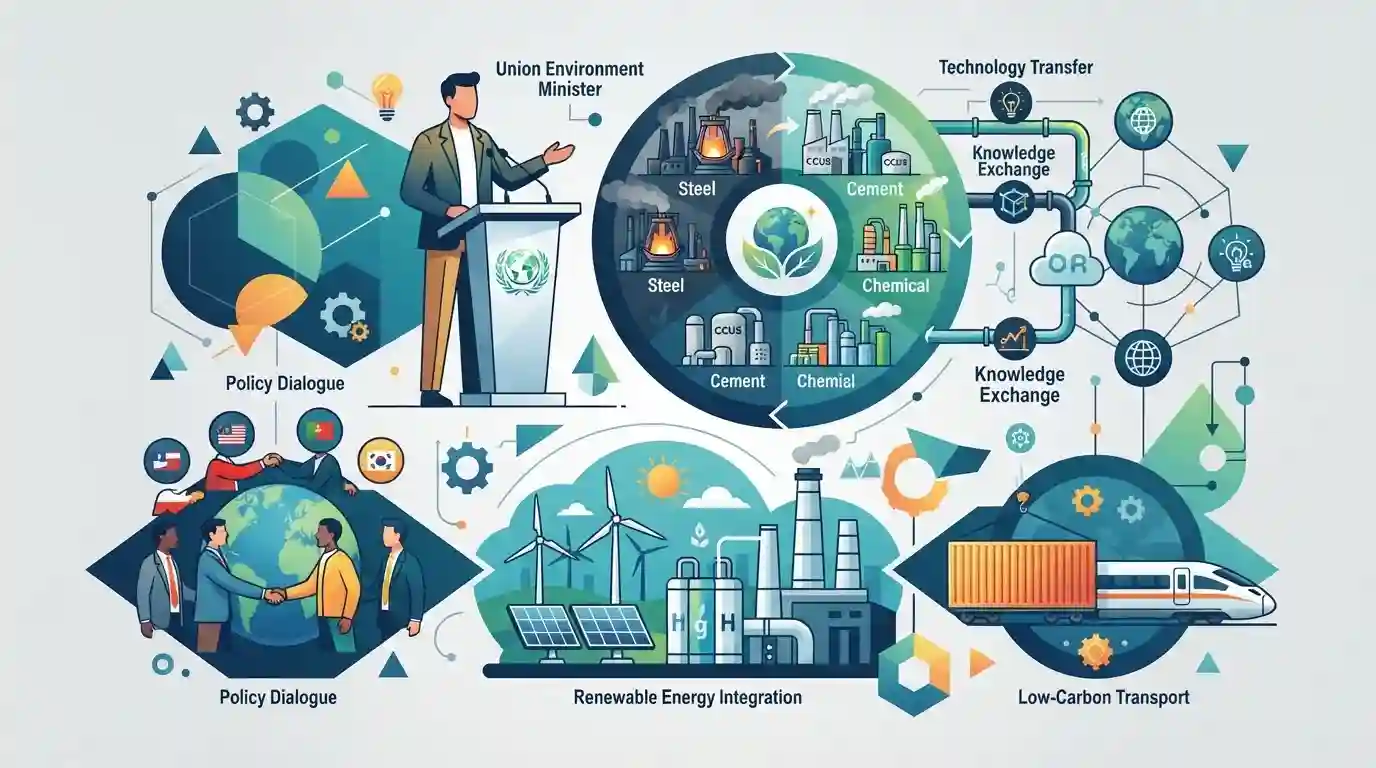
The Union Environment Minister interacted with members and partners of the Leadership Group for Industry Transition (LeadIT), reviewing progress on decarbonizing heavy industries and hard-to-abate sectors through international cooperation and technology sharing.
Key Points
- Union Environment Minister interacted with LeadIT Industry Members and Project Partners to discuss industrial decarbonization.
- LeadIT focuses on low-carbon transition in hard-to-abate sectors like steel, cement, and heavy industries.
- Emphasized international collaboration, technology transfer, and financial support for sustainable green industrial transition.
- Highlighted India's proactive climate leadership and domestic achievements in renewable energy and emission reduction targets.
Important Terms
LeadIT (Leadership Group for Industry Transition)

A global initiative launched by India and Sweden at the 2019 UN Climate Action Summit to achieve net-zero emissions in heavy industries and hard-to-abate sectors through international public-private collaboration and technology sharing.
UPSC context
GS Paper III (Environment & Climate Change). Tests knowledge of international climate coalitions, industrial decarbonization, and India's multilateral commitments.
Nationally Determined Contributions
National climate action plans under the Paris Agreement detailing each country's targets for greenhouse gas emission reduction and adaptation measures, updated every five years with increasing ambition.
UPSC context
GS Paper III (Environment and Climate Change). Essential for understanding global climate governance, UNFCCC mechanisms, and India's climate commitments.
Paris Agreement
A landmark 2015 legally binding international treaty on climate change adopted under the UNFCCC, aiming to limit global warming to well below 2 degrees Celsius above pre-industrial levels.
UPSC context
GS Paper III (Environment). Core international climate treaty tested frequently in Prelims and Mains regarding global climate targets and frameworks.
Ministry of Environment, Forest and Climate Change
The apex central government ministry in India responsible for planning, promoting, coordinating, and overseeing the implementation of environmental and forestry policies, including international climate negotiations.
UPSC context
GS Paper II/III (Governance & Environment). Tests institutional framework for environmental policymaking, statutory bodies, and India's domestic implementation of climate goals.
Static Concepts Connected
What are the core objectives and genesis of the Leadership Group for Industry Transition (LeadIT)?
- Genesis: Co-founded by India and Sweden at the UN Climate Action Summit in September 2019.
- Focus Areas: Targets low-carbon pathways for heavy industries and hard-to-abate sectors (steel, cement, aluminum) to achieve net-zero by 2050.
- Key Mechanism: Emphasizes public-private collaboration, technology co-development, and financial support for developing economies.
Cross-Topic Patterns
LeadIT Decarbonization + Domestic Industrial Policy
LeadIT's focus on hard-to-abate sectors bridges international climate diplomacy (COP summits) with domestic industrial policy like National Green Hydrogen Mission and PLI schemes.
Bilateral Tech Pacts + UNFCCC Compliance
The India-Sweden partnership showcases how bilateral clean-tech pacts operationalize broader multilateral climate commitments under Paris Agreement NDCs.

LeadIT's co-founding (India-Sweden at UN Climate Action Summit) and LeadIT 2.0 (COP28) are high-yield matches for statement-based Prelims questions.
Linked PYQs · 2
Linked PYQs · 2
- 2025MainsGS3
Write a review on India's climate commitments under the Paris Agreement (2015) and mention how these have been further strengthened in COP26 (2021). In this direction, how has the first Nationally Determined Contribution intended by India been updated in 2022?
- 2025MainsGS3
How can India achieve energy independence through clean technology by 2047? How can biotechnology can play a crucial role in this endeavour?
