Visakhapatnam Port Infrastructure Projects and Maritime Growth
Source:PIB ↗
Why It Matters
Important for understanding port-led development, maritime infrastructure upgradation, and logistics efficiency under India's economic policies.
Summary
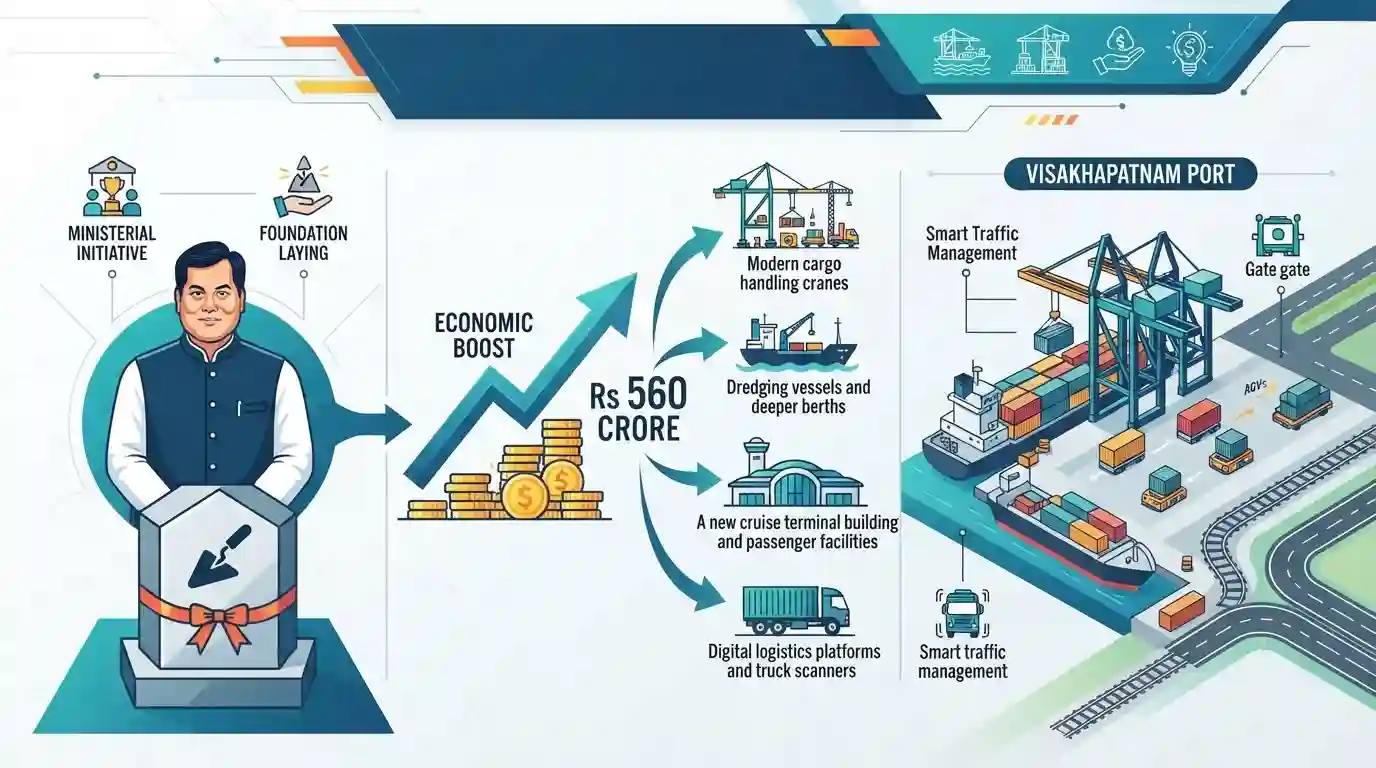
Union Minister Sarbananda Sonowal laid foundation stones for various developmental projects worth Rs 560 crore at Visakhapatnam Port, aimed at modernizing maritime infrastructure and enhancing port logistics.
Key Points
- Foundation stones laid for infrastructure and development projects worth Rs 560 crore at Visakhapatnam Port.
- Focuses on boosting port capacity, logistics efficiency, and regional economic growth under the Ministry of Ports, Shipping and Waterways.
- Aligns with national initiatives to modernize maritime infrastructure and reduce logistics costs in India.
Important Terms
Visakhapatnam Port Authority

A statutory body under the Ministry of Ports, Shipping and Waterways responsible for managing Visakhapatnam Port, one of India's major ports, focusing on cargo handling, modernization, and maritime logistics.
UPSC context
GS Paper III (Infrastructure - Ports, Logistics, Economic Development). Important for studying India's maritime trade infrastructure and major port administration.
Ministry of Ports, Shipping and Waterways
The Union Ministry responsible for formulating and administering policies, schemes, and regulations for the development and regulation of ports, shipping, and inland waterways in India.
UPSC context
GS Paper II / III (Governance and Infrastructure). Relevant for questions on federal infrastructure ministries, blue economy, and maritime transport policies.
Prelims Trap
All ports in India, including Visakhapatnam, are administered under the joint jurisdiction of the Ministry of Ports and respective coastal State maritime boards.
Aspirants often confuse Major Ports (governed by the Central government under the Union List) with Non-Major/Minor Ports (governed by respective State governments under the Concurrent List). Visakhapatnam is a Major Port.
Static Concepts Connected
What is the difference between the 'Service Port Model' and the 'Landlord Port Model' in India?
- Service model: Service Port Model: Port authority owns all assets, provides all services, and acts as regulatory and operational body (older model).
- Landlord model: Landlord Port Model: Port authority acts as regulatory landlord and owns basic infrastructure; private entities operate terminals and cargo handling.
- Policy shift: Strategic Goal: India is progressively transitioning major ports to landlord models to boost efficiency, attract PPP investments, and lower tariffs.
Cross-Topic Patterns
Port Modernization + Indo-Pacific Maritime Strategy
Visakhapatnam's deep container terminal upgrade intersects with the Indo-Pacific Maritime Domain Awareness (IPMDA) initiative and India's strategic outreach to BIMSTEC economies on the eastern seaboard.
Landlord Port Model + National Logistics Policy
The shift toward a landlord port model under the Major Port Authorities Act directly implements the broader National Logistics Policy goal of reducing logistics costs from ~14% to global benchmarks.

Major Port Authorities Act, 2021 powers, landlord port model, and the Adjudicatory Board are high-yield static-dynamic linkages.
Linked PYQs · 3
Linked PYQs · 3
- 2022MainsGS3
Why is Public Private Partnership (PPP) required in infrastructural projects ? Examine the role of PPP model in the redevelopment of Railway Stations in India.
- 2021MainsGS3
“Investment in infrastructure is essential for more rapid and inclusive economic growth.” Discuss in the light of India's experience.
- 2017MainsGS3
Examine the development of Airports in India through joint ventures under Public-Private Partnership (PPP) model. What are the challenges faced by the authorities in this regard?
