Tribal Welfare Schemes and Last-Mile Delivery Initiatives
Source:PIB ↗
Why It Matters
Understanding government initiatives like Janjatiya Gaurav Pakhwada is crucial for analyzing the implementation gaps and inclusion strategies targeting Scheduled Tribes and Particularly Vulnerable Tribal Groups (PVTGs) in governance and welfare delivery.
Summary
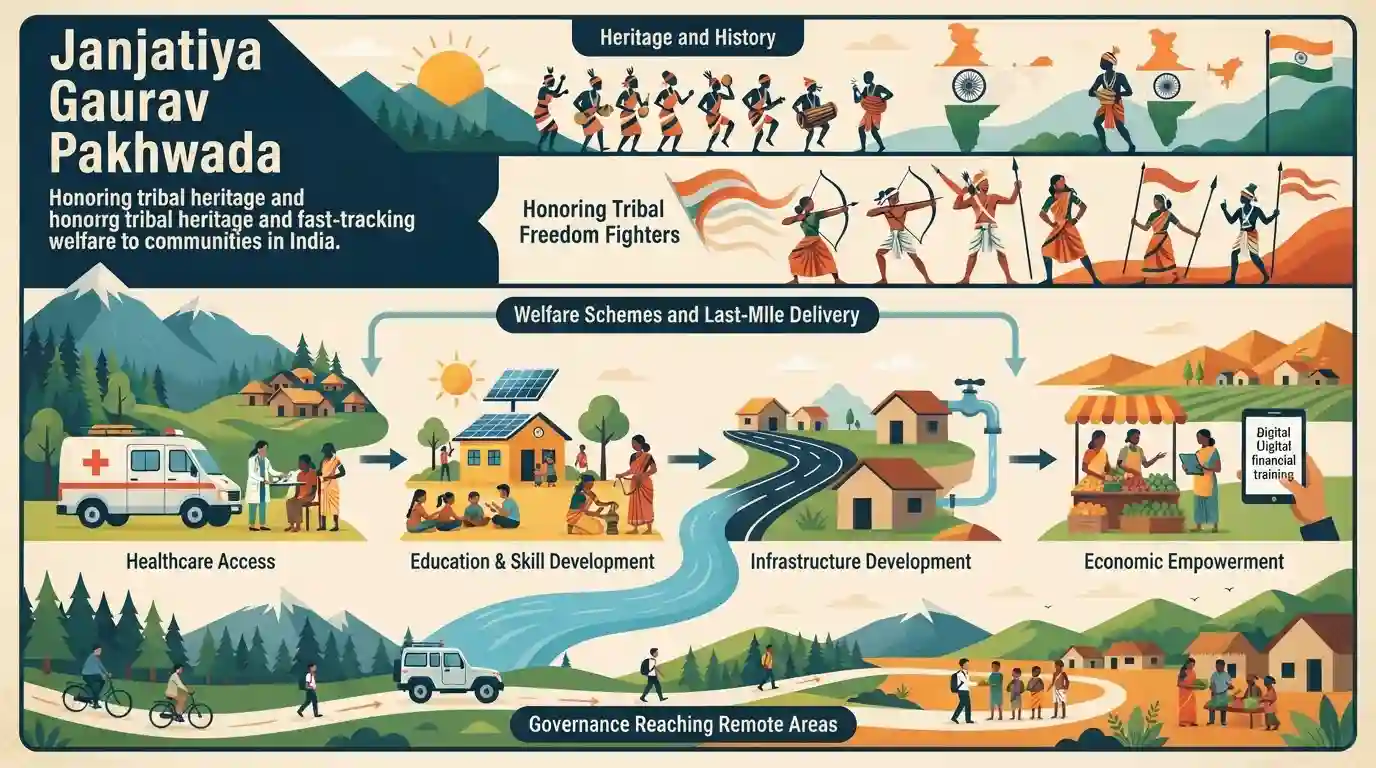
The article details the nationwide observance of Janjatiya Gaurav Pakhwada, an initiative designed to honor tribal heritage, celebrate the contributions of tribal freedom fighters, and fast-track the delivery of key welfare schemes and infrastructure to remote tribal communities and Particularly Vulnerable Tribal Groups (PVTGs) across India.
Key Points
- Janjatiya Gaurav Pakhwada focuses on honoring tribal heritage, culture, and freedom fighters across India.
- The campaign aims to accelerate last-mile delivery of crucial central welfare schemes to remote tribal habitations.
- It emphasizes saturation-based implementation of development initiatives for Particularly Vulnerable Tribal Groups (PVTGs).
Important Terms
Janjatiya Gaurav Pakhwada

An annual nationwide fortnight observance from November 1 to 15 celebrating tribal heritage, honoring freedom fighters like Bhagwan Birsa Munda, and accelerating welfare scheme delivery to remote tribal areas and PVTGs.
UPSC context
UPSC GS Paper II (Governance, Social Justice): Tests initiatives for tribal empowerment, last-mile scheme delivery, and cultural preservation.
Pradhan Mantri Janjati Adivasi Nyaya Maha Abhiyan (PM-JANMAN)
A flagship central campaign launched to achieve 100% saturation of basic welfare amenities—such as housing, clean water, and healthcare—for 75 Particularly Vulnerable Tribal Groups (PVTGs) across India.
UPSC context
UPSC GS Paper II (Welfare Schemes for Vulnerable Sections): Tests strategies targeting extreme marginalization and last-mile reach.
Ministry of Tribal Affairs
The nodal central ministry in India responsible for overall policy, planning, and coordination of socio-economic development programs for Scheduled Tribes and Particularly Vulnerable Tribal Groups.
UPSC context
UPSC GS Paper II (Governance/Polity): Tests institutional frameworks and administrative bodies governing marginalized communities.
Static Concepts Connected
What are the constitutional criteria and safeguards for Particularly Vulnerable Tribal Groups (PVTGs) in India?
- Identification Criteria: Identified groups characterized by pre-agricultural level of technology, stagnant or declining population, extremely low literacy, and a subsistence economy.
- Origin & Naming: Originally designated as Primitive Tribal Groups (PTGs) in 1975 based on the Dhebar Commission report, later renamed PVTGs in 2006.
- Constitutional Basis: Articles 341 and 342 empower the President to notify Scheduled Castes and Scheduled Tribes respectively, providing specific constitutional protections.
Cross-Topic Patterns
PVTGs + Fifth/Sixth Schedule governance integration
The PM-JANMAN mission directly operationalizes Constitutional protections under the Fifth and Sixth Schedules by pairing administrative saturation with decentralized local governance in remote tribal districts.

PM-JANMAN saturation criteria and PVTG identification parameters will appear as a statement-based match or exclusion trap in prelims.
Linked PYQs · 3
Linked PYQs · 3
- 2023MainsGS2
“Development and welfare schemes for the vulnerable, by its nature, are discriminatory in approach.” Do you agree? Give reasons for your answer.
- 2019MainsGS2
Performance of welfare schemes that are implemented for vulnerable sections is not so effective due to absence of their awareness and active involvement at all stages of policy process. Discuss.
- 2021PrelimsGS1
At the national level, which ministry is the nodal agency to ensure effective implementation of the Scheduled Tribes and Other Traditional Forest Dwellers (Recognition of Forest Rights) Act, 2006?
