NAMASTE Scheme and Empowerment of Women Sanitation Workers
Source:PIB ↗
Why It Matters
Crucial for understanding the implementation, ground-level outcomes, and convergence of welfare interventions like the NAMASTE scheme and Swachhta Udyami Yojana for marginalized sanitation workers and women's leadership.
Summary
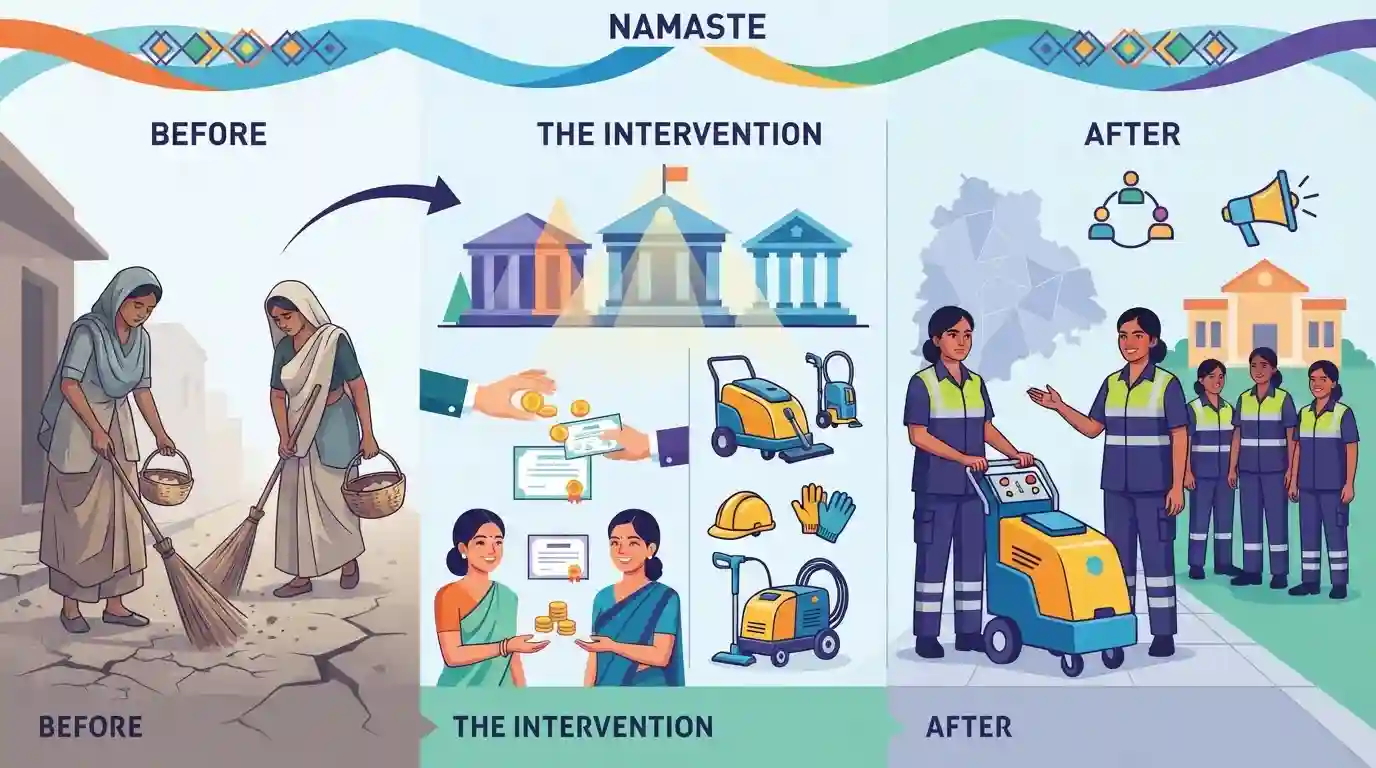
This article discusses the transformative impact of the National Action for Mechanised Sanitation Ecosystem (NAMASTE) scheme and Swachhta Udyami Yojana through the real-world journeys of women from Telangana and Delhi. These women transitioned from hazardous manual or low-paying sanitation and waste-picking roles into collective business owners of mechanized sanitation operations, Self-Help Group leaders, and community mobilizers. The initiatives demonstrate how institutional support, financial assistance, mechanization, and occupational safety measures foster dignity, safety, and holistic socio-economic empowerment for vulnerable communities.
Key Points
- The NAMASTE scheme and Swachhta Udyami Yojana (SUY) are facilitating a transition for sanitation workers and waste pickers from hazardous manual labor to safe, mechanized enterprise ownership and community leadership.
- In Siricilla, Telangana, women sanitation workers transitioned from septic tank cleaning helpers to collective owners of mechanized sanitation enterprises through financial assistance and mechanization.
- In Seemapuri, Delhi, a woman waste picker transitioned into an SHG leader, community mobilizer, and beneficiary of occupational safety training, PPE, and social security coverage under NAMASTE.
- The initiatives highlight the socio-economic empowerment of vulnerable women, moving beyond income generation to enterprise ownership, leadership, and institutional inclusion.
Important Terms
NAMASTE Scheme

A joint national initiative by MoSJE and MoHUA aimed at ensuring the safety, dignity, and mechanization of sanitation operations to eliminate hazardous manual scavenging.
UPSC context
UPSC GS Paper II: Welfare schemes for vulnerable sections and issues related to social justice and empowerment.
Swachhta Udyami Yojana
A credit-linked concessional loan scheme launched by the Ministry of Social Justice and Empowerment to assist Safai Karamcharis and waste-pickers in financing community sanitation and waste projects.
UPSC context
UPSC GS Paper II: Government policies, interventions, and financial inclusion for marginalized communities.
Ministry of Social Justice and Empowerment
The nodal union ministry responsible for welfare, social justice, and empowerment programs targeting vulnerable groups including Scheduled Castes, backward classes, and sanitation workers.
UPSC context
UPSC GS Paper II: Structure, functioning, and mandate of ministries and departments in governance.
Static Concepts Connected
What are the key institutional mandates and implementation frameworks of the NAMASTE scheme?
- Min Ministries: Joint initiative of the Ministry of Social Justice and Empowerment (MoSJE) and the Ministry of Housing and Urban Affairs (MoHUA).
- Core Objective: Aimed at achieving zero fatalities in sanitation work and completely eliminating hazardous manual scavenging practices across India.
- Target Expansion: Expanded recently to include registered waste pickers, providing them with formal ID, PPE kits, and Ayushman Bharat health insurance.
- Financial Linkage: Works alongside the Swachhata Udyami Yojana (SUY) to provide concessional finance and capital subsidies for mechanized cleaning equipment.
Cross-Topic Patterns
Urban Governance & Sanitation Worker Welfare
Urban local bodies are mandated under the 74th Constitutional Amendment to handle sanitation, making convergence between urban governance and social welfare schemes vital for field-level implementation.
Inclusive Credit & Informal Sector Formalization
Financial inclusion schemes like Swachhata Udyami Yojana bridge credit gaps for marginalized informal workers, mirroring priority sector lending objectives for vulnerable groups.

NAMASTE scheme objectives, convergence of MoSJE + MoHUA, and expansion to waste pickers are high-yield for Prelims match-the-scheme questions.
Linked PYQs · 3
Linked PYQs · 3
- 2017MainsGS2
To ensure effective implementation of policies addressing water, sanitation and hygiene needs the identification of the beneficiary segments is to be synchronized with the anticipated outcomes." Examine the statement in the context of the WASH scheme.
- 2022MainsGS2
Besides the welfare schemes, India needs deft management of inflation and unemployment to serve the poor and the underprivileged sections of the society. Discuss.
- 2019MainsGS2
Performance of welfare schemes that are implemented for vulnerable sections is not so effective due to absence of their awareness and active involvement at all stages of policy process. Discuss.
