4G Saturation Project and Rural Digital Connectivity in India
Source:PIB ↗
Why It Matters
This initiative is central to India's digital inclusion strategy, bridging the digital divide between rural and urban areas, enabling last-mile e-governance delivery, and leveraging indigenous technology for critical infrastructure development.
Summary
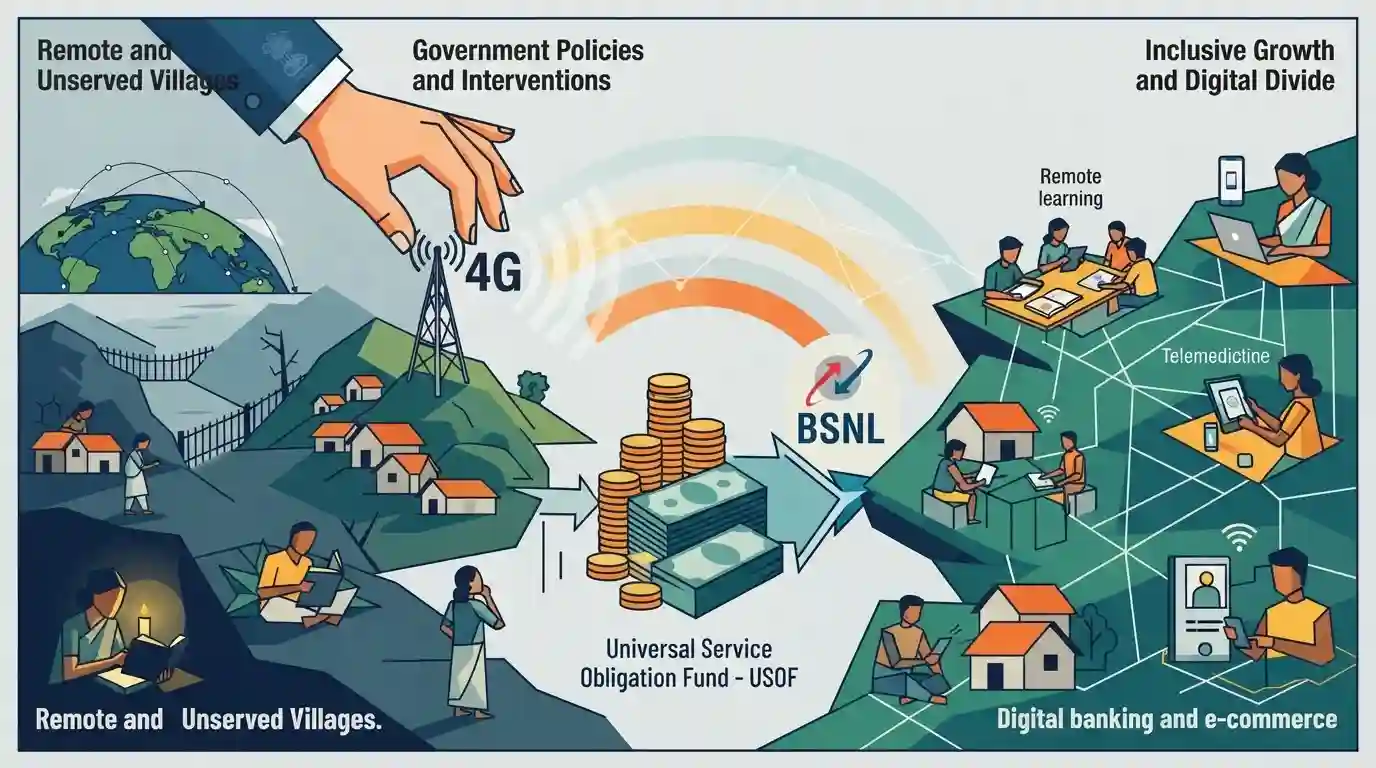
The Government of India is aggressively driving the 4G Saturation Project to expand high-speed mobile connectivity to remote and unserved villages nationwide. Financed via the Universal Service Obligation Fund (USOF) and executed primarily through BSNL, the initiative aims to bridge the rural-urban digital divide, foster inclusive growth, and support digital governance, remote education, and financial inclusion in marginalized regions.
Key Points
- The Government of India is implementing the 4G Saturation Project to provide mobile network coverage to unserved villages across remote and rural regions.
- The project bridges the digital divide, facilitating e-governance, online education, financial inclusion, and healthcare access in remote areas.
- Leverages indigenous technology and public sector execution via BSNL using the Universal Service Obligation Fund (USOF).
Important Terms
4G Saturation Project

A government initiative executed primarily by BSNL and financed via the USOF to provide 4G mobile coverage to all unserved villages across India, bridging the digital divide.
UPSC context
UPSC GS Paper III (Infrastructure - Telecom & Inclusive Growth). Tests knowledge of government schemes targeting remote rural connectivity and digital inclusion.
Universal Service Obligation Fund (USOF)
A pool of funds generated via a universal access levy on telecom operators' adjusted gross revenue, used to subsidize telecom services in rural and remote areas.
UPSC context
UPSC GS Paper III (Economy/Infrastructure). Tests financial mechanisms for bridging rural-urban divides and public sector financing in telecom.
Bharat Sanchar Nigam Limited (BSNL)
A state-owned telecommunications company in India acting as the primary executing agency for deploying public telecom infrastructure in remote and unserved rural areas.
UPSC context
UPSC GS Paper III (Infrastructure & Economy). Tests the role of Central Public Sector Enterprises (CPSEs) in public service obligations and strategic sectors.
Prelims Trap
The Universal Service Obligation Fund is financed directly through annual tax revenues allocated from the Consolidated Fund of India.
Aspirants often confuse USOF with budgetary allocations from the Consolidated Fund of India, overlooking that it is financed via a specific levy (Universal Access Levy) on telecom operators.
Static Concepts Connected
What are the key provisions and evolution of the Universal Service Obligation Fund (USOF)?
- Statutory Basis: Statutory Basis: Established under the Indian Telegraph (Amendment) Act 2003 to provide non-discriminatory access to telegraph services to people in rural and remote areas.
- Funding Source: Funding Source: Financed through a Universal Access Levy (UAL) charged as a percentage of AGR from telecom service providers.
- Recent Reform: Recent Reform: Legally renamed Digital Bharat Nidhi under the Telecommunications Act 2023, expanding its scope beyond telecom to include ICT services and R&D.
Cross-Topic Patterns
Telecom Infrastructure + Financial Inclusion
Digital infrastructure deployment via BSNL and USOF underpins direct benefit transfers and financial inclusion initiatives in remote areas.
Telecommunications Act 2023 + Statutory Funds
The renaming of USOF to Digital Bharat Nidhi under the Telecommunications Act 2023 links telecom funding to broader legal and statutory reforms.

Digital Bharat Nidhi (formerly USOF) statutory mandates and BSNL's execution role will likely feature in a governance/economy MCQ.
Linked PYQs · 1
Linked PYQs · 1
- 2023MainsGS3
What is the status of digitalization in the Indian economy? Examine the problems faced in this regard and suggest improvements.
