NAMASTE Scheme and Occupational Safety of Sanitation Workers
Source:PIB ↗
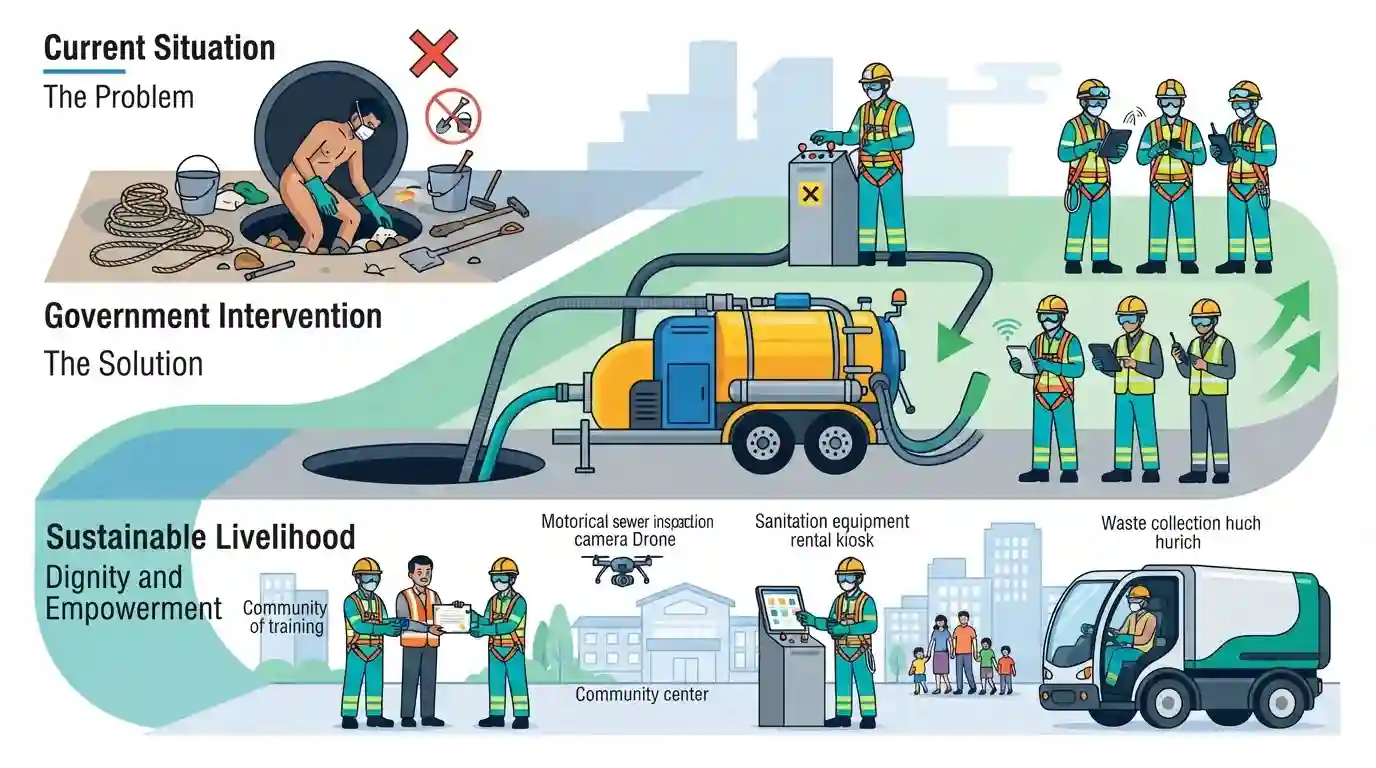
Why It Matters
Crucial for understanding government interventions targeting vulnerable sanitation workers, human rights, occupational safety, and the transition from manual scavenging to mechanised sanitation under social welfare frameworks.
Summary
The article discusses the government initiatives under the NAMASTE scheme and associated frameworks aimed at eliminating hazardous manual scavenging, preventing sewer and septic tank-related deaths, and transitioning sanitation workers toward safe, mechanised, and dignified livelihoods.
Key Points
- The NAMASTE scheme focuses on transforming hazardous manual cleaning into safe mechanised sanitation operations.
- It aims to prevent sewer and septic tank deaths by providing alternative livelihoods, safety gear, and training to sanitation workers.
- Empowerment of marginalized communities through financial assistance, capital subsidies, and institutional capacity building.
- Shifting the paradigm from traditional vulnerability to dignified, safe, and sustainable livelihoods for sewer and septic tank workers (SSWs).
Important Terms
NAMASTE Scheme

A central sector scheme launched by the Ministry of Social Justice and Empowerment to ensure zero fatalities in sanitation work, replace hazardous manual cleaning with mechanized solutions, and provide safety equipment and livelihood support.
UPSC context
GS Paper II (Social Justice - Welfare Schemes for Vulnerable Sections). Tests policies and safety frameworks for marginalized communities and sanitation workers.
Prohibition of Employment as Manual Scavengers and their Rehabilitation Act 2013
Legislation enacted in 2013 that criminalizes the employment of manual scavengers, bans hazardous manual cleaning of sewers and septic tanks without protective gear, and mandates rehabilitation.
UPSC context
GS Paper II (Social Justice / Polity). Tests statutory safeguards, human rights, and legal measures against caste-based discrimination and hazardous labor.
Ministry of Social Justice and Empowerment
The nodal union ministry responsible for welfare, social justice, and empowerment of marginalized, vulnerable, and disadvantaged sections of society, including sanitation workers and manual scavengers.
UPSC context
GS Paper II (Governance / Social Justice). Tests institutional framework and ministry mandates for vulnerable sector welfare and inclusive growth.
Prelims Trap
NAMASTE is solely administered by the Ministry of Social Justice and Empowerment to eliminate manual scavenging.
Aspirants often confuse NAMASTE as a standalone Ministry initiative, overlooking its crucial joint implementation by MoSJE and MoHUA.
Static Concepts Connected
What are the key provisions of the Prohibition of Employment as Manual Scavengers and their Rehabilitation Act, 2013?
- Statutory Ban: Complete prohibition of manual scavenging and hazardous cleaning of sewer/septic tanks without protective gear.
- Rehabilitation Duty: Mandates identification of manual scavengers and provides for their rehabilitation through cash assistance, skill training, and housing.
- Administrative Role: District Magistrate and local authorities are held legally responsible for enforcing compliance and prosecuting violators.
Cross-Topic Patterns
Welfare Schemes + Urban Governance Integration
Transitioning manual scavengers to mechanized operations links welfare policy directly with industrial safety codes and urban local governance reforms.
Targeted Welfare + Universal Healthcare Convergence
Integrating sanitation workers into AB-PMJAY bridges targeted social welfare with universal healthcare coverage mandates.

NAMASTE scheme objectives, funding mechanism (NSKFDC), and statutory overlap with the 2013 Act are high-yield Prelims areas.
Linked PYQs · 2
Linked PYQs · 2
- 2017MainsGS2
To ensure effective implementation of policies addressing water, sanitation and hygiene needs the identification of the beneficiary segments is to be synchronized with the anticipated outcomes." Examine the statement in the context of the WASH scheme.
- 2023MainsGS2
“Development and welfare schemes for the vulnerable, by its nature, are discriminatory in approach.” Do you agree? Give reasons for your answer.
