Odisha National Roadmap for Millet Led Agriculture Transformation
Source:PIB ↗
Why It Matters
Crucial for understanding how state-level agricultural initiatives like millet missions promote climate-resilient farming, nutritional security, and sustainable rural development.
Summary
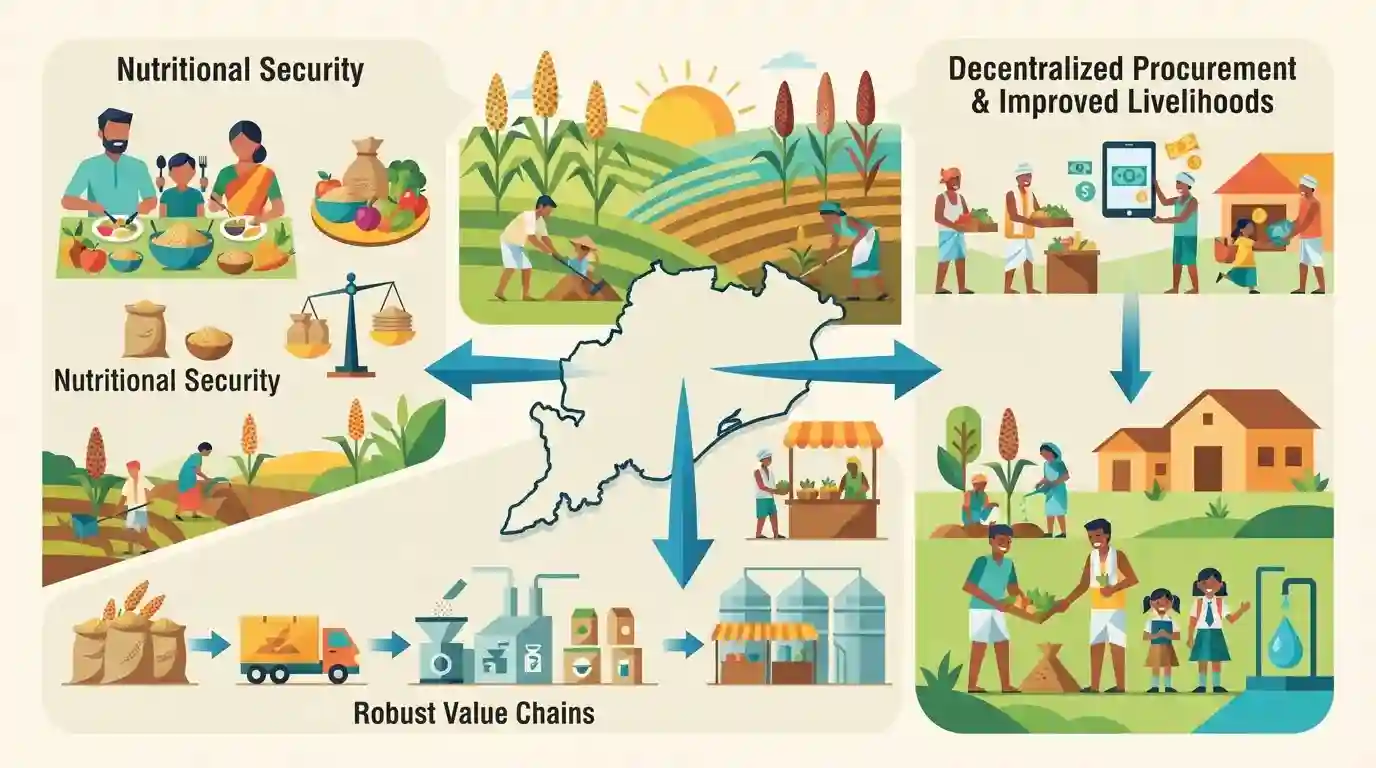
Odisha has charted a national roadmap focusing on millet-led agricultural transformation, aiming to scale up climate-resilient agriculture, enhance nutritional security, and improve farmers' livelihoods through robust value chains and decentralized procurement.
Key Points
- Odisha is spearheading a national roadmap for millet-led agricultural transformation, expanding nutritious and climate-resilient farming systems.
- The framework focuses on decentralized procurement, value addition, processing infrastructure, and integrating millets into public welfare schemes like the PDS and mid-day meal programs.
- Promoting millets aligns with nutritional security, climate-smart agriculture, and sustainable livelihood generation for small and marginal farmers.
Important Terms
Odisha Millet Mission

A pioneering state initiative launched in Odisha to promote climate-resilient millet cultivation, enhance nutritional security through public schemes like PDS, and improve farmers' livelihoods using decentralized procurement and value chains.
UPSC context
GS Paper III (Agriculture - Cropping Patterns & Food Security); tests knowledge of state-led best practices for sustainable farming and nutrition.
International Year of Millets
The year 2023 declared by the United Nations General Assembly, following India's proposal, to raise global awareness of millets' nutritional value and climate resilience.
UPSC context
GS Paper III (Agriculture - Food Security); tests international initiatives, climate-resilient agriculture, and India's global leadership in nutri-cereals.
NITI Aayog
The premier policy think tank of the Government of India providing cooperative federalism and strategic guidance on national development priorities, including agricultural transformation.
UPSC context
GS Paper II/III (Government Policies & Economic Development); tests institutional roles in policy formulation, inclusive growth, and cooperative federalism.
Prelims Trap
Millets can only be procured centrally by the Food Corporation of India (FCI) under uniform national MSP guidelines without state-level decentralized interventions.
Aspirants often assume millets are procured solely through the central MSP mechanism of FCI, whereas decentralized procurement models and state-specific initiatives like the Odisha Millet Mission drive local procurement.
Static Concepts Connected
What are the key agro-climatic advantages and nutritional properties of millets under Indian agriculture?
- Water Efficiency: Millets require significantly less water (about 30-40% of rice or wheat) and can thrive in rain-fed, arid, and semi-arid agro-climatic zones.
- Nutritional Profile: They are nutritionally superior, rich in dietary fiber, iron, calcium, and micronutrients, earning them the classification of 'Nutri-Cereals'.
- Climate Resilience: Millets have a low carbon footprint and high thermal tolerance, making them resilient to extreme weather events associated with climate change.
Cross-Topic Patterns
Millets in PDS + NFSA 2013 linkages
Integrating millets into PDS and mid-day meals directly bridges agricultural production with statutory obligations under the National Food Security Act (NFSA), 2013, linking farm policy to welfare entitlements.
Climate-Smart Agriculture + SDG 2 targets
Shifting towards low-water, climate-resilient coarse grains addresses both groundwater depletion in arid regions and international commitments under UN Sustainable Development Goal 2 (Zero Hunger).

Odisha's millet model vs MSP-centric procurement and its convergence with NFSA welfare schemes is a high-yield Mains thematic question.
Linked PYQs · 1
Linked PYQs · 1
- 2024MainsGS3
Explain the role of millets for ensuring health and nutritional security in India.
