Yamuna Cruise Service Launch and Urban River Tourism in India
Source:PIB ↗
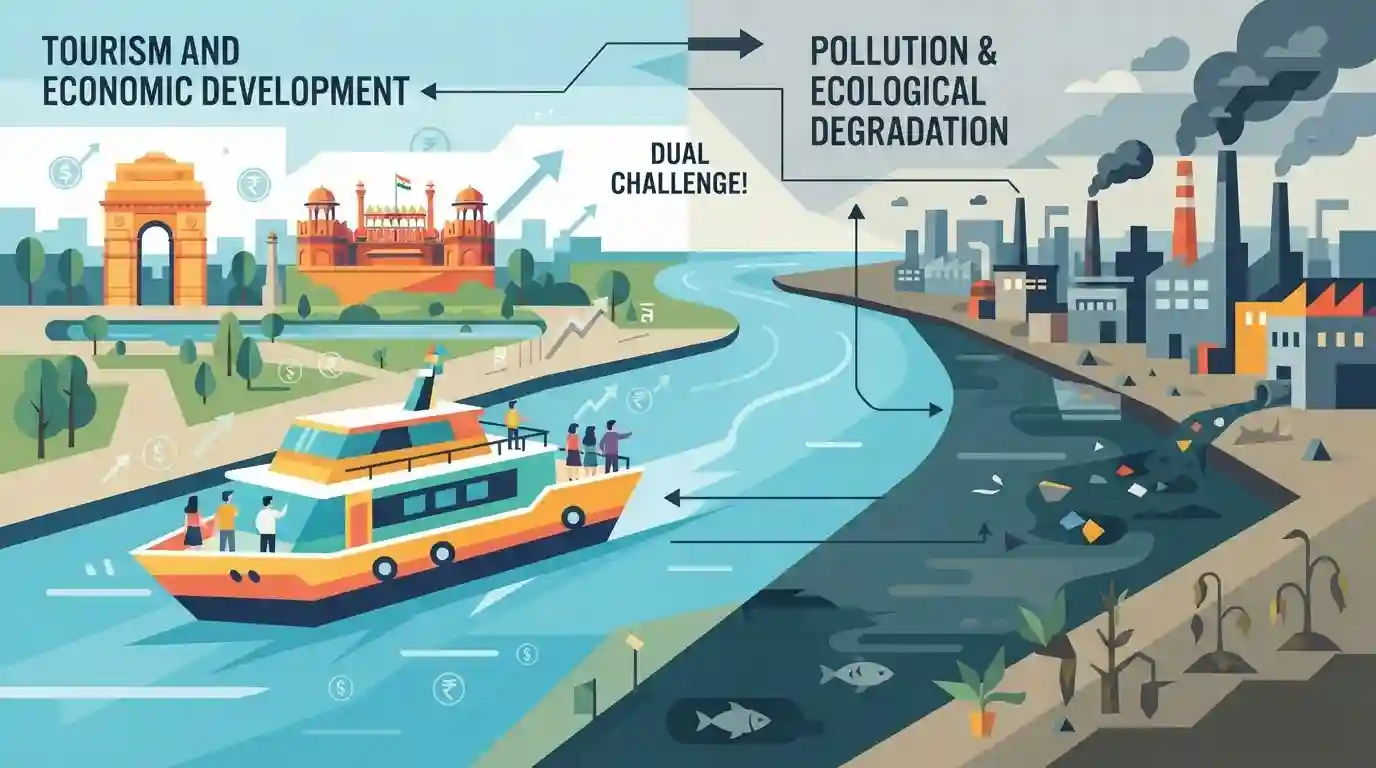
Why It Matters
The introduction of river tourism and urban water transport initiatives like the Yamuna Cruise Service provides a critical context for questions on sustainable infrastructure development, inland water transport economics, and urban river conservation challenges in India.
Summary
The launch of the Yamuna Recreational Cruise Service marks the beginning of river tourism in New Delhi, highlighting the economic and recreational potential of urban river networks. While promoting inland waterways and tourism, it brings to focus the dual challenge of ecological conservation, urban river management, and pollution control in water bodies like the Yamuna.
Key Points
- Delhi's first river tourism initiative, the Yamuna Recreational Cruise Service, was launched to boost urban riverfront tourism and inland water transport.
- The initiative highlights the utilization of urban water bodies for economic, recreational, and transport development while posing ecological challenges.
- Balances urban development and tourism promotion with the imperative need for river rejuvenation and pollution mitigation.
Important Terms
Inland Waterways development

The strategic utilization of navigable rivers, canals, and backwaters for cargo transport, passenger movement, and tourism to reduce logistics costs and promote sustainable multimodal connectivity across India.
UPSC context
UPSC Prelims & Mains (GS Paper III - Infrastructure, Transport & Economy): Tests knowledge of multimodal transport networks, logistics policy, and alternative freight/passenger transit.
Yamuna Cruise Service
A pioneering recreational cruise service operating on the Sonia Vihar-Jagatpur stretch of the Yamuna River, marking the introduction of structured river tourism and urban waterway navigation in New Delhi.
UPSC context
UPSC Prelims (Current Affairs) & GS Paper III (Urban Development & Tourism): Tests awareness of urban riverfront revitalization and sustainable tourism initiatives.
Ministry of Ports, Shipping and Waterways
The Union ministry responsible for formulating policies, regulations, and infrastructure development concerning ports, shipping, maritime transport, and national inland waterways across India.
UPSC context
UPSC Prelims: Tests institutional framework, ministries, and executive bodies governing maritime and inland transport infrastructure in India.
National Waterways Act, 2016
An Act of Parliament that designated 111 national waterways across India, including the Yamuna River (NW-110), to streamline navigation, regulation, and commercial/recreational infrastructure development.
UPSC context
UPSC Prelims: Tests statutory provisions, legislative acts, and legal frameworks governing India's water transport sector.
Prelims Trap
Yamuna river tourism launch implies the Delhi stretch has met CPCB water quality standards for recreational use.
The CPCB classifies the Delhi stretch as Priority-I due to critically high BOD, not because of industrial heavy metals alone; untreated sewage contributes the lion's share of the 70-80% pollution load.
Static Concepts Connected
What are the core mandates and execution tiers of the National Mission for Clean Ganga (NMCG)?
- Statutory Origin: Statutory backing provided by the Environment (Protection) Act, 1986 under the National Council for River Ganga.
- Execution Body: Operates as the implementation arm of the National Council for Rejuvenation, Protection and Management of River Ganga.
- Key Interventions: Focuses on tier-based pollution abatement including sewage treatment, industrial effluent monitoring, and afforestation.
Cross-Topic Patterns
Inland Waterways vs. Urban River Pollution Load
While the Jal Marg Vikas Project promotes commercial navigation on national waterways, urban cruise initiatives force a re-evaluation of municipal wastewater management and CPCB Priority-I classifications.
NMCG Frameworks and Urban Waterfront Development
The integration of river tourism with urban planning requires synchronizing National Mission for Clean Ganga (NMCG) guidelines with Smart Cities urban waterfront redevelopments.

CPCB river pollution criteria (Priority I-V) combined with inland waterway development mandates will feature in multi-statement prelims.
Linked PYQs · 2
Linked PYQs · 2
- 2026PrelimsGS1
Consider the following statements with reference to the Sagarmala Programme of the Government of India : I. The Sagarmala Programme seeks to achieve port-led economic growth through cost-effective and sustainable coastal infrastructure. II. The success of the Sagarmala Programme is reflected in significant growth in coastal and inland waterway shipping, along with improved global port rankings. III. Sagarmala 2.0 aims to position India as a global maritime innovation hub aligned with Atmanirbhar Bharat and Viksit Bharat 2047 visions. Which of the following relationships among the above statements is/are correct ? 1. Statement II validates the effectiveness of the strategies envisioned in statement I. 2. Statement III extends the objectives of statement I by embedding them into a future-oriented innovation framework. 3. Statement I contradicts statement III by focusing only on traditional infrastructure instead of modern innovation. Select the answer using the code given below :
- 2024MainsGS3
Industrial pollution of river water is a significant environmental issue in India. Discuss the various mitigation measures to deal with this problem and also the government's initiatives in this regard.
