Coal Gasification Incentive Scheme Advances to Round 3
Source:PIB ↗
Why It Matters
This scheme represents a major policy push toward cleaner fossil fuel utilization, transforming coal into high-value chemicals (syngas, methanol, ammonia) and enhancing India's energy self-reliance. It is crucial for questions on clean tech, energy transition, and reducing import dependencies.
Summary
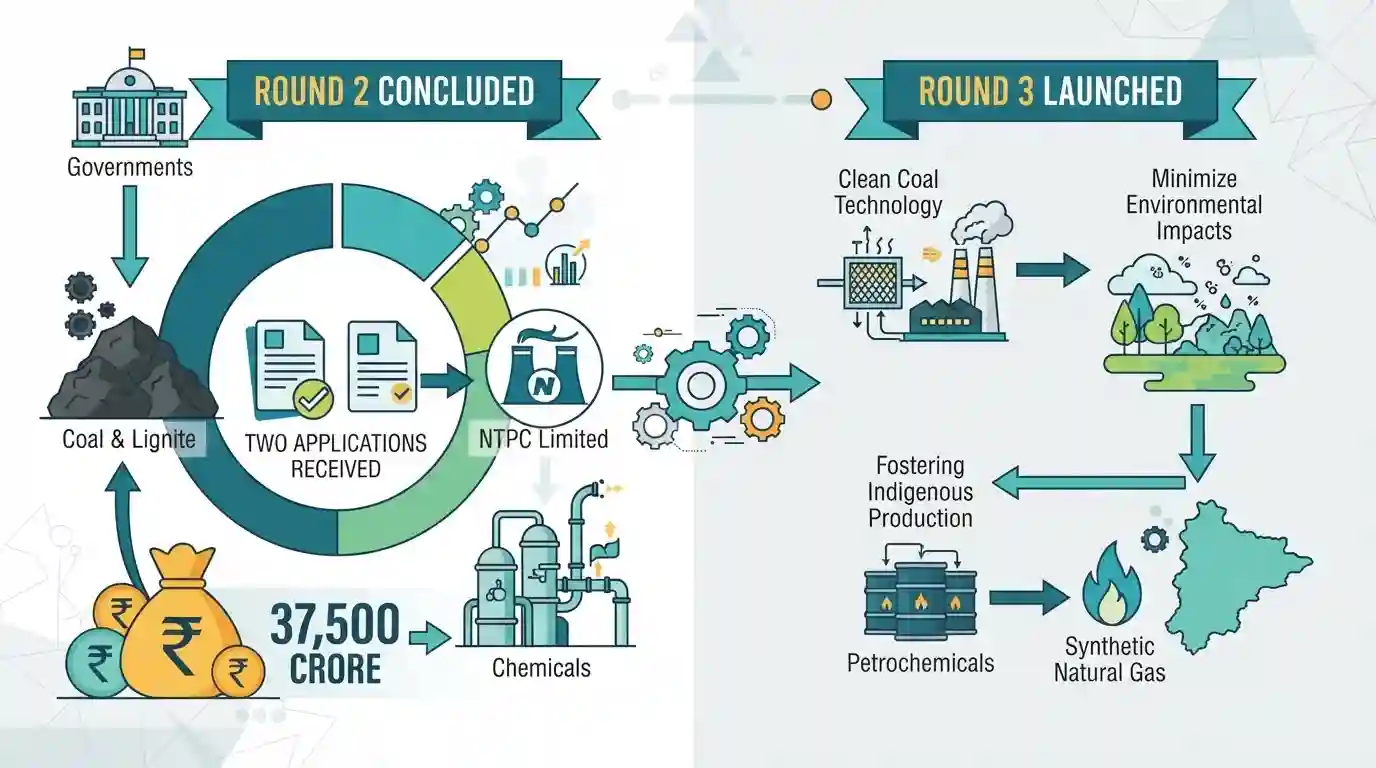
The Ministry of Coal concluded Round 2 of its ₹37,500 crore incentive scheme for coal and lignite gasification projects, receiving two applications from NTPC Limited. Concurrently, Round 3 of the scheme has been launched to boost clean coal technology, minimize environmental impacts of coal usage, and foster indigenous production of essential petrochemicals and synthetic natural gas.
Key Points
- Round 2 of the ₹37,500 crore financial incentive scheme for coal/lignite gasification projects concluded with two applications submitted by NTPC Limited.
- The scheme aims to promote coal gasification to transition towards cleaner energy options and reduce import dependence for critical chemicals like methanol, ammonia, and synthetic natural gas.
- Round 3 of the scheme has been officially opened for further applications from public and private sector enterprises.
- Financial assistance is provided as capital grants to incentivize commercial-scale gasification plants.
Important Terms
Scheme for Promotion of Surface Coal/Lignite Gasification Projects

A financial incentive scheme by the Ministry of Coal with a ₹37,500 crore outlay to promote surface coal and lignite gasification, aiming to reduce chemical imports and achieve 100 million tonnes of coal gasification capacity by 2030.
UPSC context
Relevant for GS Paper III (Infrastructure, Energy, and Clean Technology), testing government initiatives for energy security and cleaner fossil fuel use.
NTPC Limited
India's largest state-owned power generation company under the Ministry of Power, which participated in the coal gasification incentive scheme by submitting proposals for urea, methanol, and DME production.
UPSC context
Relevant for GS Paper III (Energy and Public Sector Undertakings), testing the diversification of PSUs into green technologies and clean energy.
Ministry of Coal
The central government ministry responsible for the formulation of policy and legislation for the exploration, development, and commercial utilization of coal and lignite resources in India.
UPSC context
Relevant for GS Paper III (Economic Development and Infrastructure), testing institutional frameworks governing national mineral resources and energy policy.
Prelims Trap
incentive scheme for coal and lignite gasification projects restricted exclusively to private sector energy enterprises
Aspirants might assume the scheme is restricted exclusively to private sector entities or renewable energy firms, overlooking participation by central PSUs like NTPC.
Static Concepts Connected
What are the primary products and environmental advantages of underground and surface coal gasification?
- Syngas Conversion: Process converts coal into synthesis gas (syngas) comprising carbon monoxide, hydrogen, carbon dioxide, and methane.
- Chemical Derivatives: Produces cleaner derivatives like methanol, synthetic natural gas (SNG), and ammonia without direct coal combustion.
- Emission Reductions: Reduces sulfur dioxide and nitrogen oxide emissions significantly compared to conventional thermal power plants.
Cross-Topic Patterns
Coal Gasification and Chemical Import Substitution
Coal gasification directly connects domestic fossil fuel transition strategies with chemical import substitution (methanol, ammonia), linking energy security with industrial self-reliance.

Coal gasification incentive schemes and clean energy transition milestones frequently feature in multi-statement environment and economy MCQs.
Linked PYQs · 3
Linked PYQs · 3
- 2025MainsGS3
How can India achieve energy independence through clean technology by 2047? How can biotechnology can play a crucial role in this endeavour?
- 2022MainsGS3
Do you think India will meet 50 percent of its energy needs from renewable energy by 2030 ? Justify your answer. How will the shift of subsidies from fossil fuels to renewables help achieve the above objective ? Explain.
- 2014MainsGS3
Environmental Impact Assessment studies are increasingly undertaken before a project is cleared by the Government. Discuss the environmental impacts of coal-fired thermal plants located at coal pitheads.
