India Saudi Arabia Bilateral Relations and Haj Cooperation
Source:PIB ↗
Why It Matters
The visit highlights the robust diplomatic, cultural, and strategic engagement between India and West Asian nations, particularly concerning diaspora welfare and religious pilgrimage management.
Summary
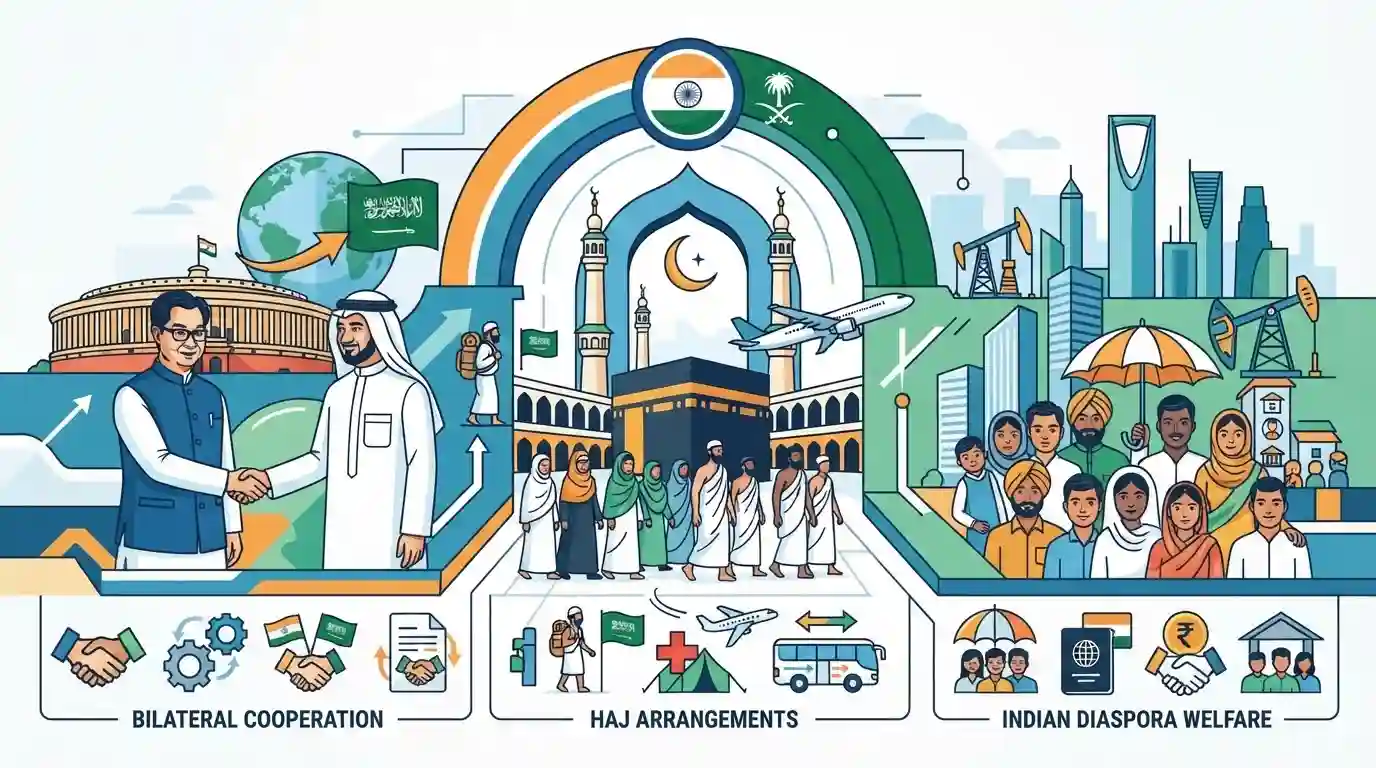
Union Minister of Minority Affairs and Parliamentary Affairs Shri Kiren Rijiju visited the Kingdom of Saudi Arabia to review bilateral cooperation, discuss arrangements for the Haj pilgrimage, and enhance administrative collaboration for the welfare of Indian citizens and pilgrims.
Key Points
- Union Minister of Minority Affairs and Parliamentary Affairs Shri Kiren Rijiju undertook an official visit to the Kingdom of Saudi Arabia.
- The visit focused on strengthening bilateral cooperation, reviewing preparations for the Haj pilgrimage, and ensuring the welfare of Indian pilgrims and the diaspora.
- Discussions emphasized deepening the strategic partnership between India and Saudi Arabia, particularly in administrative arrangements for religious travel and people-to-people ties.
Important Terms
Haj Pilgrimage Agreement

An annual bilateral pact between India and Saudi Arabia determining quotas, logistical arrangements, and health guidelines for Indian citizens undertaking the Islamic pilgrimage to Mecca.
UPSC context
Important for GS Paper II (International Relations - Bilateral Agreements) and welfare of the Indian diaspora.
Ministry of Minority Affairs
The nodal central ministry in India responsible for formulating policies, planning, and coordinating programs for the socio-economic and educational development of notified minority communities, including Haj management.
UPSC context
Important for GS Paper II (Governance - Ministries, Departments, and Welfare Schemes for Vulnerable Sections).
Kingdom of Saudi Arabia
A strategic West Asian nation holding significant economic and geopolitical importance for India, particularly regarding energy security, diaspora welfare, and annual Haj coordination.
UPSC context
Crucial for GS Paper II (International Relations - India and West Asia) and energy security.
Prelims Trap
The Haj pilgrimage arrangements and quota allocations with Saudi Arabia are exclusively managed by the Ministry of External Affairs.
Aspirants often assume the Ministry of External Affairs is the sole executing body for the Haj pilgrimage, overlooking the direct administrative role played by the Ministry of Minority Affairs.
Static Concepts Connected
What is the institutional architecture of the India-Saudi Arabia Strategic Partnership Council?
- Founding Year: Establishment: Formed in 2019 during Prime Minister Narendra Modi's visit, making Saudi Arabia the fourth country with which India has such a mechanism.
- Core Pillars: Pillars: Operates through two main pillars: Political, Security, Culture & Society; and Economy & Investments.
- Apex Leadership: Leadership: Headed by the Prime Minister of India and the Crown Prince of Saudi Arabia at the apex level.
Cross-Topic Patterns
Energy Security & IMEC Connectivity
India-Saudi energy partnership intersects with maritime security cooperation in the Western Indian Ocean and the proposed India-Middle East-Europe Economic Corridor (IMEC).
Diaspora Diplomacy & Bilateral Governance
Management of the Haj quota via bilateral agreements highlights India's institutionalized diaspora engagement mechanisms across West Asia.

Expect match-the-following or statement-based questions on the Strategic Partnership Council (SPC) members and energy dependencies.
Linked PYQs · 2
Linked PYQs · 2
- 2023MainsGS2
Indian diaspora has scaled new heights in the West. Describe its economic and political benefits for India.
- 2026PrelimsGS1
Consider the following statements about platforms for multilateral co-operation : 1. The 'Colombo Process' is a regional consultative process in which member states take binding decisions by consensus. 2. The 'Abu Dhabi Dialogue' is a voluntary non-binding consultative process among Asian countries of labour origin and destination to facilitate regional cooperation on contractual labour mobility. 3. The 'Global Forum for Migration and Development', created upon the proposal of a former UN Secretary General, is a voluntary forum whose decisions are non-binding in nature. Which of the statements given above is/are correct ?
