TRAI Interconnection Port Charges Amendment Regulations
Source:PIB ↗
Why It Matters
Important for understanding the role of statutory regulators like TRAI in shaping infrastructure pricing, competition, and ease of doing business in India's telecom sector.
Summary
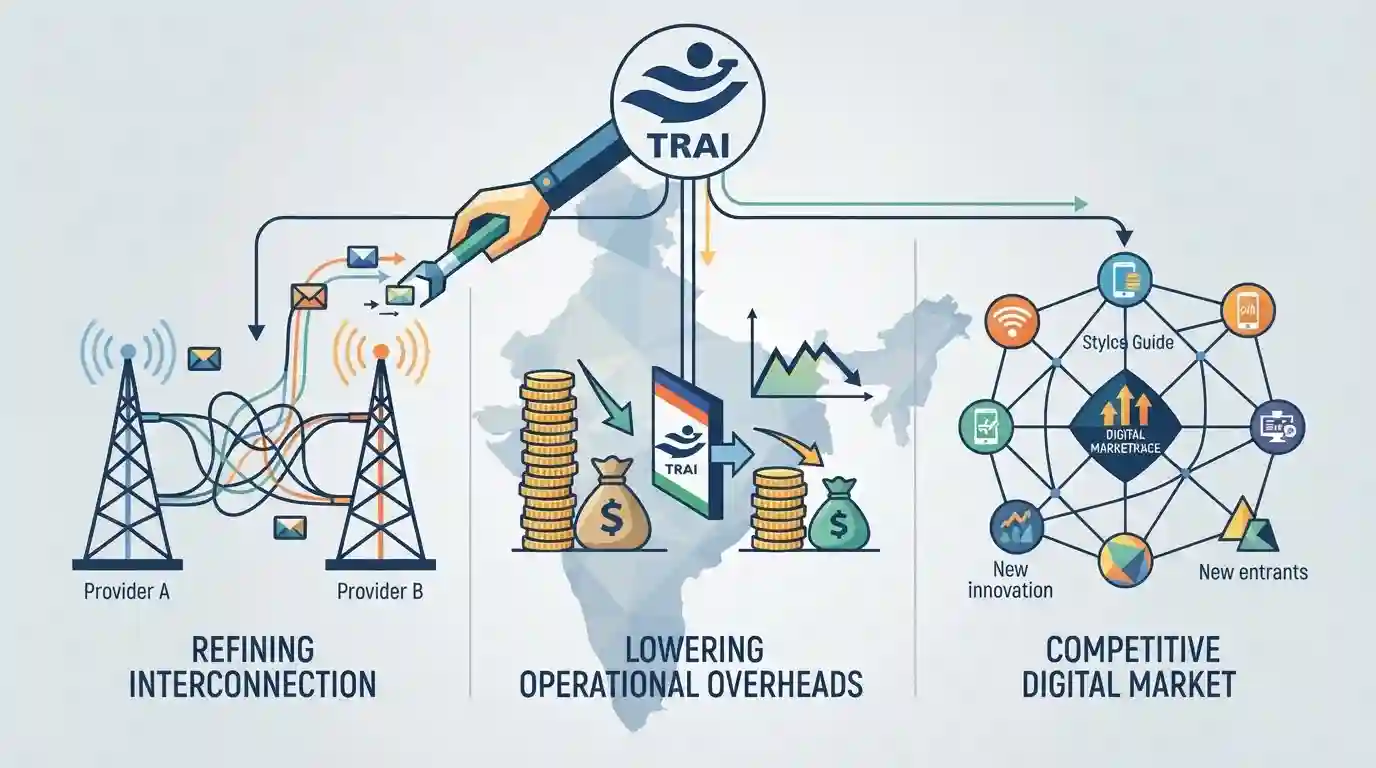
The Telecom Regulatory Authority of India (TRAI) has issued the Telecommunication Interconnection (Port Charges) (Third Amendment) Regulations, 2026. This regulatory update seeks to refine the interconnection and port charge framework between telecommunication service providers, promoting enhanced network interoperability, lowering operational overheads, and fostering a competitive digital infrastructure market in India.
Key Points
- TRAI has released the Telecommunication Interconnection (Port Charges) (Third Amendment) Regulations, 2026.
- Focuses on rationalizing port charges and interconnection frameworks to facilitate seamless communication and network connectivity between different service providers.
- Aims to reduce costs and ease business operations within the Indian telecommunications ecosystem.
Important Terms
Telecom Regulatory Authority of India (TRAI)

A statutory regulatory body established in 1997 under the TRAI Act to regulate telecom services, tariffs, quality of service, and interconnection frameworks across India's telecommunications and broadcasting sectors.
UPSC context
UPSC GS Paper III (Infrastructure: Telecom, Government Policies & Interventions). Tests knowledge of statutory regulatory bodies and telecom sector governance.
The Telecommunication Interconnection (Port Charges) (Third Amendment) Regulations, 2026
Regulatory amendments issued by TRAI that establish a modern ceiling-based port charge framework for Internet Protocol (IP)-based telecom network interconnections, taking effect in January 2027.
UPSC context
UPSC GS Paper III (Infrastructure & Regulatory Policies). Tests understanding of digital infrastructure reforms and regulatory updates in telecommunications.
Prelims Trap
TRAI recommendations are binding on the Central Government across all policy and licensing decisions.
Aspirants might assume TRAI recommendations are binding on the Central Government in all matters, whereas government has final licensing powers and can seek reconsideration.
Static Concepts Connected
What are the statutory powers and appeal mechanism under the TRAI Act, 1997?
- Statutory Origin: Established in 1997 to regulate telecom services, fix tariffs, and ensure fair competition among service providers.
- Appellate Mechanism: TRAI's orders and tariff/interconnection regulations can be challenged before the Telecom Disputes Settlement and Appellate Tribunal (TDSAT).
- Enforcement Scope: TRAI lacks direct judicial power to impose criminal penalties; it enforces rules via financial disincentives and directions under its statutory mandate.
Cross-Topic Patterns
Telecom Regulation + Statutory Penalty Enforcement
TRAI's statutory enforcement powers and graded financial disincentives parallel regulatory penalties found in competition law and consumer protection frameworks.
Digital Infrastructure Modernization + TRAI Mandates
The transition from legacy E1/TDM-based ports to IP-based port ceilings highlights India's digital infrastructure modernization under the broader Digital India initiative.

TRAI statutory powers under the TRAI Act 1997, including enforcement penalties and port charge ceilings, suit a multi-statement prelims question.
Linked PYQs · 2
Linked PYQs · 2
- 2019PrelimsGS1
In India, which of the following review the independent regulators in sectors like telecommunications, insurance, electricity, etc.? 1. Ad Hoc Committees set up by the Parliament 2. Parliamentary Department Related Standing Committees 3. Finance Commission 4. Financial Sector Legislative Reforms Commission 5. NITI Aayog Select the correct answer using the code given below.
- 2026PrelimsGS1
Which one of the following best describes the key objective of India's 'Open Network for Digital Commerce' (ONDC) initiative ?
