Swachh Survekshan Awards and Urban Sanitation Governance
Source:PIB ↗
Why It Matters
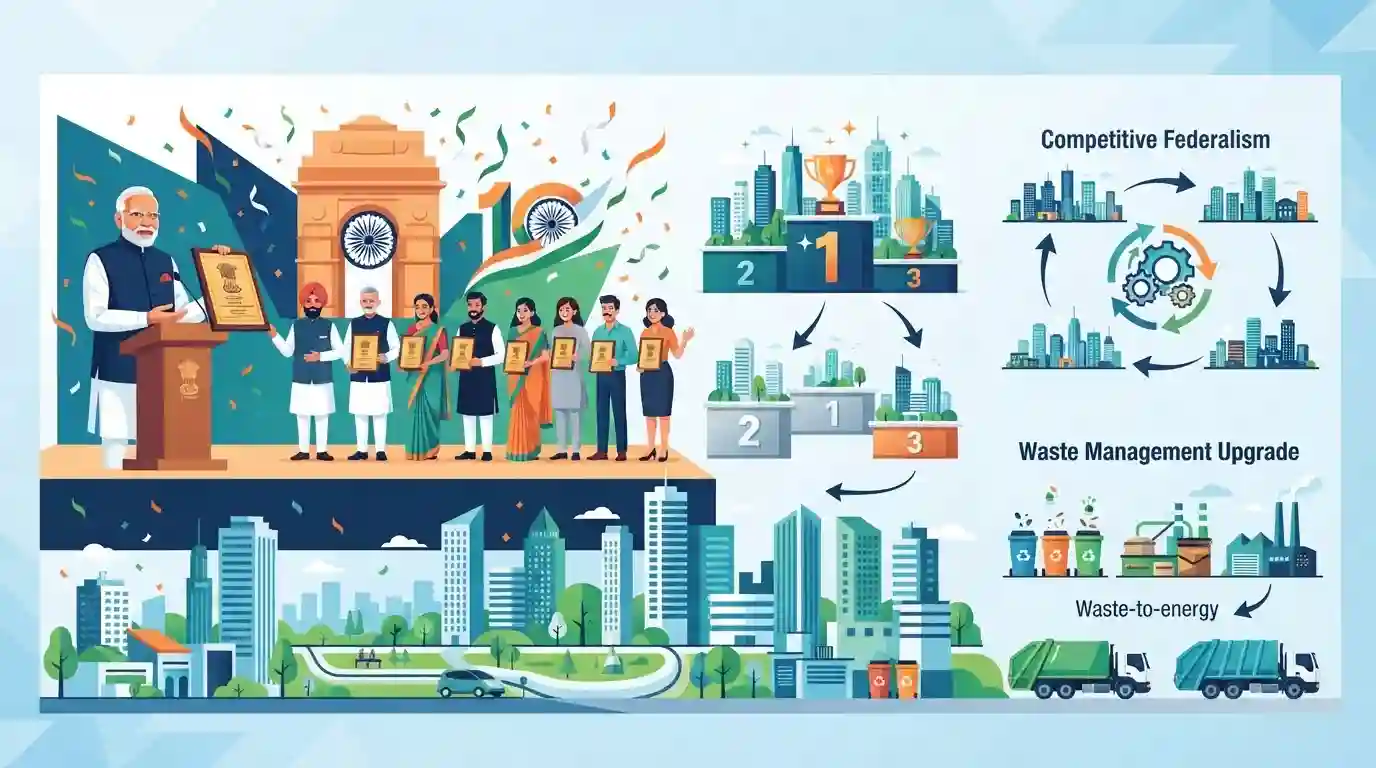
It highlights the role of competitive federalism and performance-based ranking systems in driving governance outcomes in urban sanitation and local bodies.
Summary
The President of India conferred the 10th edition of Swachh Survekshan awards, celebrating cities and states for urban cleanliness and sanitation under the Swachh Bharat Mission Urban. The survey acts as a crucial tool for competitive federalism, encouraging urban local bodies to upgrade waste management infrastructure and governance.
Key Points
- The President of India conferred the 10th edition of Swachh Survekshan 2025-26 awards to recognize cities and states excelling in urban sanitation and cleanliness.
- Swachh Survekshan is the world's largest urban sanitation and cleanliness survey conducted annually by the Ministry of Housing and Urban Affairs (MoHUA).
- The initiative fosters competitive federalism among urban local bodies (ULBs) to improve civic governance, waste management, and public health standards.
Important Terms
Swachh Survekshan

An annual urban cleanliness survey conducted by the Ministry of Housing and Urban Affairs to foster competitive federalism among Indian cities in waste management and sanitation.
UPSC context
Relevant for GS Paper II (Governance, Government Policies) and GS Paper III (Urbanization, Sanitation). Tests knowledge of urban local governance and performance metrics.
Swachh Bharat Mission Urban
A flagship national flagship initiative launched in 2014 to achieve universal sanitation coverage and efficient solid waste management in urban areas across India.
UPSC context
Crucial for GS Paper II and III under government interventions, public health, and sustainable urban development.
Ministry of Housing and Urban Affairs
The central nodal ministry responsible for formulating policies, coordinating programs, and overseeing urban development, housing, and sanitation initiatives like SBM-U in India.
UPSC context
Important for GS Paper II (Ministries, institutional framework, and governance structures implementing developmental schemes).
Prelims Trap
Swachh Survekshan is conducted annually by NITI Aayog under the Ministry of Environment, Forest and Climate Change.
Aspirants often assume Swachh Survekshan is conducted by an independent autonomous body or NITI Aayog, missing that it is anchored directly under MoHUA.
Static Concepts Connected
What are the core objectives and implementation framework of Swachh Bharat Mission (Urban) 2.0?
- Core Objective: Garbage Free Cities: Focuses on achieving garbage-free status for all cities through 100% source segregation and scientific processing.
- Legacy Remediation: Legacy Waste: Remediation of all legacy dumpsites and reclaiming land to transform them into green spaces.
- Wastewater Focus: Water Security: Focuses on grey and black water management, ensuring no untreated wastewater flows into water bodies.
Cross-Topic Patterns
Urban Governance & 74th Amendment Linkages
Swachh Survekshan scorecards directly interface with the 74th Constitutional Amendment by benchmarking ULB functional autonomy and fiscal decentralization in sanitation delivery.
Circular Economy & Methane Mitigation Goals
SBM-Urban waste processing targets directly intersect with India's Net-Zero commitments, methane emission reduction, and circular economy transition pathways.

Swachh Survekshan criteria changes + 74th Amendment fiscal devolution make a strong matching pair for Prelims/Mains.
Linked PYQs · 2
Linked PYQs · 2
- 2022PrelimsGS1
Consider the following statements : 1. The India Sanitation Coalition is a platform to promote sustainable sanitation and is funded by the Government of India and the World Health Organization. 2. The National Institute of Urban Affairs is an apex body of the Ministry of Housing and Urban Affairs in Government of India and provides innovative solutions to address the challenges of Urban India. Which of the statements given above is/are correct?
- 2023MainsGS2
“The states in India seem reluctant to empower urban local bodies both functionally as well as financially.” Comment.
