Green Diwali Campaign and Delhi NCR Air Pollution Mitigation
Source:PIB ↗
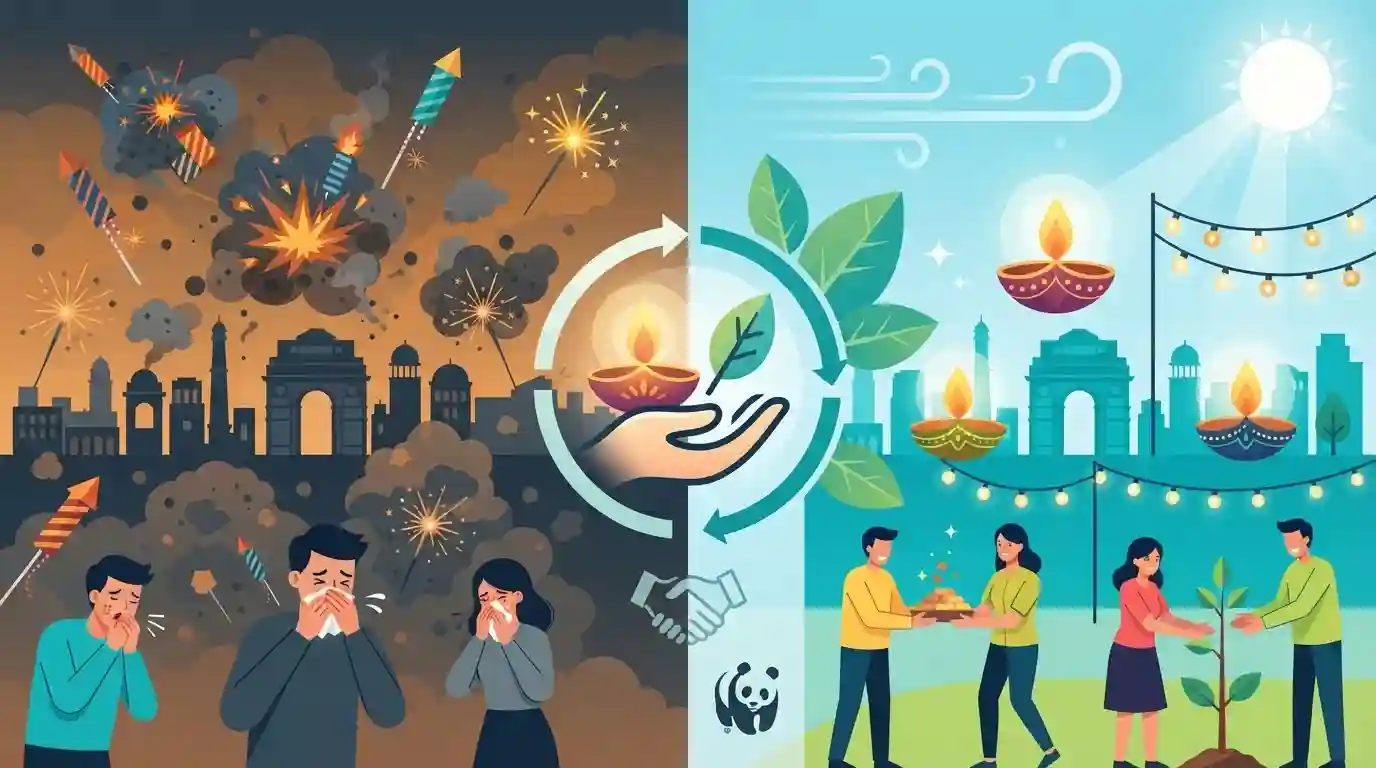
Why It Matters
Festive air pollution management and behavioral nudges are critical components of urban environmental governance and public health strategies in regions like Delhi-NCR, directly aligning with GS3 syllabus topics on environmental degradation and pollution control.
Summary
WWF-India's EIACP program appealed to citizens in the Delhi-NCR region to take the Green Diwali Pledge, promoting eco-friendly festive practices to tackle severe winter air pollution and curb toxic emissions from firecrackers.
Key Points
- WWF-India's EIACP launched a Green Diwali campaign urging Delhi-NCR residents to adopt eco-friendly festive practices.
- The initiative aims to curb severe air pollution spikes typically witnessed during the winter season and festival times in the capital region.
- It emphasizes behavioral changes, reducing cracker bursting, minimizing waste, and promoting sustainable celebrations.
Important Terms
EIACP

A program supported by the Ministry of Environment, Forest and Climate Change focused on environmental information, awareness, capacity building, and livelihood programs across India.
UPSC context
UPSC Prelims/Mains (Environment): Tests awareness of institutional mechanisms and schemes for environmental information dissemination and capacity building under MoEFCC.
Green Diwali Campaign
An awareness initiative encouraging citizens to celebrate festivals without bursting toxic firecrackers, aiming to mitigate severe seasonal air pollution spikes, particularly in regions like Delhi-NCR.
UPSC context
UPSC Prelims/Mains (Environment & Pollution): Tests knowledge of public participation campaigns addressing urban air pollution and seasonal smog.
WWF-India
A leading international conservation organization working in the fields of wilderness preservation and the reduction of human impact on the environment.
UPSC context
UPSC Prelims (Environment): Important for questions on international and national non-governmental organizations (NGOs) involved in biodiversity and conservation.
Ministry of Environment, Forest and Climate Change
The apex central government body in India responsible for formulating environmental and forestry policies, regulating pollution, and administering wildlife conservation laws.
UPSC context
UPSC Prelims/Mains (Governance/Environment): Tests understanding of key central ministries executing environmental laws, climate action, and pollution control frameworks.
Static Concepts Connected
What are the key institutional mechanisms and targets under India's National Clean Air Programme (NCAP)?
- Reduction Target: Targetting a 40% reduction in particulate matter (PM2.5 and PM10) concentrations by 2026 in 131 non-attainment cities.
- Nodal Ministry: Implemented by the Ministry of Environment, Forest and Climate Change (MoEF&CC) as a national-level strategy.
- Key Focus: Focuses on augmenting real-time ambient air quality monitoring networks and city-specific clean air action plans.
Cross-Topic Patterns
NCAP, Mission LiFE, and Urban Air Governance
The National Clean Air Programme (NCAP) and Mission LiFE link urban air pollution management directly with citizen-centric behavioral economics and statutory mandates.

Expect match-the-following questions linking pollution schemes (NCAP, GRAP, Mission LiFE) with their implementing bodies.
Linked PYQs · 3
Linked PYQs · 3
- 2019PrelimsGS1
Consider the following: 1. Carbon monoxide 2. Methane 3. Ozone 4. Sulphur dioxide Which of the above are released into atmosphere due to the burning of crop/biomass residue?
- 2022PrelimsGS1
In the context of WHO Air Quality Guidelines, consider the following statements: 1. The 24-hour mean of PM2.5 should not exceed 15 µg/m³ and annual mean of PM2.5 should not exceed 5 µg/m³. 2. In a year, the highest levels of ozone pollution occur during the periods of inclement weather. 3. PM10 can penetrate the lung barrier and enter the bloodstream. 4. Excessive ozone in the air can trigger asthma. Which of the statements given above are correct?
- 2020MainsGS3
What are the key features of the National Clean Air Programme (NCAP) initiated by the Government of India?
