Shram Samvad Programme and Implementation of New Labour Codes
Source:PIB ↗
Why It Matters
Understanding grassroots-level outreach and implementation challenges regarding the four Labour Codes is crucial for analyzing India's labor market reforms and social security expansion.
Summary
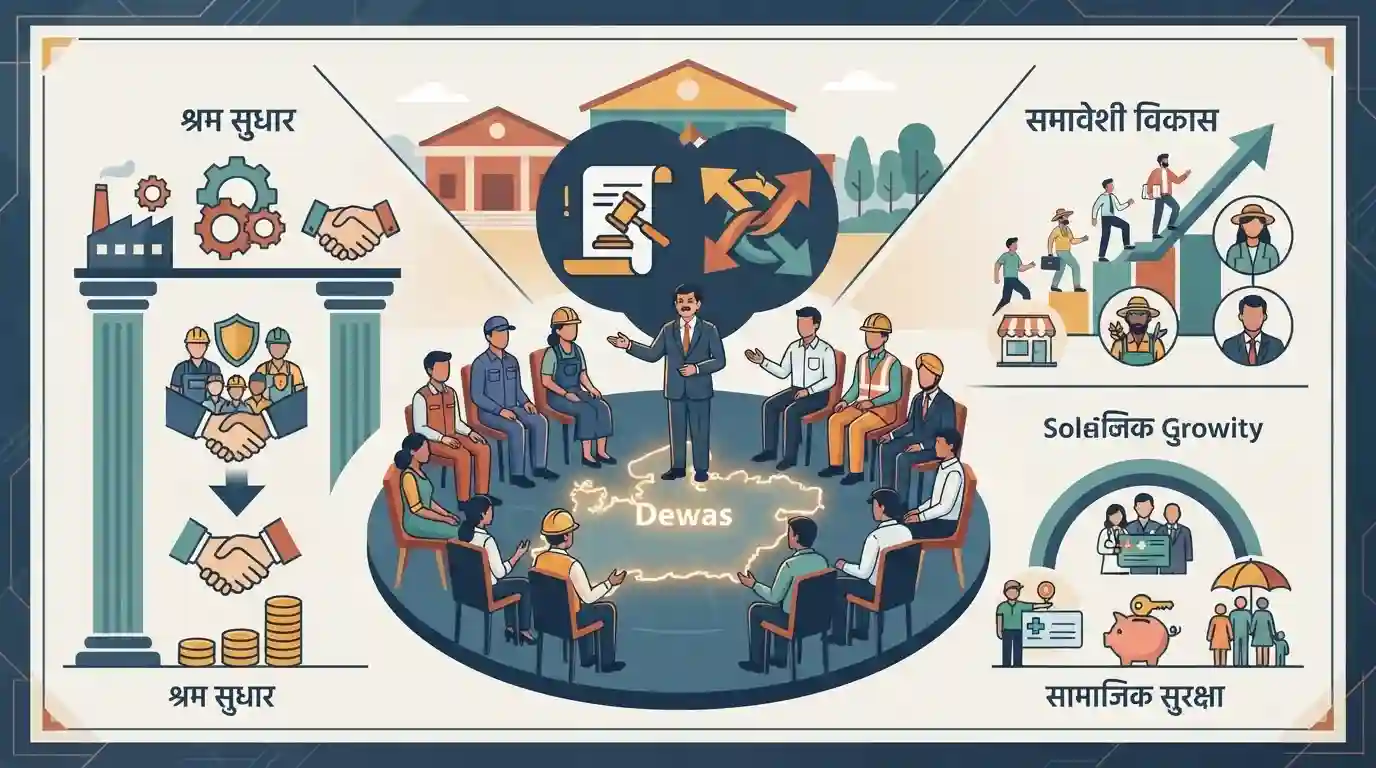
The Ministry of Labour and Employment organized a district-level capacity-building and awareness programme named 'Shram Samvad' in Dewas, Madhya Pradesh, to educate stakeholders about the new Labour Codes and their implications for workforce protection and ease of doing business.
Key Points
- Shram Samvad is a district-level capacity-building and awareness programme organized to create awareness about the new Labour Codes.
- The program in Dewas, Madhya Pradesh, focused on educating stakeholders, employers, workers, and administrative officials about labor reforms.
- The four Labour Codes aim to streamline 29 central labor laws, ensuring ease of compliance for businesses and enhanced social security for workers.
- Emphasizes cooperative federalism and grassroots-level stakeholder consultation for effective implementation of labor reforms.
Important Terms
Labour Codes

Four consolidated legislations enacted to streamline India's complex labor laws into four categories: Wages, Industrial Relations, Social Security, and Occupational Safety, Health and Working Conditions.
UPSC context
UPSC Mains Paper II/III: Essential for questions on labor reforms, ease of doing business, and worker welfare/social security.
Shram Samvad
A nationwide 90-day district-level capacity-building and awareness campaign launched across industrial clusters in India to educate stakeholders about new labor reforms and codes.
UPSC context
UPSC Prelims/Mains: Tests awareness of government outreach programs, center-state cooperation, and labor welfare implementation.
Ministry of Labour and Employment
The central government ministry responsible for formulating labor policies, ensuring worker safety, welfare, social security, and administering labor laws in India.
UPSC context
UPSC Prelims/Mains: Important for governance, institutional framework, and statutory bodies functioning under social sector policies.
Prelims Trap
The four Labour Codes have been uniformly operationalized across all states and Union Territories simultaneously without state-level rule notifications.
Aspirants often assume the four Labour Codes have been fully implemented nationwide, whereas rules are notified by both Centre and States under cooperative federalism.
Static Concepts Connected
What are the four pillars of India's consolidated Labour Codes and the key laws they subsume?
- Code on Wages: Code on Wages, 2019: Subsumes the Minimum Wages Act, Payment of Wages Act, Payment of Bonus Act, and Equal Remuneration Act.
- IR Code: Industrial Relations Code, 2020: Subsumes the Industrial Disputes Act, Trade Unions Act, and Industrial Employment (Standing Orders) Act.
- Social Security Code: Code on Social Security, 2020: Subsumes 9 laws including EPF Act, ESI Act, Maternity Benefit Act, and Unorganised Workers' Social Security Act.
- OSH Code: Occupational Safety, Health and Working Conditions Code, 2020: Subsumes 13 acts including Factories Act, Mines Act, and Contract Labour Act.
Cross-Topic Patterns
Labour Reforms vs. Cooperative Federalism
Labour Code consolidation from 29 acts impacts compliance burdens for MSMEs, intersecting directly with the Ease of Doing Business rankings and cooperative federalism debates.
Gig Economy & Social Security Code
The inclusion of gig and platform workers in social security codes links labour economics with digital economy regulatory challenges.

Expect a statement-based Prelims question on the specific changes introduced by the four Labour Codes (e.g. threshold limits, floor wages).
Linked PYQs · 1
Linked PYQs · 1
- 2024MainsGS3
Discuss the merits and demerits of the four 'Labour Codes' in the context of labour market reforms in India. What has been the progress so far in this regard?
