EPFO concludes Special Campaign 6 for grievance redressal
Source:PIB ↗
Why It Matters
This initiative highlights institutional efforts toward administrative reforms, prompt grievance redressal, and e-governance optimization within statutory social security bodies like EPFO, directly connecting to mains themes of transparency, accountability, and citizen-centric service delivery.
Summary
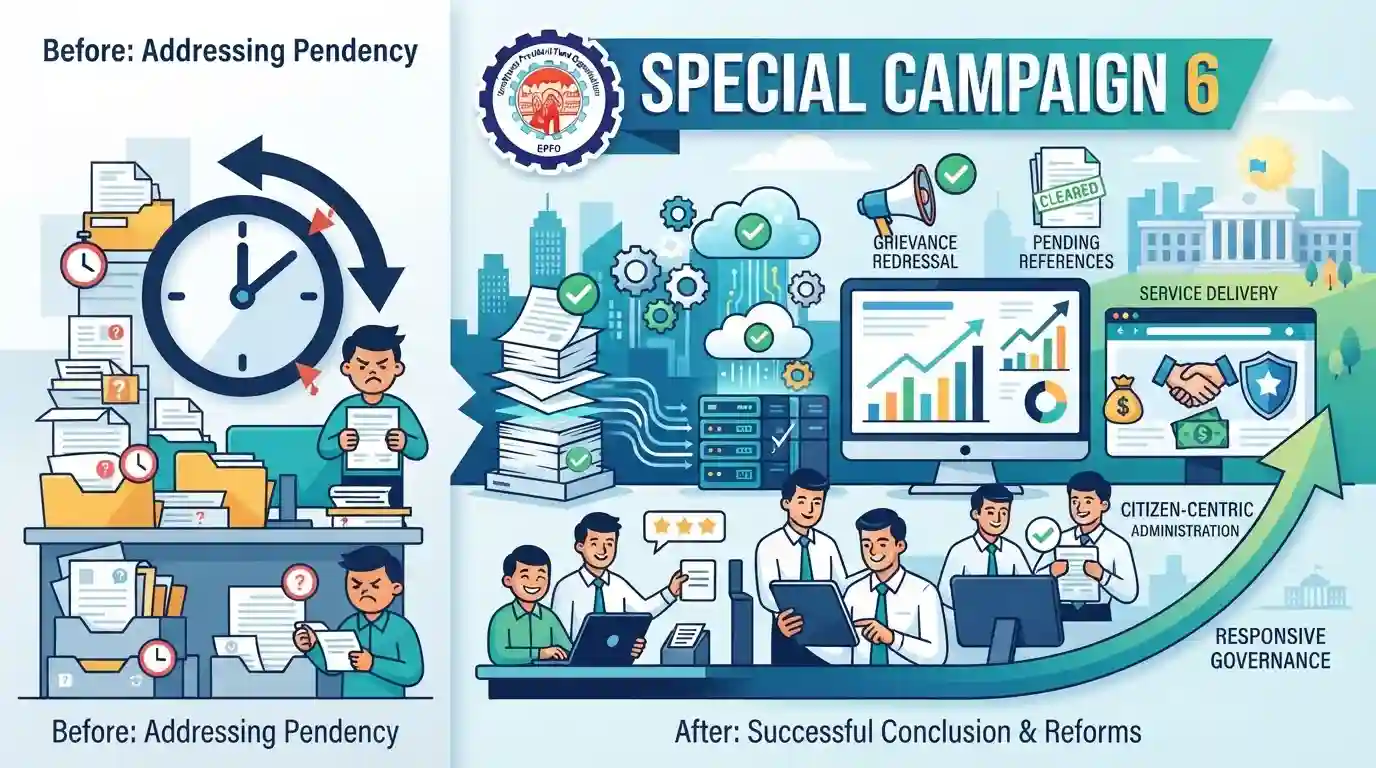
The Employees Provident Fund Organisation (EPFO) has successfully concluded Special Campaign 6, aimed at improving public grievance redressal, clearing pending references, and enhancing administrative efficiency in social security service delivery. The initiative reflects ongoing governance reforms focused on reducing bureaucratic pendency and ensuring responsive citizen-centric administration.
Key Points
- The Employees Provident Fund Organisation (EPFO) successfully concluded Special Campaign 6, focusing on targeted administrative reforms, public grievance redressal, and disposal of pending references.
- The campaign emphasized improving citizen-centric service delivery, reducing pendency of grievances, and enhancing transparency and accountability in statutory social security administration.
- Special drives like Special Campaign 6 serve as institutional mechanisms to streamline internal processes, promote digital governance, and reduce operational bottlenecks within public sector bodies.
Important Terms
Employees Provident Fund Organisation

A statutory body under the Ministry of Labour and Employment, Government of India, responsible for regulating and managing provident fund, pension, and insurance schemes for the country's workforce.
UPSC context
GS Paper II (Governance, Social Security, Statutory Bodies); tests knowledge of institutional frameworks for worker welfare and social security delivery.
Employees Provident Funds and Miscellaneous Provisions Act 1952
The core legislation enacted in 1952 that provides for the institution of compulsory provident funds, pension funds, and deposit-linked insurance funds for factory and other establishment employees.
UPSC context
GS Paper II/III (Labour Laws, Social Security Schemes); tests understanding of statutory backing for organized-sector worker benefits in India.
Ministry of Labour and Employment
The central government ministry responsible for protecting and safeguarding the interests of workers, promoting welfare measures, and regulating labour standards and social security institutions in India.
UPSC context
GS Paper II (Government Ministries and Policies); tests familiarity with nodal administrative structures handling employment and labour welfare.
Prelims Trap
EPFO is a department under the Ministry of Finance functioning as a commercial banking institution.
Aspirants often assume EPFO is a commercial banking institution or a purely central government department, overlooking its statusas a statutory body under the Ministry of Labour and Employment administering a quasi-judicial social security scheme.
Static Concepts Connected
What is the statutory basis and organizational structure of the Employees' Provident Fund Organisation (EPFO)?
- Enacting Statute: Statutory body established under the Employees' Provident Funds and Miscellaneous Provisions Act, 1952.
- Tripartite Body: Administered by the Central Board of Trustees (CBT), consisting of representatives from central government, state governments, employers, and employees.
- Parent Ministry: Functions under the administrative control of the Ministry of Labour and Employment, Government of India.
Cross-Topic Patterns
EPFO Redressal + Digital Governance Frameworks
EPFO's digital grievance integration mirrors governance reforms across ministries, linking citizen feedback loops with Right to Information transparency standards and digital public infrastructure.

EPFO administrative reforms + CPGRAMS grievance disposal metrics frequently appear in matching or multi-statement governance questions.
Linked PYQs · 3
Linked PYQs · 3
- 2025MainsGS2
e-governance projects have a built-in bias towards technology and back-end integration than user-centric designs. Examine.
- 2024MainsGS2
e-governance is not just about the routine application of digital technology in service delivery process. It is as much about multifarious interactions for ensuring transparency and accountability. In this context evaluate the role of the 'Interactive Service Model' of e-governance.
- 2023MainsGS2
e-governance, as a critical tool of governance, has ushered in effectiveness, transparency and accountability in governments. What inadequacies hamper the enhancement of these features ?
