E20 Petrol Quality Compliance and Energy Security Progress
Source:PIB ↗
Why It Matters
The expansion and quality compliance of E20 petrol under India's Ethanol Blended Petrol Programme is central to the country's targets for cutting crude oil imports, meeting net-zero goals, and promoting sustainable biofuels.
Summary
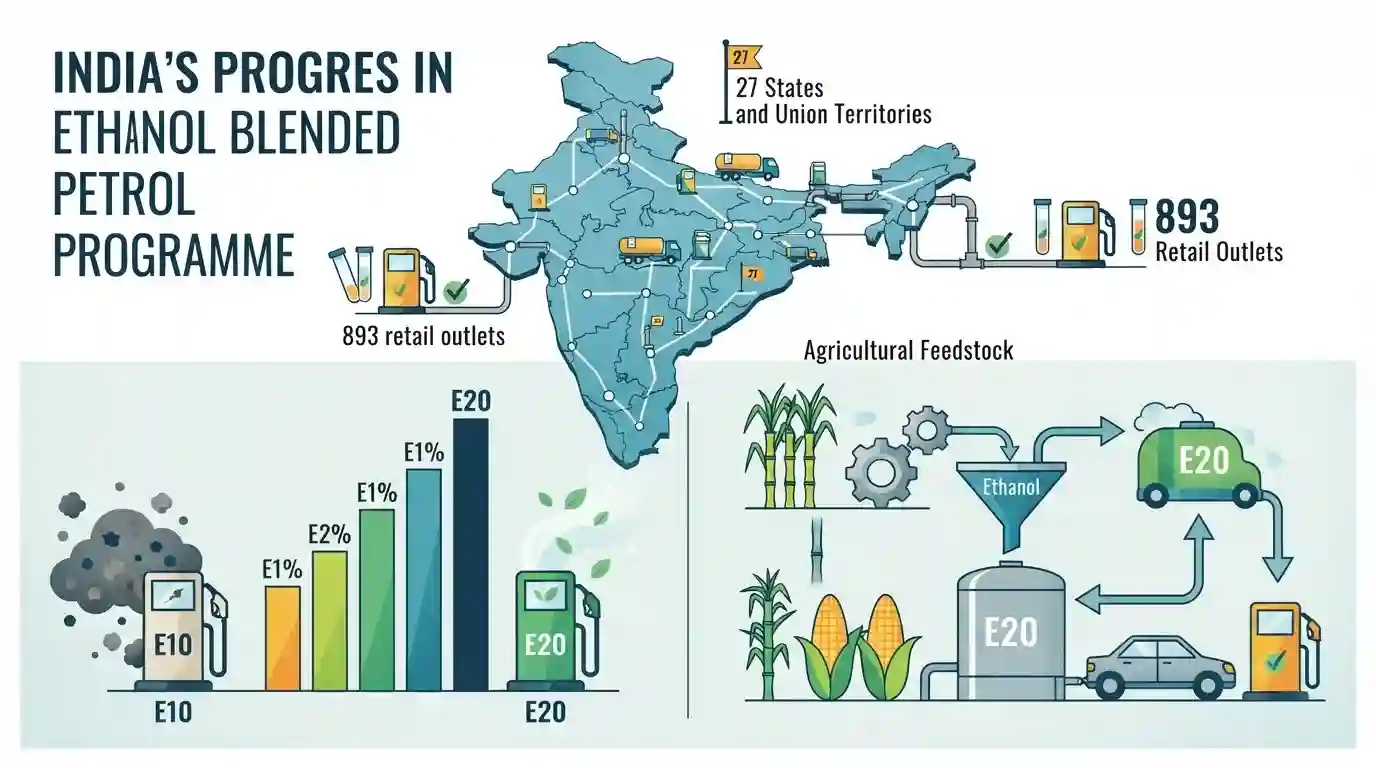
Public Sector Undertaking (PSU) Oil Marketing Companies across India successfully supplied E20 petrol (petrol blended with 20% ethanol) that fully complies with prescribed Bureau of Indian Standards (BIS) quality standards. A widespread sampling drive covering 893 retail outlets across 27 States and Union Territories confirmed that all tested samples met rigorous quality parameters. This milestone highlights the robust progress of India's Ethanol Blended Petrol Programme, which aims to enhance energy security, reduce fossil fuel dependency, lower carbon emissions, and support agricultural livelihoods through cleaner energy adoption.
Key Points
- PSU oil marketing companies successfully supply E20 petrol meeting prescribed Bureau of Indian Standards (BIS) quality standards across India.
- Extensive nationwide quality monitoring across 27 States and Union Territories showed 100% compliance among 893 tested samples.
- The E20 fuel initiative advances India's energy security, cuts crude oil import dependence, and lowers greenhouse gas emissions.
- Automotive compatibility and consumer confidence are bolstered through rigorous fuel testing and quality assurance protocols.
Important Terms
Ethanol Blended Petrol Programme

An initiative by the Government of India aiming to blend domestically produced ethanol with petrol to reduce fossil fuel dependence, enhance energy security, lower carbon emissions, and support agricultural incomes.
UPSC context
UPSC Mains GS Paper III (Environment & Economy): Tests knowledge of clean energy transitions, biofuel policies, and sustainable development goals.
E20 Petrol Initiative
A major milestone under India's biofuel roadmap involving the retail distribution of petrol blended with 20% anhydrous ethanol, designed to reduce crude oil imports and vehicular pollution.
UPSC context
UPSC Prelims & Mains: Important for questions on India's net-zero targets, renewable energy adoption, and fuel standards.
Public Sector Undertaking Oil Marketing Companies
State-owned enterprises like IOCL, BPCL, and HPCL responsible for the commercial refining, distribution, and retail supply of petroleum products across India, ensuring adherence to BIS quality benchmarks.
UPSC context
UPSC Mains GS Paper III (Infrastructure & Economy): Tests the role of PSUs in energy security and policy implementation.
Prelims Trap
All legacy vehicles on Indian roads are completely incompatible with E20 petrol without retrofitting.
Aspirants often assume blending 20% ethanol requires complete redesign of all legacy internal combustion engines, whereas modern vehicles manufactured post-2023 are E20 compliant by design.
Static Concepts Connected
What are the key milestones and objectives of India's Ethanol Blended Petrol (EBP) Programme?
- Target Timeline: Target timeline: India advanced its target of achieving 20% ethanol blending in petrol (E20) from 2030 to Ethanol Supply Year 2025-26.
- Feedstock Base: Feedstock diversity: Ethanol is procured from sugarcane molasses as well as surplus food grains like broken rice and maize through FCI.
- Core Objectives: Strategic benefits: Aims to reduce crude import dependency, save foreign exchange, cut greenhouse gas emissions, and provide remunerative income to farmers.
Cross-Topic Patterns
Biofuels vs. Food Security & Agricultural Pricing
Ethanol blending diverts sugarcane and grains, creating a critical intersection between agricultural MSP policies, surplus grain management by FCI, and national carbon emission targets.
Energy Transition & Macroeconomic Vulnerability
Lowering crude oil import bills through domestic ethanol production directly strengthens India's current account balance and macroeconomic stability.

EBP roadmap targets and BIS standard compliance are frequently tested in match-the-following or multi-statement prelims questions.
Linked PYQs · 3
Linked PYQs · 3
- 2025MainsGS3
How can India achieve energy independence through clean technology by 2047? How can biotechnology can play a crucial role in this endeavour?
- 2025PrelimsGS1
Consider the following statements : Statement I: Of the two major ethanol producers in the world, i.e., Brazil and the United States of America, the former produces more ethanol than the latter. Statement II: Unlike in the United States of America where corn is the principal feedstock for ethanol production, sugarcane is the principal feedstock for ethanol production in Brazil. Which one of the following is correct in respect of the above statements?
- 2025PrelimsGS1
Consider the following substances: I. Ethanol II. Nitroglycerine III. Urea Coal gasification technology can be used in the production of how many of them?
