GRAP Stage-III Invocation and Air Quality Management in Delhi-NCR
Source:PIB ↗
Why It Matters
Understanding emergency pollution control mechanisms like GRAP and the institutional role of CAQM is crucial for GS3 Environment and Disaster Management questions addressing urban air pollution, institutional mandates, and policy responses.
Summary
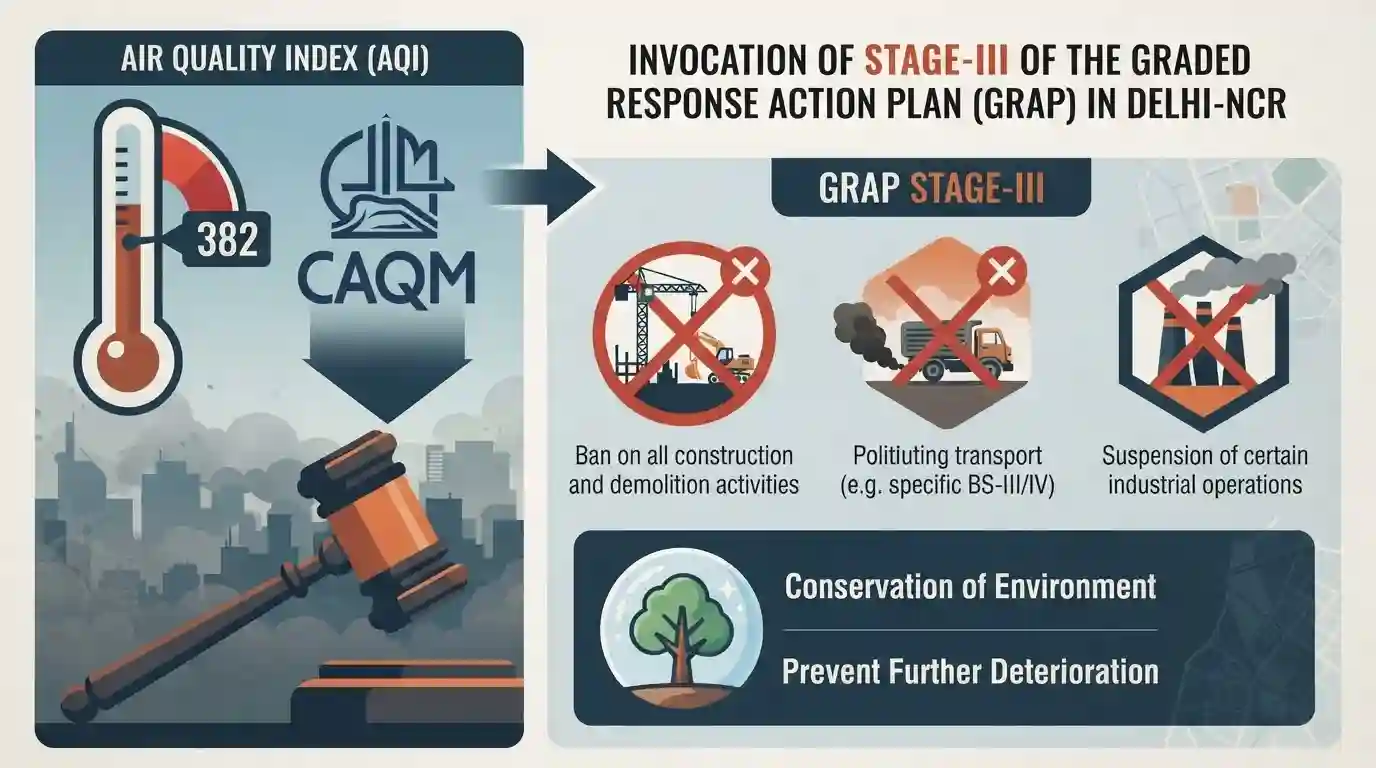
The Commission for Air Quality Management (CAQM) invoked Stage-III of the Graded Response Action Plan (GRAP) across the Delhi-NCR region following a spike in the Air Quality Index (AQI) to 382. This emergency response framework entails severe restrictions on construction, demolition, and polluting transport activities to prevent further deterioration of air quality.
Key Points
- CAQM invoked Stage-III of the Graded Response Action Plan (GRAP) in Delhi-NCR after the air quality index (AQI) touched 382 ('Very Poor' to 'Severe' category).
- Stage-III restrictions include a strict ban on non-essential construction and demolition activities, specific curbs on commercial four-wheelers, and intensified dust mitigation measures.
- The Commission for Air Quality Management (CAQM) serves as the statutory overarching body responsible for planning, coordinating, and monitoring air quality management in the National Capital Region and adjoining areas.
Prelims Trap
Central Pollution Control Board (CPCB) is the statutory body that formulates and implements the Graded Response Action Plan (GRAP) for Delhi-NCR.
The CPCB does not formulate or implement GRAP anymore in Delhi-NCR; CAQM is the overarching statutory body whose directives supersede CPCB and State Boards.
Static Concepts Connected
What are the statutory powers, jurisdiction, and appellate mechanisms of the CAQM?
- Statutory Status: Statutory Creation Established under the Commission for Air Quality Management in National Capital Region and Adjoining Areas Act, 2021 as an overarching body.
- Geographic Reach: Jurisdiction Covers Delhi and adjoining areas in Haryana, Punjab, Rajasthan, and Uttar Pradesh where sources of pollution impact Delhi-NCR air quality.
- Legal Supremacy: Supremacy CAQM orders and directions override conflicting orders of the CPCB and individual State Pollution Control Boards of Delhi, Haryana, Punjab, Rajasthan, and UP.
- Appellate Forum: Appellate Body Appeals against any direction or order of the CAQM lie directly with the National Green Tribunal (NGT), not civil courts.
Cross-Topic Patterns
CAQM + Cooperative Federalism in Air Management
CAQM jurisdiction spans NCR and adjoining states, testing cooperative federalism where states like Punjab and Haryana implement stubble-burning and anti-pollution mandates under central statutory oversight.
Urban Planning + Emergency Air Quality Protocols
GRAP emergency protocols directly intersect with urban transport electrification and construction zoning laws, linking air quality governance with municipal urban planning policies.

CAQM statutory powers vs State Pollution Control Boards and NGT appeal mechanisms are high-yield static traps for Prelims.
Linked PYQs · 3
Linked PYQs · 3
- 2022PrelimsGS1
In the context of WHO Air Quality Guidelines, consider the following statements: 1. The 24-hour mean of PM2.5 should not exceed 15 µg/m³ and annual mean of PM2.5 should not exceed 5 µg/m³. 2. In a year, the highest levels of ozone pollution occur during the periods of inclement weather. 3. PM10 can penetrate the lung barrier and enter the bloodstream. 4. Excessive ozone in the air can trigger asthma. Which of the statements given above are correct?
- 2020MainsGS3
What are the key features of the National Clean Air Programme (NCAP) initiated by the Government of India?
- 2021MainsGS3
Describe the key points of the revised Global Air Quality Guidelines (AQGs) recently released by the World Health Organisation (WHO). How are these different from its last update in 2005? What changes in India's National Clean Air Programme are required to achieve these revised standards?
