Chemicals and Petrochemicals Sector Growth and Industrial Policy
Source:PIB ↗
Why It Matters
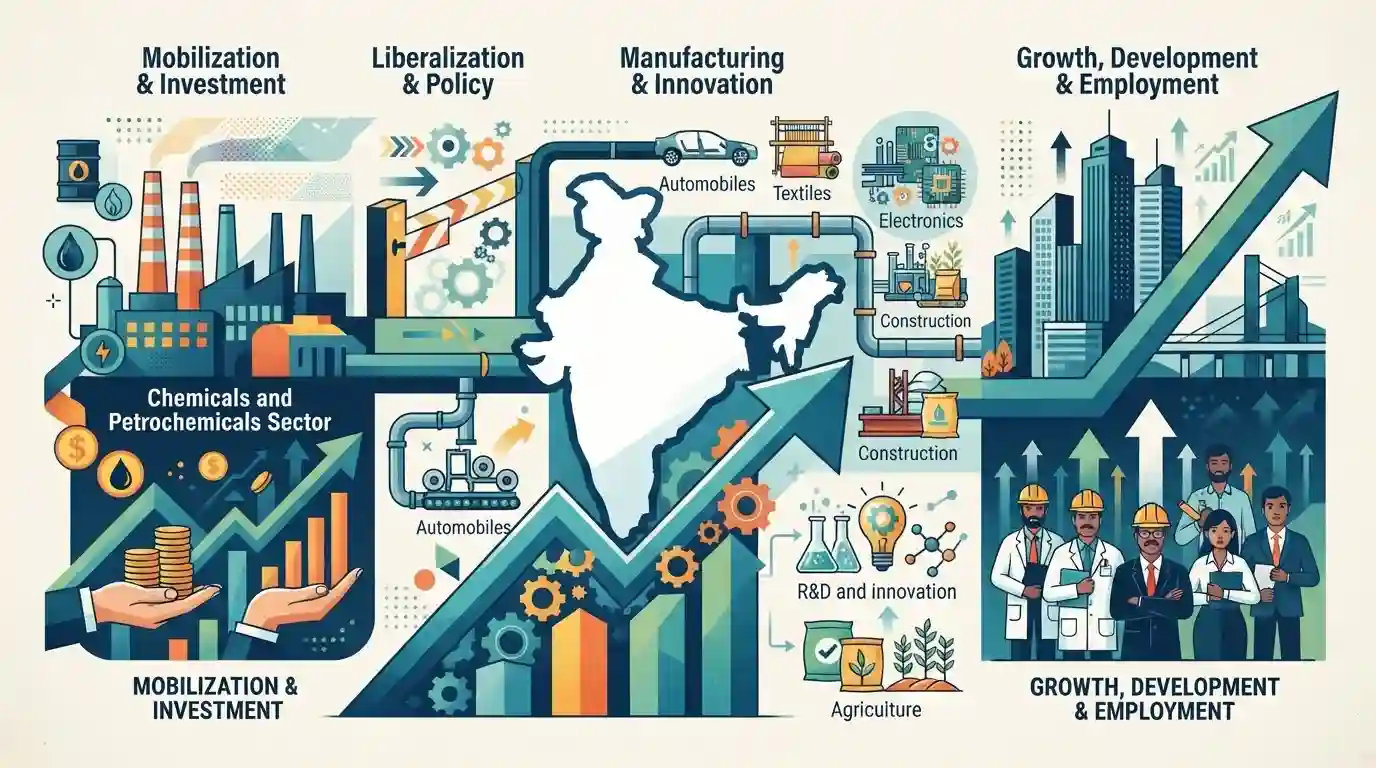
The chemicals and petrochemicals sector is a key pillar of India's manufacturing ecosystem, supporting downstream industries like agriculture, electronics, and infrastructure, making it crucial for UPSC GS3 preparation on industrial growth.
Summary
The article discusses the crucial role of India's chemicals and petrochemicals sector as a foundation for industrial growth, emphasizing its contributions to manufacturing, innovation, and economic development.
Key Points
- India's chemicals and petrochemicals sector plays a foundational role in driving industrial growth, manufacturing output, and exports.
- The sector contributes significantly to various sub-sectors including pharmaceuticals, agriculture, polymers, and specialty chemicals.
- Policy initiatives, investments, and petro-clusters are vital for boosting domestic production and reducing import dependence.
Important Terms
Ministry of Chemicals and Fertilizers

A central government body in India responsible for the policy formulation, planning, development, and regulation of the chemicals, petrochemicals, fertilizers, and pharmaceutical industries.
UPSC context
Important for GS Paper III (Indian Economy & Industrial Growth), testing governance and policy frameworks in core manufacturing sectors.
Static Concepts Connected
What are the key provisions and objectives of the PCPIR (Petroleum, Chemicals and Petrochemicals Investment Regions) policy in India?
- Objective: Designed to promote investment and integrated manufacturing in petroleum, chemicals, and petrochemicals on a mega scale.
- Scale: Each PCPIR requires a minimum area of about 250 sq km with state government backing and central infrastructure support.
- Infrastructure: Aims to reduce logistics costs through shared utilities, captive power, and common effluent treatment plants.
Cross-Topic Patterns
PCPIR Clusters and Industrial Policy Evolution
The PCPIR policy demonstrates how spatial economic planning and infrastructure integration are leveraged to build globally competitive manufacturing clusters, echoing themes in the National Manufacturing Policy.

Chemical sector's GDP contribution, PCPIR policy framework, and automatic route FDI rules are high-yield static-dynamic prelims targets.
Linked PYQs · 2
Linked PYQs · 2
- 2023MainsGS3
Faster economic growth requires increased share of the manufacturing sector in GDP, particularly of MSMEs. Comment on the present policies of the Government in this regard.
- 2025MainsGS3
Discuss the rationale of the Production Linked Incentive (PLI) scheme. What are its achievements? In what way can the functioning and outcomes of the scheme be improved?
