NAMASTE Scheme Impact on Sanitation Workers Occupational Safety
Source:PIB ↗
Why It Matters
This article highlights the ground-level impact of the NAMASTE Scheme, a major central initiative targeting vulnerable sanitation workers. It links social justice, occupational safety, and livelihood enhancement, which is directly relevant to GS Paper 2 questions on government welfare interventions for marginalized sections.
Summary
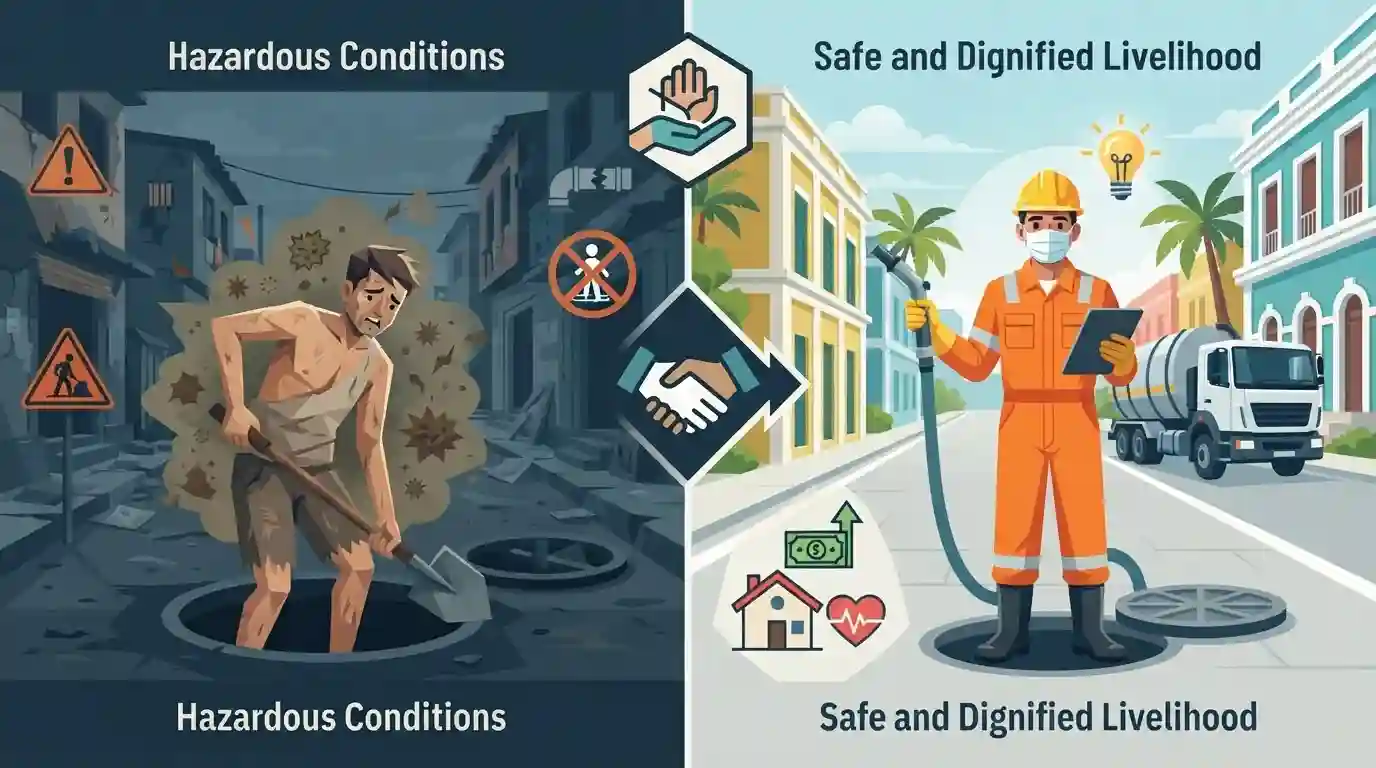
An account of how the NAMASTE scheme helped a sanitation worker in Pondicherry transition from hazardous working conditions to safer, more dignified livelihoods through PPE provision and safety awareness.
Key Points
- The NAMASTE Scheme of the Ministry of Social Justice and Empowerment provides vital support to sanitation workers through PPE kits and safety training.
- Ramesh Kumar, a 60-year-old sanitation worker in Pondicherry, benefited from safer working conditions, improved health, and reduced medical expenses under the scheme.
- The intervention helped improve work consistency and raised monthly earnings from ₹12,000 to ₹16,000–₹18,000, ensuring better livelihood security.
- The initiative underscores India's broader policy push towards mechanised sanitation and the elimination of hazardous manual scavenging and occupational health risks.
Important Terms
National Action for Mechanised Sanitation Ecosystem (NAMASTE) Scheme

A central sector scheme by the Ministry of Social Justice and Empowerment and MoHUA aimed at eliminating hazardous manual sewer and septic tank cleaning through mechanization, PPE provision, and alternative livelihood support for sanitation workers.
UPSC context
UPSC Prelims and Mains (GS Paper II - Social Justice / Welfare Schemes for Vulnerable Sections). Essential for questions on occupational safety and manual scavenging eradication.
Ministry of Social Justice and Empowerment
The nodal union ministry in India responsible for designing and implementing policies, legislation, and welfare programmes for the upliftment and social protection of marginalized sections, including Scheduled Castes, OBCs, PwDs, and sanitation workers.
UPSC context
UPSC Mains GS Paper II (Governance and Social Justice). Crucial for questions on institutional frameworks and ministries implementing welfare policies for vulnerable groups.
Prelims Trap
NAMASTE is a Central Sector Scheme exclusively implemented by the Ministry of Housing and Urban Affairs.
Aspirants often assume NAMASTE is implemented exclusively by the Ministry of Housing and Urban Affairs, whereas it is a joint initiative with the Ministry of Social Justice and Empowerment.
Static Concepts Connected
What are the key objectives and implementing structure of the NAMASTE Scheme?
- Dual Ministries: Joint Ministry execution by the Ministry of Social Justice and Empowerment and the Ministry of Housing and Urban Affairs.
- Zero Fatalities: Goal to eliminate hazardous manual scavenging and achieve zero fatalities in sanitation work through 100% mechanisation.
- Beneficiary Support: Provides capital subsidies, safety gear (PPE), occupational training, and health insurance via Ayushman Bharat-PMJAY.
- SRMS Subsumption: Subsumed the erstwhile Self Employment Scheme for Rehabilitation of Manual Scavengers (SRMS).
Cross-Topic Patterns
NAMASTE Scheme & Urban Governance Capacity
Mechanisation of sewer cleaning connects urban local body (ULB) capacity under the 74th Constitutional Amendment with Article 21 (Right to Life) jurisprudence.
Waste Pickers & Circular Economy Livelihoods
The inclusion of waste pickers links occupational welfare schemes with plastic waste management rules and circular economy livelihood transitions.

NAMASTE scheme objectives, joint ministries, and its expansion to cover waste pickers make it a prime target for a multi-statement prelims Q.
Linked PYQs · 3
Linked PYQs · 3
- 2017MainsGS2
To ensure effective implementation of policies addressing water, sanitation and hygiene needs the identification of the beneficiary segments is to be synchronized with the anticipated outcomes." Examine the statement in the context of the WASH scheme.
- 2023MainsGS2
“Development and welfare schemes for the vulnerable, by its nature, are discriminatory in approach.” Do you agree? Give reasons for your answer.
- 2022MainsGS2
Besides the welfare schemes, India needs deft management of inflation and unemployment to serve the poor and the underprivileged sections of the society. Discuss.
