Central Bureau of Narcotics and Anti-Drug Enforcement in India
Source:PIB ↗
Why It Matters
It provides vital updates on India's premier drug law enforcement agency, institutional measures under the NDPS Act, source-level crop eradication strategies, and youth-centric preventive frameworks crucial for internal security questions on narco-terrorism and drug trafficking.
Summary
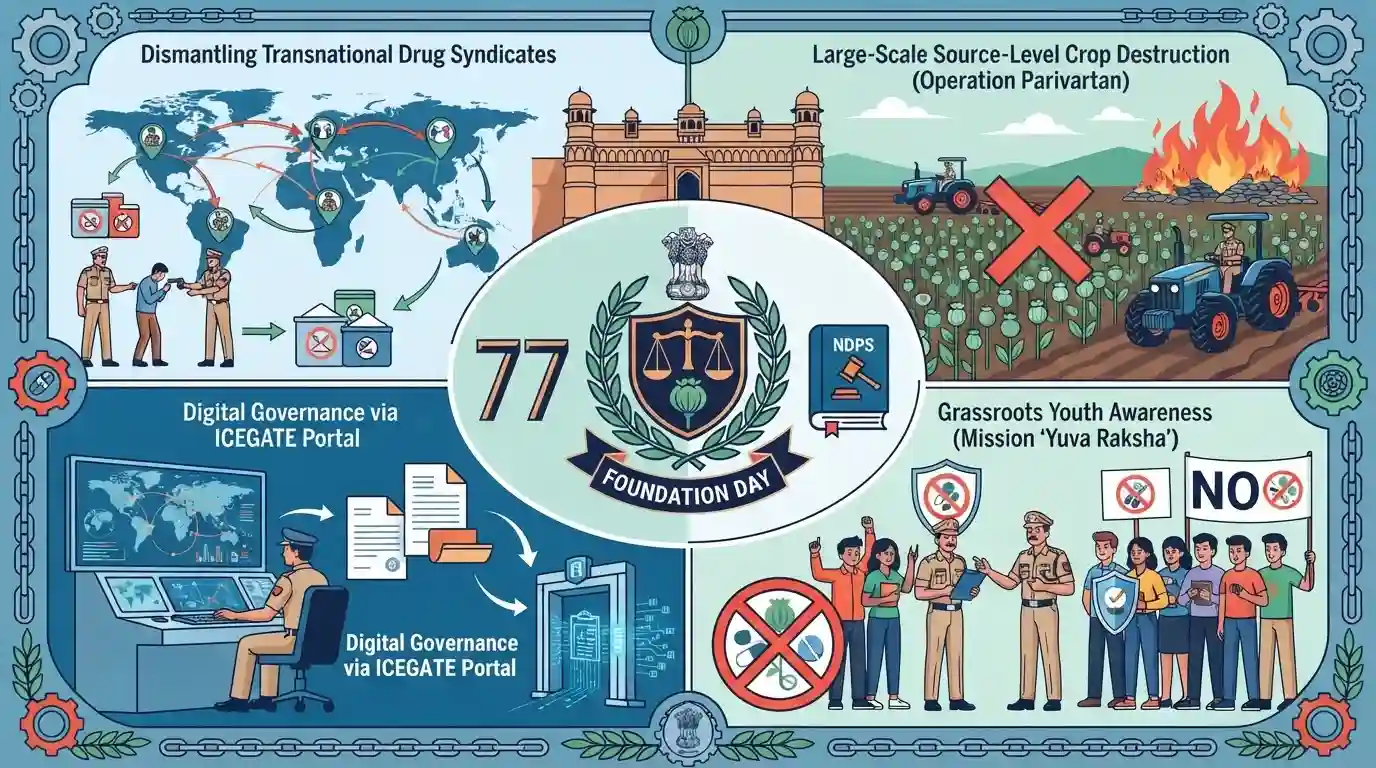
The Central Bureau of Narcotics (CBN) marked its 77th Foundation Day in Gwalior, highlighting its evolution into a premier drug law enforcement and regulatory agency under the Ministry of Finance. The agency detailed its achievements in dismantling transnational drug syndicates, executing large-scale source-level crop destruction (such as Operation Parivartan), driving digital governance via the ICEGATE portal, and running grassroots youth awareness initiatives like Mission 'Yuva Raksha' in alignment with the NDPS Act 1985.
Key Points
- The Central Bureau of Narcotics (CBN) celebrated its 77th Foundation Day on November 6, 2026, at its headquarters in Gwalior, Madhya Pradesh.
- CBN regulates licit opium cultivation, oversees import/export of narcotic drugs and precursor chemicals under the NDPS Act 1985, and acts as India's Competent National Authority under UN conventions.
- Between 2022 and October 2026, CBN eradicated over 1,11,300 acres of illicit opium and cannabis cultivation across high-risk states like Himachal Pradesh, Arunachal Pradesh, and Manipur.
- Launched Mission 'Yuva Raksha' and partnered with Brahma Kumaris to educate youth against drug abuse, supporting the vision of 'Nasha Mukt Yuva for Viksit Bharat'.
- Integrated workflows onto the ICEGATE SWIFT 2.0 portal for streamlined digital governance and Ease of Doing Business in chemical and pharmaceutical trade clearances.
Important Terms
Central Bureau of Narcotics (CBN)

The premier drug law enforcement and regulatory agency under the Department of Revenue, Ministry of Finance, responsible for regulating opium poppy cultivation and enforcing anti-narcotics laws.
UPSC context
UPSC Prelims/Mains (GS Paper III - Internal Security): Tests knowledge of statutory bodies, drug enforcement agencies, and narcotics control frameworks.
NDPS Act 1985
India's principal legislation enacted in 1985 to control and regulate operations relating to narcotic drugs and psychotropic substances, prescribing stringent penal provisions for drug trafficking.
UPSC context
UPSC GS Paper III (Internal Security): Essential for questions on legal frameworks countering drug trafficking, organized crime, and narco-terrorism.
Mission Yuva Raksha
A grassroots youth awareness and preventive outreach initiative led by the Central Bureau of Narcotics to educate youth, curb substance abuse, and foster a drug-free society.
UPSC context
UPSC GS Paper II/III (Governance/Internal Security): Relevant for social welfare initiatives, youth development, and preventive anti-drug strategies.
Operation Parivartan
A specialized anti-narcotics operation conducted by law enforcement agencies to map, target, and eradicate illicit cultivation of cannabis and opium crops at source.
UPSC context
UPSC GS Paper III (Internal Security): Tests awareness of targeted operations against drug syndicates and source-level crop destruction.
Prelims Trap
Central Bureau of Narcotics is the apex national law enforcement coordinator for drug offences in India.
Aspirants often confuse CBN with the Narcotics Control Bureau (NCB). CBN regulates licit opium cultivation and is under the Ministry of Finance, whereas NCB is the apex national coordinator for anti-drug law enforcement.
Static Concepts Connected
What are the core mandates and institutional differences between CBN and NCB under the NDPS Act 1985?
- Administrative Control: Ministry Control: CBN functions under the Department of Revenue, Ministry of Finance, while NCB functions under the Ministry of Home Affairs.
- Core Mandate: Licit Cultivation: CBN regulates and supervises the licit cultivation of opium poppy and export of narcotic drugs. NCB acts as the apex coordinating agency for enforcement.
- UN Conventions: International Obligations: CBN serves as India's Competent National Authority for implementing UN drug conventions regarding precursor chemicals and licit trade.
Cross-Topic Patterns
Narco-terrorism + Border Management + Financial Intelligence
India's border vulnerabilities along the Golden Triangle and Golden Crescent feed domestic narco-terrorism, linking financial regulation (CBN) directly with territorial integrity and border guarding forces (BSF/Assam Rifles).
Ease of Doing Business + Export Controls
Digitization of chemical trade via ICEGATE shows how trade facilitation must be balanced against stringent domestic security and compliance with international UN conventions.

Expect statement-based questions on the distinct statutory mandates of NCB vs CBN under the NDPS Act 1985.
Linked PYQs · 3
Linked PYQs · 3
- 2024MainsGS3
Explain how narco-terrorism has emerged as a serious threat across the country. Suggest suitable measures to counter narco-terrorism.
- 2018MainsGS3
India's proximity to two of the world's biggest illicit opium-growing states has enhanced her internal security concerns. Explain the linkages between drug trafficking and other illicit activities such as gunrunning, money laundering and human trafficking. What counter-measures should be taken to prevent the same?
- 2023MainsGS3
The use of unmanned aerial vehicles (UAVs) by our adversaries across the borders to ferry arms/ammunitions, drugs, etc., is a serious threat to the internal security. Comment on the measures being taken to tackle this threat.
