Startup India and I-STEM Portals API Integration for R and D
Source:PIB ↗
Why It Matters
Directly connects India's startup ecosystem with national research infrastructure, promoting deep-tech R&D, patent commercialization, and industry-academia synergy under GS3 Science and Technology.
Summary
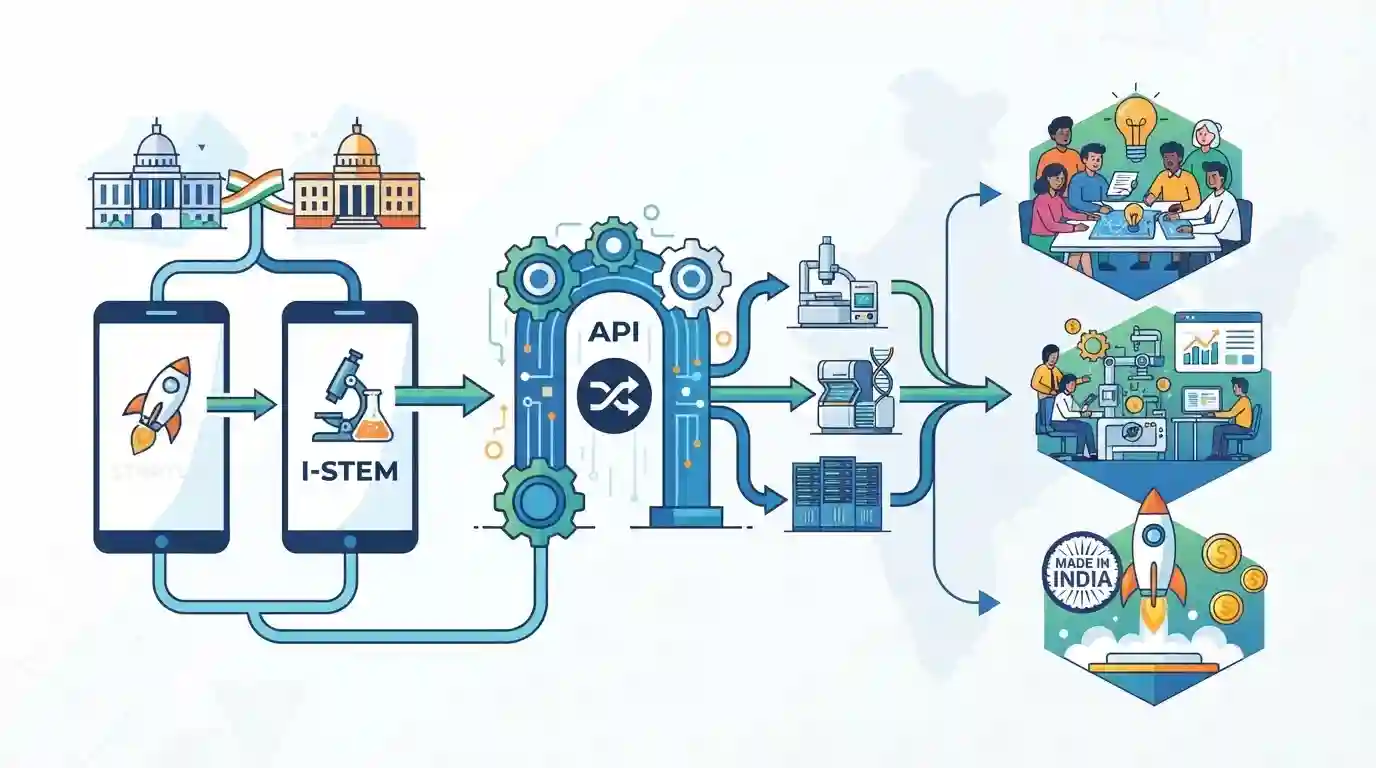
The Office of the Principal Scientific Adviser and DPIIT launched an API integration between the Startup India and I-STEM portals. This integration connects startups directly with national research facilities and equipment, fostering R&D collaboration, deep-tech innovation, and commercialization of research in India.
Key Points
- API integration achieved between Startup India and I-STEM portals by Office of the Principal Scientific Adviser and DPIIT.
- Aims to streamline access to publicly funded national research infrastructure and laboratories for startups and researchers.
- Reduces bureaucratic hurdles and enhances R&D collaboration between academia, industry, and startups.
- Boosts innovation, deep-tech development, and commercialization of patents in India.
Important Terms
I-STEM portal

A national web portal that acts as a centralized database of publicly funded research equipment and facilities across Indian institutions, allowing researchers and startups to access critical R&D infrastructure.
UPSC context
GS Paper III (Science & Technology - Indigenous Technology and R&D). Tests awareness of institutional mechanisms supporting scientific research and deep-tech innovation.
Office of the Principal Scientific Adviser
The apex body providing overarching advice to the government on science, technology, and innovation policies, and coordinating major national S&T missions and inter-ministerial initiatives.
UPSC context
GS Paper II/III (Governance and S&T Policy). Tests knowledge of apex scientific advisory bodies and governance frameworks for R&D.
Startup India initiative
A flagship government initiative launched to build a strong ecosystem for nurturing innovation, boosting startup growth, and driving sustainable economic development and employment.
UPSC context
GS Paper III (Indian Economy - Mobilization of Resources, Growth, and Innovation). Tests understanding of government interventions promoting entrepreneurship.
DPIIT
A government department under the Ministry of Commerce and Industry responsible for formulation of promotional and overall industrial policies, including the administration of Startup India.
UPSC context
GS Paper III (Indian Economy - Industrial Growth & Policy). Tests knowledge of key nodal bodies driving industrial development and startup recognition.
Prelims Trap
I-STEM portal is administered exclusively by the Ministry of Science and Technology or Ministry of Education.
Aspirants often assume I-STEM is managed by the Ministry of Education or CSIR, whereas it functions under the aegis of the Office of the Principal Scientific Adviser (PSA).
Static Concepts Connected
What are the core mandates and administrative domains of I-STEM and Startup India portals?
- I-STEM Mandate:: Launched under the National Mission on Nano Science and Technology, it acts as a national web portal for sharing publicly funded research equipment.
- Startup India:: Managed by DPIIT (Ministry of Commerce and Industry), it promotes entrepreneurship through tax incentives, fund of funds, and compliance relief.
- Office of PSA:: The Office of the PSA advises the government on S&T policy, coordinating major scientific missions across ministries.
Cross-Topic Patterns
Deep-Tech Startups & Academia Linkages
The I-STEM portal bridges academic labs and market-ready startups, directly feeding deep-tech innovations into the industrial ecosystem.
Digital Public Infrastructure for R&D
Publicly funded research infrastructure sharing echoes broader national asset monetization and digital public infrastructure (DPI) governance strategies.

I-STEM and Startup India API integration questions will test institutional mandates (PSA vs DPIIT) and deep-tech funding access.
Linked PYQs · 1
Linked PYQs · 1
- 2024MainsGS3
What is the present world scenario of intellectual property rights with respect to life materials? Although, India is second in the world to file patents, still only a few have been commercialized. Explain the reasons behind this less commercialization.
