BIMSTEC Maritime Security Exercise at Andaman and Nicobar Command
Source:PIB ↗
Why It Matters
It marks a milestone in multilateral maritime security cooperation among BIMSTEC nations, directly relevant to India's regional diplomacy, SAGAR vision, and Indo-Pacific security architecture.
Summary
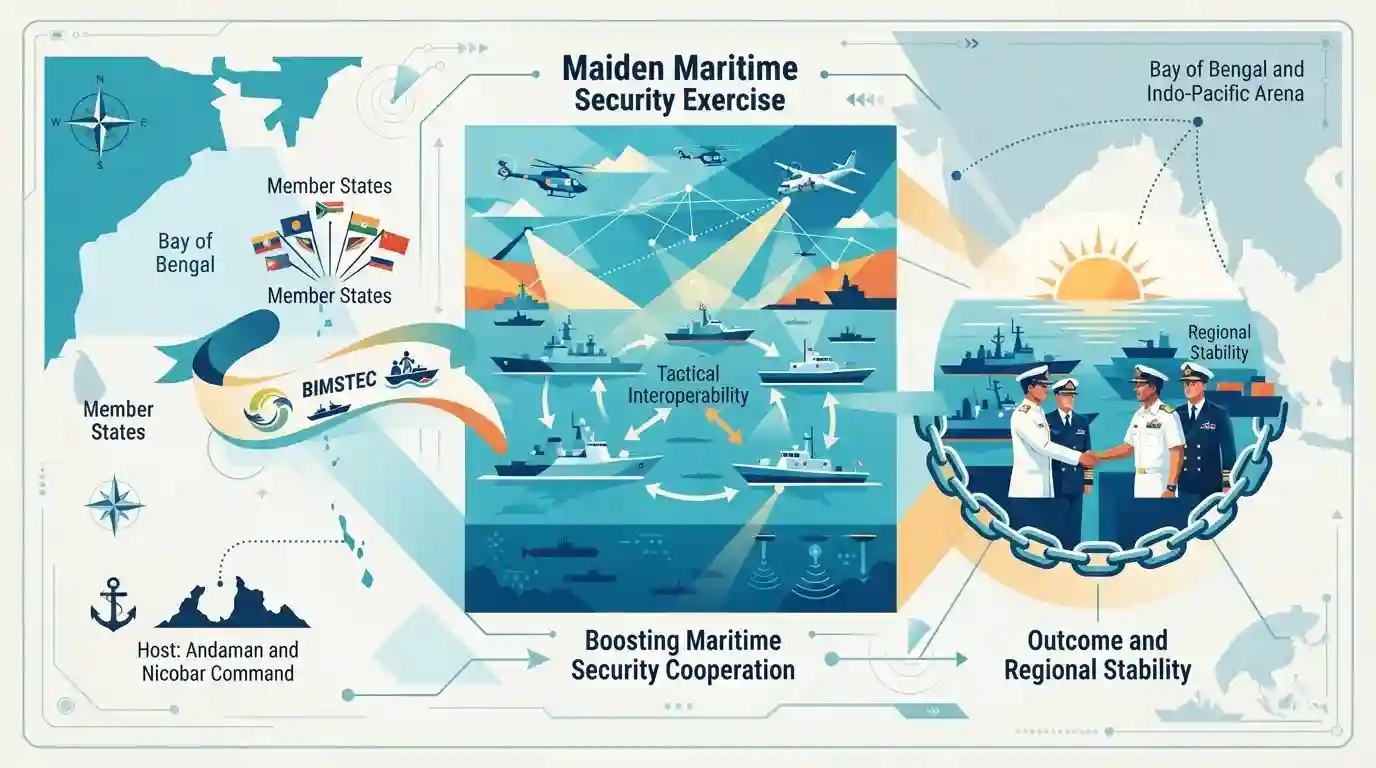
The article highlights the conclusion of the maiden BIMSTEC Maritime Security Exercise hosted by the Andaman and Nicobar Command. The exercise brought together member states to boost maritime security cooperation, tactical interoperability, and regional stability in the Bay of Bengal and the broader Indo-Pacific arena.
Key Points
- The maiden BIMSTEC Maritime Security Exercise concluded at the Andaman and Nicobar Command, focusing on maritime cooperation, interoperability, and addressing common security challenges in the Bay of Bengal region.
- The exercise enhanced tactical proficiency and synergy among member nations in areas like Search and Rescue (SAR), anti-piracy operations, and humanitarian assistance.
- Reinforces India's strategic leadership and commitment to regional security framework under SAGAR (Security and Growth for All in the Region) and Indo-Pacific vision.
Important Terms
BIMSTEC

An international economic and technical cooperation grouping of seven nations bordering the Bay of Bengal, fostering regional integration and maritime security.
UPSC context
GS Paper II (International Relations - Regional Groupings). Tests understanding of India's 'Neighbourhood First' and 'Act East' policies via multilateral sub-regional platforms.
Andaman and Nicobar Command
India's first unified tri-service theater command, situated in the Andaman and Nicobar Islands, responsible for safeguarding strategic maritime choke points.
UPSC context
GS Paper III (Security & Defence). Tests knowledge of India's military structures, jointness, theater commands, and Indo-Pacific security architecture.
Prelims Trap
Landlocked BIMSTEC member states like Bhutan and Nepal do not participate in maritime security exercises.
Aspirants often assume landlocked nations like Nepal and Bhutan are excluded from maritime security groupings. In BIMSTEC, all seven member states engage in maritime cooperation due to trade and regional connectivity stakes.
Static Concepts Connected
What are the foundational principles, member states, and unique institutional features of BIMSTEC?
- Member States: BIMSTEC includes seven members: Bangladesh, Bhutan, India, Myanmar, Nepal, Sri Lanka, and Thailand (bridging South and Southeast Asia).
- Establishment & Charter: Established in 1997 via the Bangkok Declaration, shifting focus from a sub-regional bloc to a formal organization with a charter signed in 2022.
- Pillar-based Focus: Operates on sector-driven cooperation where member states lead specific pillars (e.g., India leads security, counter-terrorism, and disaster management).
Cross-Topic Patterns
BIMSTEC Maritime Drills and Landlocked State Engagement
BIMSTEC exercises integrate landlocked members like Nepal and Bhutan into maritime security frameworks, illustrating how geoeconomics intersects with regional naval diplomacy in the Bay of Bengal.
ANC Tri-Service Command and Island Security
The Andaman and Nicobar Command serves as India's sole tri-service command, linking Indo-Pacific strategy with joint theater command debates and island territory development.

BIMSTEC membership trap (assuming only coastal states) + Andaman & Nicobar Command's status as India's sole tri-service command.
Linked PYQs · 2
Linked PYQs · 2
- 2022MainsGS2
Do you think that BIMSTEC is a parallel organisation like the SAARC ? What are the similarities and dissimilarities between the two ? How are Indian foreign policy objectives realized by forming this new organisation?
- 2025MainsGS3
Why is maritime security vital to protect India's sea trade? Discuss maritime and coastal security challenges and the way forward.
