Semicon 2.0 Portal and Electronics Components Manufacturing Scheme
Source:PIB ↗
Why It Matters
This initiative directly addresses India's push towards high-tech manufacturing, supply chain resilience, and self-reliance in critical electronics and semiconductors, aligning closely with Mains GS3 syllabus requirements on industrial growth and technology.
Summary
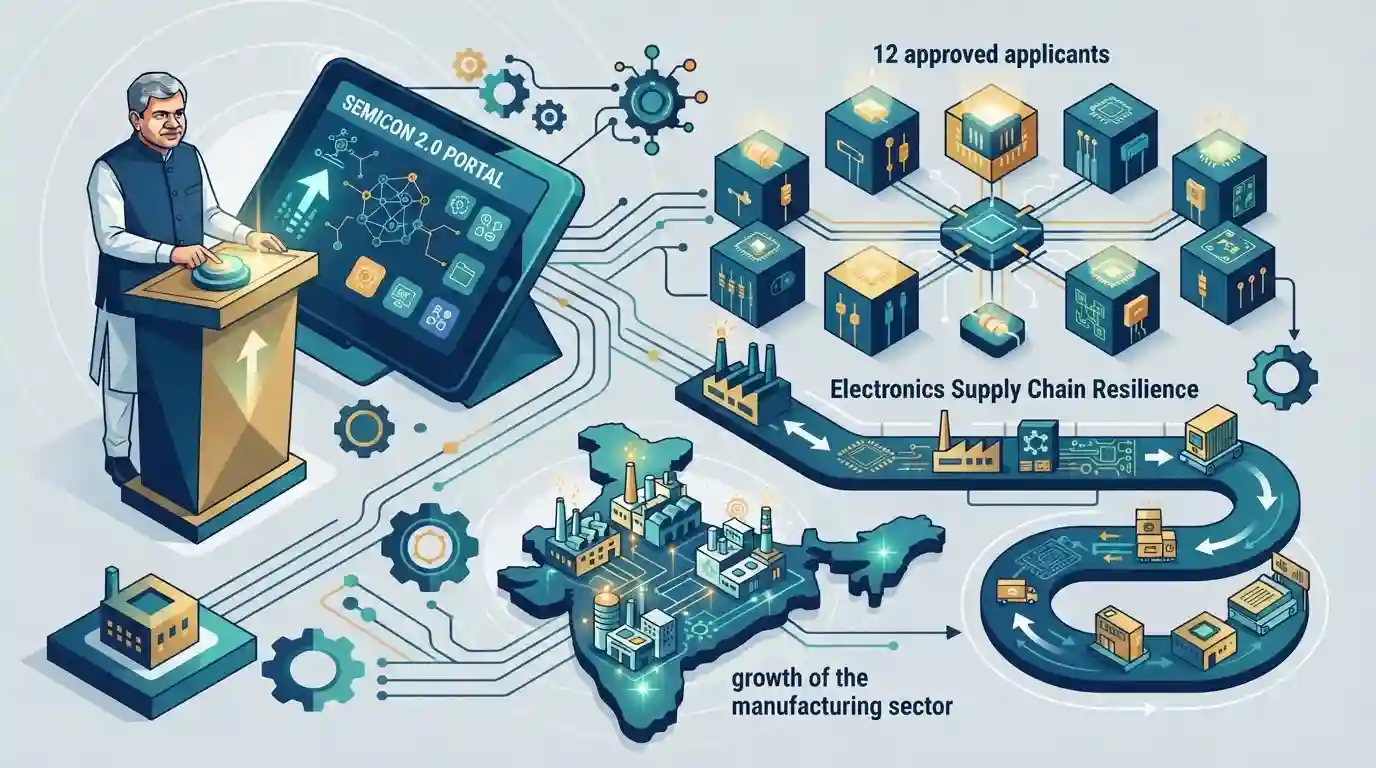
Union Minister Ashwini Vaishnaw launched the Semicon 2.0 web application portal and announced 12 approved applicants under the Electronics Components Manufacturing Scheme, advancing India's semiconductor manufacturing ecosystem and electronics supply chain resilience.
Key Points
- Union Minister Ashwini Vaishnaw launched the Semicon 2.0 web application portal to streamline and enhance governance in semiconductor manufacturing incentives.
- Twelve new applicants were approved under the Electronics Components Manufacturing Scheme to strengthen the domestic electronics supply chain.
- The initiative supports India's broader vision of establishing a resilient semiconductor ecosystem and reducing import dependence for critical electronic components.
Important Terms
Semicon 2.0 Web Application Portal

A digital platform launched to streamline applications and governance under India's next-phase semiconductor development programme (Semicon 2.0), focusing on chip design, materials, manufacturing, and R&D.
UPSC context
GS Paper III (Technology, Industrial Policy). Tests understanding of India's strategic push for semiconductor self-reliance and electronics supply chain resilience.
Electronics Components Manufacturing Scheme
A government scheme aimed at strengthening the domestic electronics supply chain by supporting the manufacturing of electronic components, semiconductor packaging, and raw materials.
UPSC context
GS Paper III (Manufacturing Sector Growth). Tests government initiatives for boosting domestic value addition and reducing import dependence in electronics.
Ministry of Electronics and Information Technology
The nodal Union ministry responsible for formulating policies related to information technology, electronics, and internet proliferation in India, steering the India Semiconductor Mission.
UPSC context
GS Paper II / III (Government Policies and Interventions). Tests institutional framework for implementing digital governance and high-tech manufacturing policies.
Static Concepts Connected
What are the key pillars of India’s Semiconductor Mission (ISM) and its implementation architecture?
- Nodal Agency: Nodal Agency: Implemented under the aegis of Digital India Corporation (DIC) by the Ministry of Electronics and IT (MeitY).
- Financial Support: Fiscal Support: Offers up to 50% of project cost for semiconductor fabs, display fabs, and compound semiconductor facilities.
- DLI Scheme: Design Linked Incentive: DCI scheme provides financial incentives and design infrastructure support across various stages of integrated circuit (IC) design.
Cross-Topic Patterns
Semiconductors + iCET & Technology Diplomacy
Semiconductor manufacturing incentives connect industrial policy with external economic diplomacy, as seen in the India-US iCET and Quad critical technology partnerships.
PLI Schemes + WTO Subsidy Disciplines
Domestic manufacturing subsidies intersect with WTO rules, specifically the ASCM (Agreement on Subsidies and Countervailing Measures) on actionable vs non-actionable subsidies.

Semicon 2.0 and electronics components schemes will feature in matching or multi-statement questions on India's tech self-reliance.
Linked PYQs · 1
Linked PYQs · 1
- 2025MainsGS3
India aims to become a semiconductor manufacturing hub. What are the challenges faced by the semiconductor industry in India? Mention the salient features of the India Semiconductor Mission.
