Mining Ministers Conference and Centre State Coordination
Source:PIB ↗
Why It Matters
The conference highlights cooperative federalism and strategic policy updates in the mining sector, crucial for India's industrial growth, critical mineral supply chains, and sustainable resource governance.
Summary
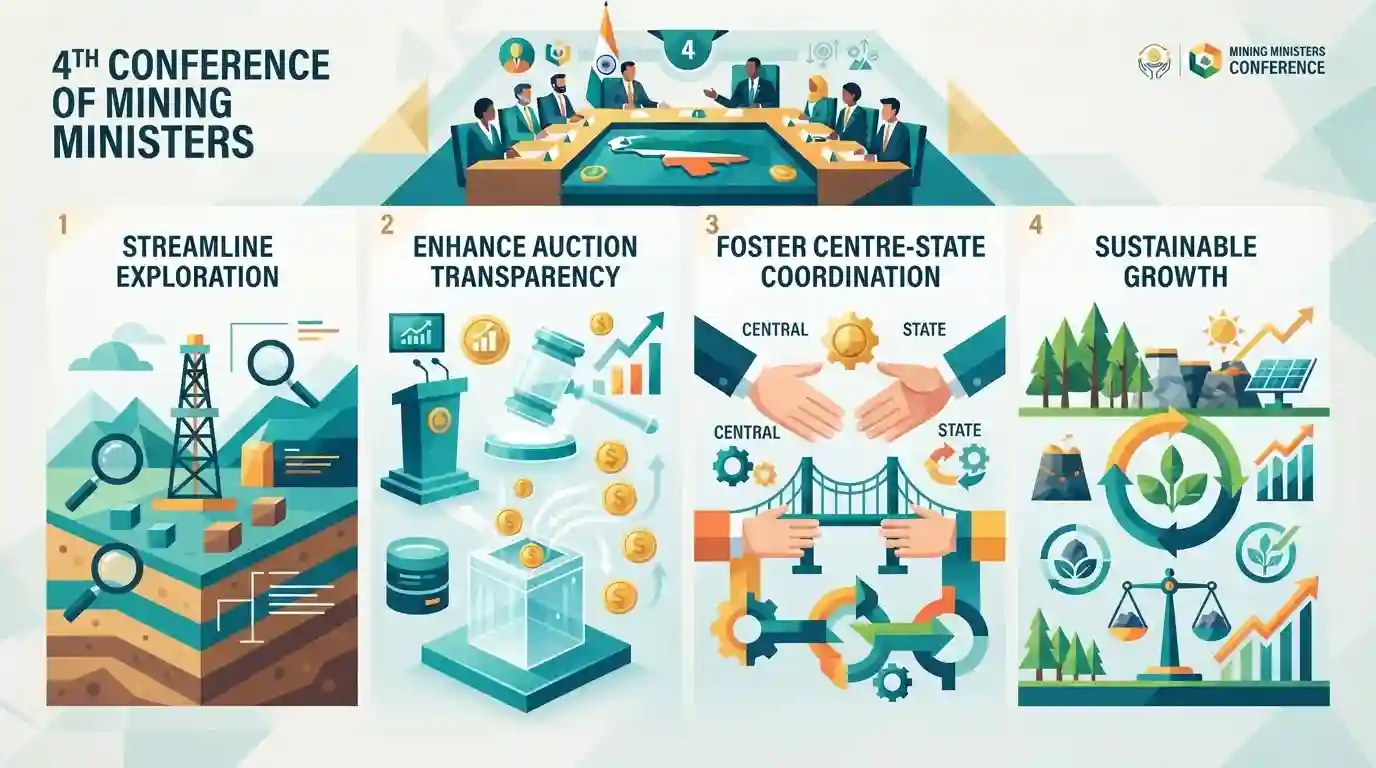
The 4th Conference of Mining Ministers brought together union and state stakeholders to deliberate on key initiatives, streamline mineral exploration, enhance auction transparency, and foster robust Centre-State coordination for sustainable growth in the mining sector.
Key Points
- The 4th Conference of Mining Ministers focused on strengthening Centre-State coordination to accelerate mineral exploration and sustainable mining.
- Emphasis was laid on leveraging technological advancements, streamlining auction processes, and enhancing transparency in the mining sector.
- Discussions highlighted the importance of critical minerals for the clean energy transition and national economic growth.
Important Terms
Mines and Minerals Development and Regulation Act

The primary central legislation governing India's mining sector, establishing the regulatory framework for mineral exploration, extraction, and concessions under Union control.
UPSC context
UPSC GS Paper III (Economy & Resources): Tests legal frameworks, mineral governance, auction transparency, and policy reforms in the mining sector.
Ministry of Mines
The Union government department responsible for formulating policy, administering legislation, and overseeing the survey and development of major minerals across India.
UPSC context
UPSC GS Paper II (Governance): Essential for understanding central administrative control, policy formulation, and federal coordination in industrial sectors.
State Governments
Sub-national administrative bodies holding ownership over onshore mineral wealth and executing regulatory powers regarding minor minerals and mineral concession grants within their territorial boundaries.
UPSC context
UPSC GS Paper II (Polity & Federalism): Tests Centre-State relations, fiscal federalism, mineral taxation powers, and cooperative federalism in resource governance.
Prelims Trap
All revenues generated from the competitive auction of mineral blocks under the MMDR Act accrue directly to the Consolidated Fund of India.
Revenues from mineral auctions accrue directly to the respective State Governments where the mineral block is located, not to the Consolidated Fund of India.
Static Concepts Connected
What are the key provisions and institutional mechanisms under the MMDR Act for mineral administration in India?
- Transparent Auctions: Competitive auctions introduced via 2015 and subsequent amendments to ensure absolute transparency and eliminate discretionary allocation of mineral concessions.
- Fiscal Federalism: Revenues from mineral auctions accrue directly to the respective State Governments, strengthening their fiscal autonomy and resource base.
- Welfare Framework: Establishment of the District Mineral Foundation (DMF) in all districts affected by mining operations for the welfare of local communities.
- Exploration Funding: Creation of the National Mineral Exploration Trust (NMET) to fund regional and detailed exploration of minerals across the country.
Cross-Topic Patterns
Mineral Auctions and Fiscal Federalism
Revenues from mineral auctions flow directly to state governments, reinforcing fiscal federalism under Schedule VII while demanding robust environmental safeguards under EIA norms.
Critical Minerals and Clean Energy Transition
Critical mineral exploration drives India's clean energy transition, directly intersecting with Net Zero targets and strategic supply chain diversification away from China.

MMDR Act amendments + fiscal federalism + critical minerals will likely feature as a multi-statement prelims question.
Linked PYQs · 3
Linked PYQs · 3
- 2025MainsGS3
Mineral resources are fundamental to the country's economy and these are exploited by mining. Why is mining considered an environmental hazard? Explain the remedial measures required to reduce the environmental hazard due to mining.
- 2025PrelimsGS1
Consider the following statements : I. India has joined the Minerals Security Partnership as a member. II. India is a resource-rich country in all the 30 critical minerals that it has identified. III. The Parliament in 2023 has amended the Mines and Minerals (Development and Regulation) Act, 1957 empowering the Central Government to exclusively auction mining lease and composite license for certain critical minerals. Which of the statements given above are correct?
- 2025PrelimsGS1
Consider the following statements : Statement I: In India, State Governments have no power for making rules for grant of concessions in respect of extraction of minor minerals even though such minerals are located in their territories. Statement II: In India, the Central Government has the power to notify minor minerals under the relevant law. Which one of the following is correct in respect of the above statements?
