India Steel Consumption and Manufacturing Growth Trends
Source:PIB ↗
Why It Matters
Steel consumption is a vital barometer of industrial activity, infrastructure development, and manufacturing growth in the Indian economy.
Summary
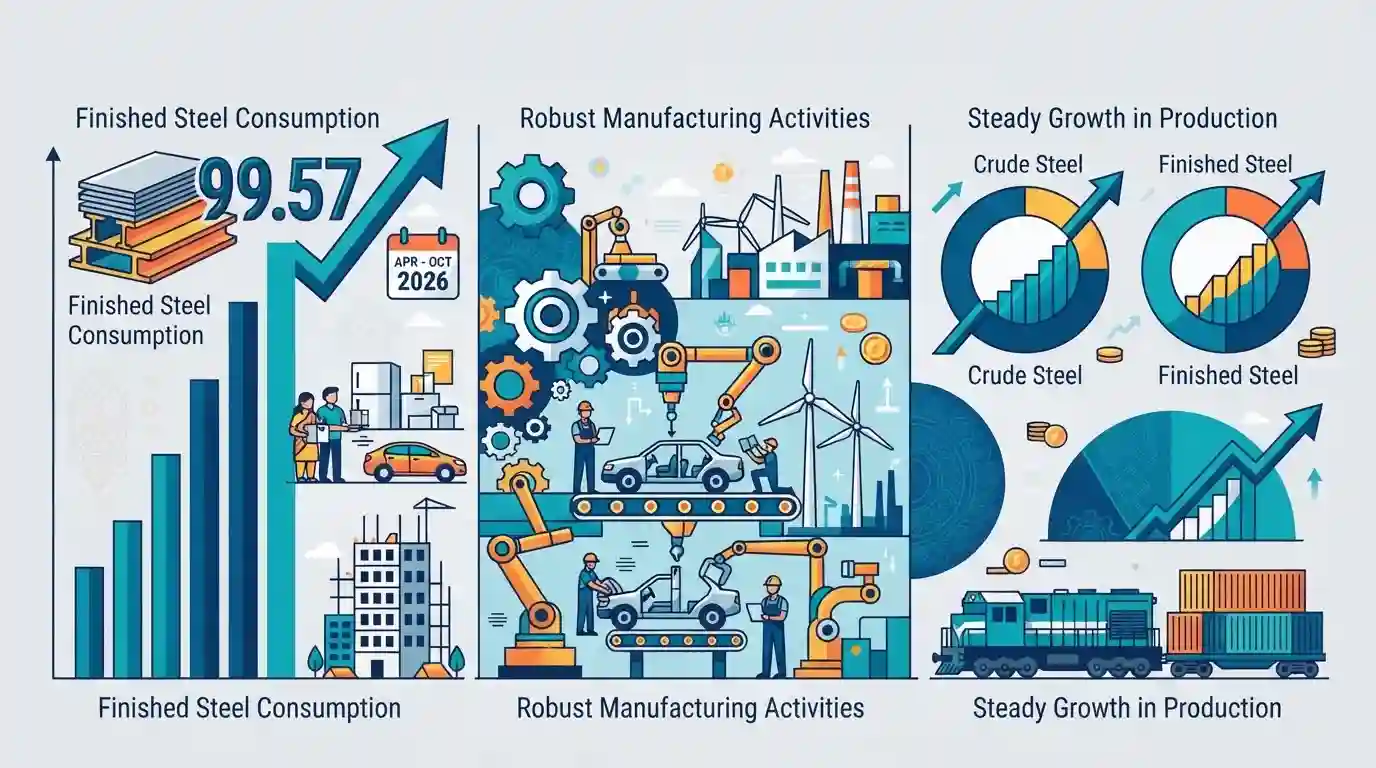
India's finished steel consumption touched 99.57 million tonnes between April and October 2026, showcasing strong domestic demand, robust manufacturing activities, and steady growth in both crude and finished steel production.
Key Points
- India's finished steel consumption reached nearly 100 million tonnes (99.57 Mt) during the first seven months of the financial year (April-October 2026), marking a robust growth trend.
- Crude steel production stood at 90.66 Mt, while finished steel production reached 87.53 Mt during the same period.
- India maintained its net exporter status in steel, exporting 3.84 Mt against imports of 5.54 Mt, reflecting strong domestic demand matching domestic supply capabilities.
Important Terms
Ministry of Steel

The Union government department responsible for planning, policy formulation, development, and regulation of the iron and steel industry in India.
UPSC context
UPSC GS Paper III (Indian Economy & Infrastructure): Tests knowledge of industrial policy, manufacturing growth, and core sector regulation.
Prelims Trap
India was a net exporter of finished steel throughout the April-October 2026 period, exporting more finished steel than it imported.
India recorded higher finished steel imports (5.54 Mt) than exports (3.84 Mt) during this period, despite maintaining overall structural net-exporter status in specific years or product categories.
Static Concepts Connected
What are the structural stages of steel making and key policy targets for India's steel sector?
- Process stages: Crude to Finished,Crude steel is the primary output from blast furnaces/electric arcs, which is then processed into finished steel items like sheets, bars, and rods.
- Policy targets: National Steel Policy,Aims for 300 MT of crude steel capacity by 2030-31 and long-term vision 2047 targets over 600 MT capacity.
- Inputs & Ores: Raw Material Link,Requires massive coking coal and iron ore inputs, making domestic captive mining and logistics critical cost determinants.
Cross-Topic Patterns
Steel Consumption + Capital Expenditure (NIP/GatiShakti)
Steel demand reflects infrastructure push under National Infrastructure Pipeline (NIP) and PM GatiShakti, linking core manufacturing output directly with capital expenditure targets.
Steel Trade + WTO Safeguards & Antidumping
High steel imports alongside strong domestic demand highlight anti-dumping and safeguard duty debates under WTO rules for domestic manufacturers.

Steel sector capacity targets (Vision 2047) combined with import-export status will likely feature in a core infrastructure matching question.
Linked PYQs · 2
Linked PYQs · 2
- 2023MainsGS3
Faster economic growth requires increased share of the manufacturing sector in GDP, particularly of MSMEs. Comment on the present policies of the Government in this regard.
- 2025MainsGS3
Discuss the rationale of the Production Linked Incentive (PLI) scheme. What are its achievements? In what way can the functioning and outcomes of the scheme be improved?
