Coal sector reforms and gasification for energy security
Source:PIB ↗
Why It Matters
It highlights India's strategic push towards coal gasification, technology-driven mining, and structural reforms to balance fossil fuel reliance with cleaner technology integration, directly aligning with GS3 energy security and industrial policy syllabi.
Summary
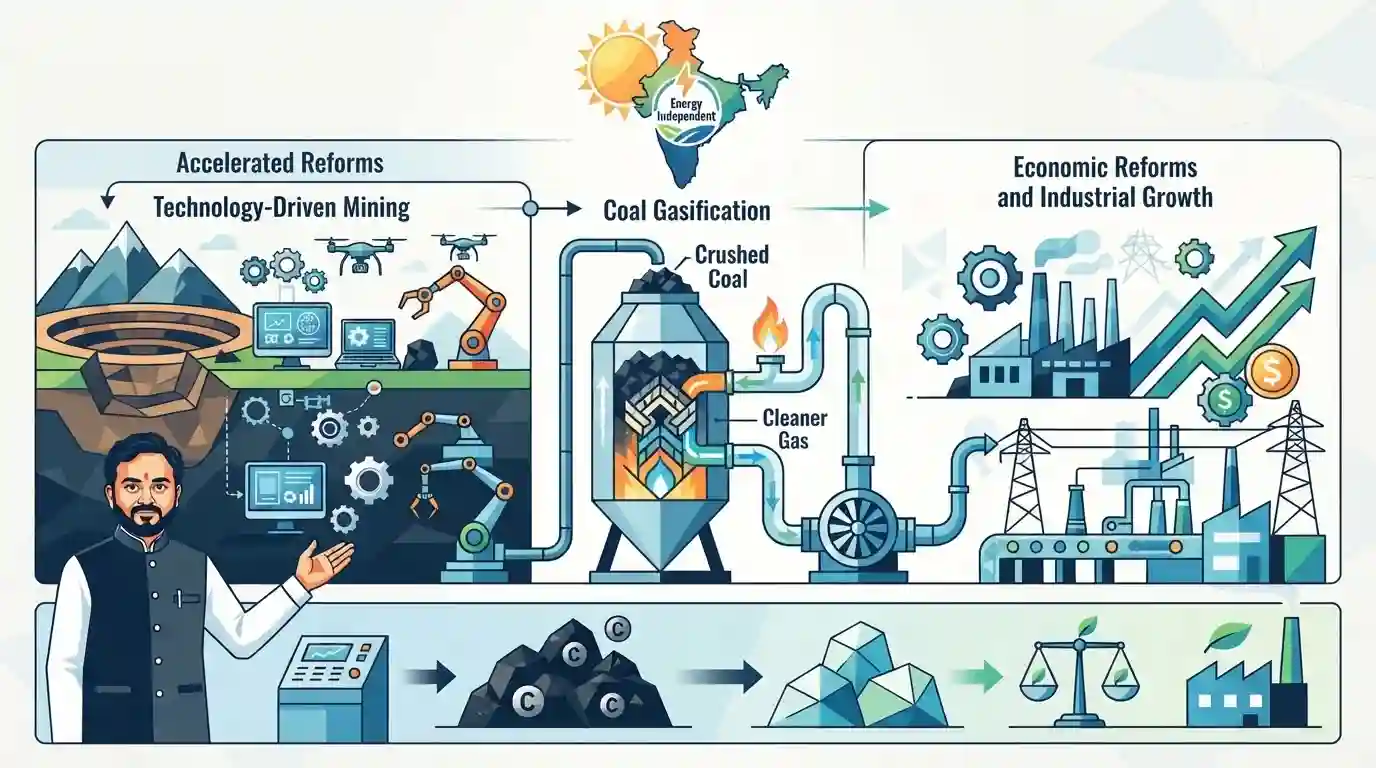
Union Minister Shri G. Kishan Reddy has called for accelerated reforms in India's coal sector, highlighting coal gasification and technology-driven mining as pivotal steps to secure the nation's energy independence while managing environmental footprints.
Key Points
- Union Minister Shri G. Kishan Reddy emphasized the need for accelerated coal sector reforms to achieve national energy security.
- The focus was placed on promoting coal gasification technologies to shift away from raw coal burning towards cleaner chemical feedstocks.
- Adoption of advanced, technology-driven mining practices is being prioritized to enhance operational efficiency, safety, and productivity.
- Balancing domestic fossil fuel utilization with sustainable development goals forms a key component of India's long-term energy strategy.
Important Terms
Ministry of Coal

The Union Government ministry in India responsible for exploration, development, production, and overall policy formulation regarding coal and lignite reserves across the country.
UPSC context
GS Paper II & III (Governance and Economy/Infrastructure). Important for questions on energy security, public sector enterprises, and mineral administration.
Government of India
The central governing authority of the Republic of India, responsible for national executive policy-making, administration, economic planning, and strategic infrastructure development.
UPSC context
GS Paper II (Indian Polity and Governance). Fundamental for understanding institutional frameworks, policy execution, and federal governance structures.
Static Concepts Connected
What is Coal Gasification and what are its primary environmental and industrial advantages?
- Syngas Production: Process: Converts coal into synthesis gas (syngas)—a mixture of carbon monoxide and hydrogen—using air, oxygen, steam, or carbon dioxide.
- Chemical Feedstock: Clean Feedstocks: Syngas can be processed to produce downstream chemicals like methanol, ammonia, and synthetic natural gas, reducing direct burning emissions.
- Import Substitution: Energy Independence: Reduces India's heavy import dependence on natural gas and petro-chemicals by utilizing abundant domestic non-coking coal reserves.
Cross-Topic Patterns
Coal Gasification & NDC Climate Targets
India's push for 100 MT coal gasification by 2030 links domestic fossil fuel security with green hydrogen and chemical feedstock transitions under climate commitments.

National Coal Gasification Mission targets and financial incentives (50% revenue share rebate) are prime candidates for Prelims matching.
Linked PYQs · 2
Linked PYQs · 2
- 2025MainsGS3
How can India achieve energy independence through clean technology by 2047? How can biotechnology can play a crucial role in this endeavour?
- 2020PrelimsGS1
Consider the following statements: 1. Coal ash contains arsenic, lead and mercury. 2. Coal-fired power plants release sulphur dioxide and oxides of nitrogen into the environment. 3. High ash content is observed in Indian coal. Which of the statements given above is/are correct?
