Drug Manufacturing License Suspension for Substandard Quality
Source:PIB ↗
Why It Matters
Crucial for evaluating India's drug regulatory framework, patient safety measures, and public health governance against substandard medications.
Summary
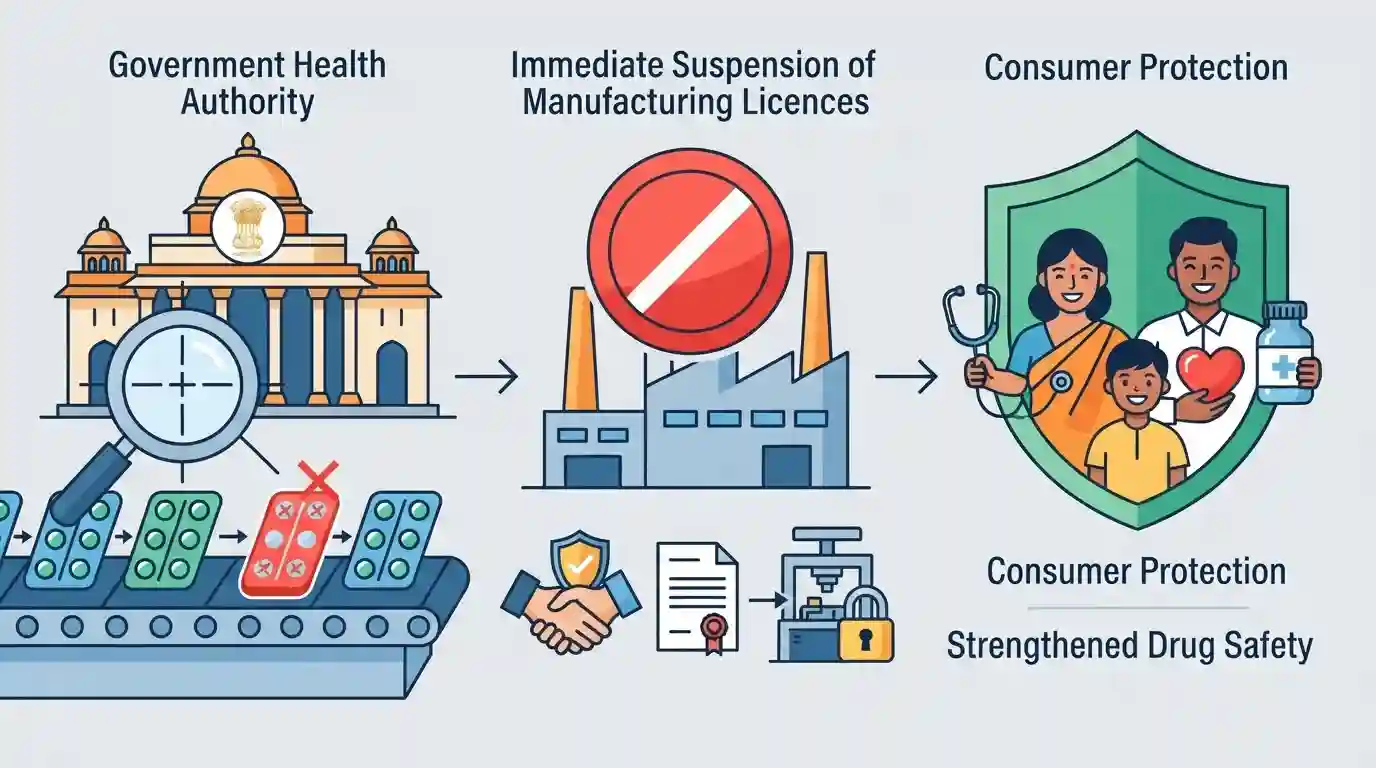
The Union Health Ministry has proposed the immediate suspension of manufacturing licences for pharmaceutical products that fail to meet standard quality requirements on specified critical parameters, aiming to strengthen drug safety and regulatory enforcement in India.
Key Points
- The Union Health Ministry proposed immediate suspension of manufacturing licences for drugs found 'Not of Standard Quality' (NSQ) on critical parameters.
- This aims to tighten pharmaceutical regulations, ensure patient safety, and crack down on substandard drug manufacturing.
- Critical parameters involve serious quality defects that pose direct risks to public health and safety.
Important Terms
Union Health Ministry

The principal central government ministry responsible for formulating national health policies, family welfare programs, and regulating public health standards and pharmaceutical manufacturing in India.
UPSC context
GS Paper II (Governance, Health Policies). Tests understanding of institutional frameworks governing public health and statutory policy formulation in India.
Drugs and Cosmetics Act
India's premier legislation regulating the import, manufacture, distribution, and sale of drugs and cosmetics to ensure safety, efficacy, and standard quality.
UPSC context
GS Paper II (Government Policies & Interventions). Evaluates legal mechanisms for consumer protection, drug safety enforcement, and regulatory compliance.
Central Drugs Standard Control Organization
The national regulatory authority under the Ministry of Health and Family Welfare responsible for ensuring the safety, efficacy, and quality of drugs, medical devices, and cosmetics in India.
UPSC context
GS Paper II (Statutory Bodies & Regulatory Mechanisms). Tests knowledge of agencies tasked with drug approval, safety monitoring, and quality enforcement.
Prelims Trap
Immediate suspension of manufacturing licences applies to all categories of Not of Standard Quality (NSQ) drugs.
Aspirants often assume that ALL 'Not of Standard Quality' (NSQ) drugs attract immediate suspension, whereas the proposed rule specifically targets violations of *critical parameters* (like sterility and assay failures).
Static Concepts Connected
What are the key regulatory bodies and statutory frameworks governing drug standards in India?
- Drugs and Cosmetics Act: Statutory Act enacted in 1940 to regulate import, manufacture, distribution, and sale of drugs and cosmetics in India.
- CDSCO Role: National regulatory authority under the Ministry of Health and Family Welfare, responsible for approval of new drugs and clinical trials.
- DTAB & DCC: Statutory advisory board that advises central and state governments on technical matters arising out of the administration of the Act.
Cross-Topic Patterns
Drug Regulations + Global Pharma Exports
Substandard drug enforcement connects domestic consumer protection with India's reputation as the 'Pharmacy of the Global South', impacting bilateral trade agreements and WHO-GMP compliance standards.

Expect statements on CDSCO powers, Drugs & Cosmetics Act, and the distinction between critical vs non-critical NSQ parameters.
Linked PYQs · 2
Linked PYQs · 2
- 2024MainsGS2
In a crucial domain like the public healthcare system the Indian State should play a vital role to contain the adverse impact of marketisation of the system. Suggest some measures through which the State can enhance the reach of public healthcare at the grassroots level.
- 2013MainsGS3
What do you understand by Fixed Dose Drug Combinations (FDCs) ? Discuss their merits and demerits.
