PM Surya Ghar Yojana and Rooftop Solar Mass Movement
Source:PIB ↗
Why It Matters
Directly relevant to India's targets for renewable energy, rooftop solar adoption, climate change commitments, and government schemes aimed at sustainable energy security.
Summary
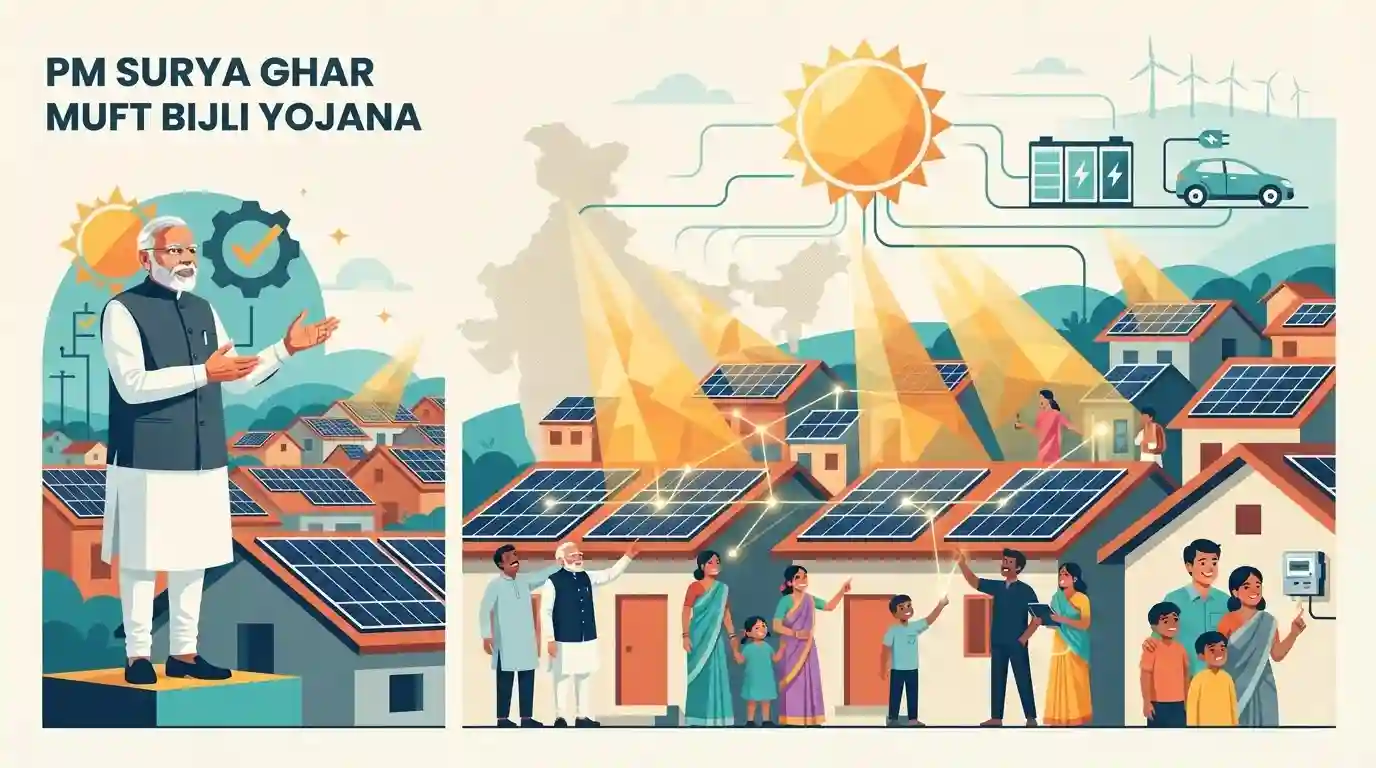
Union Minister Pralhad Joshi highlighted that the PM Surya Ghar Muft Bijli Yojana has transformed into a significant mass movement, driving grassroots adoption of rooftop solar energy and accelerating India's clean energy transition.
Key Points
- PM Surya Ghar Muft Bijli Yojana has evolved into a mass movement for renewable energy adoption in India.
- The scheme aims to provide rooftop solar installations and free electricity to households, promoting clean energy transition at the grassroots level.
- Government initiatives focus on financial assistance, subsidies, and streamlined processes to boost solar capacity.
Important Terms
PM Surya Ghar Muft Bijli Yojana

A flagship central government scheme aimed at providing rooftop solar electricity to one crore households, offering substantial subsidies to reduce electricity bills and promote clean energy adoption.
UPSC context
UPSC GS Paper III (Infrastructure, Energy & Government Schemes): Tests knowledge of renewable energy targets, subsidies, and grassroots sustainable development initiatives.
Ministry of New and Renewable Energy
The nodal ministry of the Government of India responsible for formulating and implementing policies, programs, and schemes relating to renewable energy, including solar, wind, and bio-energy.
UPSC context
UPSC GS Paper III (Environment & Energy): Evaluates institutional frameworks driving India's net-zero commitments and green energy transition.
Prelims Trap
provides unlimited free electricity to all households across India without any capacity caps or financial ceilings
Aspirants frequently assume the PM Surya Ghar scheme provides 100% free electricity without limits or that the subsidy applies beyond 3 kW without capping.
Static Concepts Connected
What are the key institutional mechanisms and financing structures under India's National Solar Mission?
- Capital Subsidies: Central Financial Assistance (CFA) provides capital subsidies directly to residential and institutional rooftop consumers to lower upfront adoption barriers.
- Low-Interest Debt: concessional debt is facilitated through multilateral agencies and domestic public sector banks at low interest rates without collateral.
- Net Metering: Net metering regulations allow consumers to feed surplus power back into the grid, offsetting their electricity bills.
Cross-Topic Patterns
Rooftop Solar and State Discom Finances
Decentralized renewable energy schemes intersect with Discom financial health, cross-subsidies, and agricultural feeder solarisation (PM-KUSUM) under cooperative federalism.
DBT Architecture in Energy Subsidy Delivery
Mass grassroots subsidies tied to digital portal registration echo Direct Benefit Transfer (DBT) governance models across DBT-linked welfare.

PM Surya Ghar subsidy structure, household capacity caps (3 kW), and financing terms are prime targets for match-the-following Prelims MCQs.
Linked PYQs · 3
Linked PYQs · 3
- 2020MainsGS3
Describe the benefits of deriving electric energy from sunlight in contrast to the conventional energy generation. What are the initiatives offered by our Government for this purpose?
- 2022MainsGS3
Do you think India will meet 50 percent of its energy needs from renewable energy by 2030 ? Justify your answer. How will the shift of subsidies from fossil fuels to renewables help achieve the above objective ? Explain.
- 2025MainsGS3
How can India achieve energy independence through clean technology by 2047? How can biotechnology can play a crucial role in this endeavour?
