India Releases Guidelines for Designation of OECMs at CBD COP-17
Source:PIB ↗
Why It Matters
The introduction of national guidelines for OECMs marks a critical shift in biodiversity governance by formally incorporating community-led and non-protected conservation areas into India's formal conservation accounting, directly linking with international CBD targets and GS3 environment syllabus.
Summary
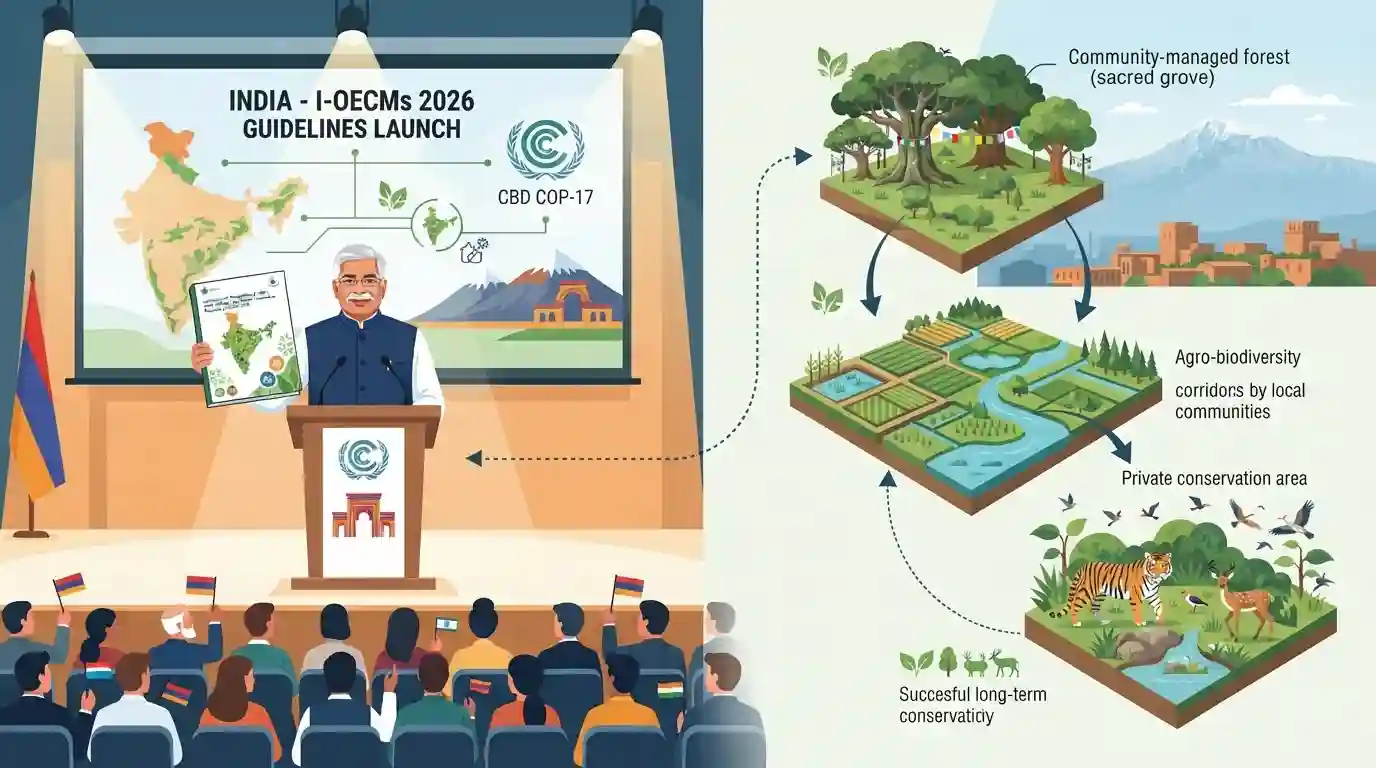
Union Environment Minister Shri Bhupender Yadav released the Guidelines for Designation of India's Other Effective Area-Based Conservation Measures (I-OECMs), 2026, at CBD COP-17 held in Yerevan, Armenia. The guidelines establish a formal framework for identifying and recognizing areas outside traditional protected networks—such as community-managed lands, sacred groves, and private conservation areas—that successfully deliver long-term biodiversity conservation. This move supports India's alignment with international biodiversity frameworks like the Kunming-Montreal Global Biodiversity Framework.
Key Points
- Union Environment Minister released India's Guidelines for Designation of Other Effective Area-Based Conservation Measures (I-OECMs), 2026, at CBD COP-17 in Yerevan, Armenia.
- OECMs refer to geographically defined spaces that are not protected areas but achieve positive and sustained long-term outcomes for in-situ biodiversity conservation.
- These guidelines provide a formal framework to recognize areas conserved by indigenous communities, private entities, and local stakeholders outside traditional protected areas (like national parks and wildlife sanctuaries).
- The initiative aids India in fulfilling its global biodiversity commitments, including the Kunming-Montreal Global Biodiversity Framework targets.
Important Terms
Other Effective Area-Based Conservation Measures (OECMs)

Geographically defined areas outside traditional protected networks—such as sacred groves and community lands—that achieve positive, long-term outcomes for in-situ biodiversity conservation.
UPSC context
UPSC GS Paper III (Environment): Important international conservation concepts, 30x30 targets, and community-led biodiversity initiatives.
CBD COP-17
The 17th meeting of the Conference of the Parties to the Convention on Biological Diversity, held in Yerevan, Armenia, focusing on global biodiversity frameworks and OECM action hubs.
UPSC context
UPSC GS Paper III (Environment): Current updates on international environmental conventions, summits, and India's multilateral commitments.
Convention on Biological Diversity (CBD)
A legally binding multilateral treaty opened at the 1992 Rio Earth Summit dedicated to the conservation of biological diversity, sustainable use, and equitable sharing of benefits.
UPSC context
UPSC GS Paper III (Environment): Core international environmental conventions, protocols, and global biodiversity governance frameworks.
Prelims Trap
biodiversity conservation must be the primary designated objective of an OECM site
Aspirants often assume OECMs require biodiversity conservation as their primary statutory objective, whereas they only require positive and sustained long-term in-situ conservation outcomes regardless of primary purpose.
Static Concepts Connected
What is the difference between Protected Areas (PAs) and OECMs under international biodiversity frameworks?
- Primary Objective: Statutory Objective: PAs have biodiversity conservation as their primary designated objective, whereas OECMs achieve positive in-situ conservation outcomes even if established for other purposes.
- Governance Diversity: Governance: PAs are strictly state-notified (National Parks, Wildlife Sanctuaries), while OECMs encompass diverse governance types including indigenous peoples, private entities, and local communities.
- CBD Recognition: Global Framework: OECMs were formally introduced under CBD Decision 14/8 in 2018 to help achieve area-based conservation targets like KM-GBF Target 3.
Cross-Topic Patterns
OECMs + Forest Rights Act (FRA) linkages
OECMs offer a legal bridge between traditional conservation and community rights, frequently intersecting with the Forest Rights Act and Panchayat (Extension to Scheduled Areas) Act.
KM-GBF 30x30 Target + Developmental Land Use
Meeting KM-GBF Target 3 (30x30) via non-state spaces requires balancing developmental pressures with voluntary indigenous conservation frameworks.

Expect a matching or statement-based question on OECMs vs Protected Areas, specifically testing primary vs secondary conservation objectives.
Linked PYQs · 3
Linked PYQs · 3
- 2026PrelimsGS1
Which one of the following is the first Plan Vivo certified Reducing Emissions from Deforestation and Forest Degradation (REDD+) project in India ?
- 2023PrelimsGS1
Consider the following statements: Once the Central Government notifies an area as a 'Community Reserve' 1. the Chief Wildlife Warden of the State becomes the governing authority of such forest 2. hunting is not allowed in such area 3. people of such area are allowed to collect non-timber forest produce 4. people of such area are allowed traditional agricultural practices How many of the above statements are correct?
- 2023MainsGS3
Comment on the National Wetland Conservation Programme initiated by the Government of India and name a few India's wetlands of international importance included in the Ramsar Sites.
