Bharatiya Vayuyan Niyam 2026 and Modern Aviation Regulation
Source:PIB ↗
Why It Matters
Crucial for understanding reforms in India's civil aviation infrastructure, regulatory modernization, and alignment with global safety standards to foster growth and ease of doing business.
Summary
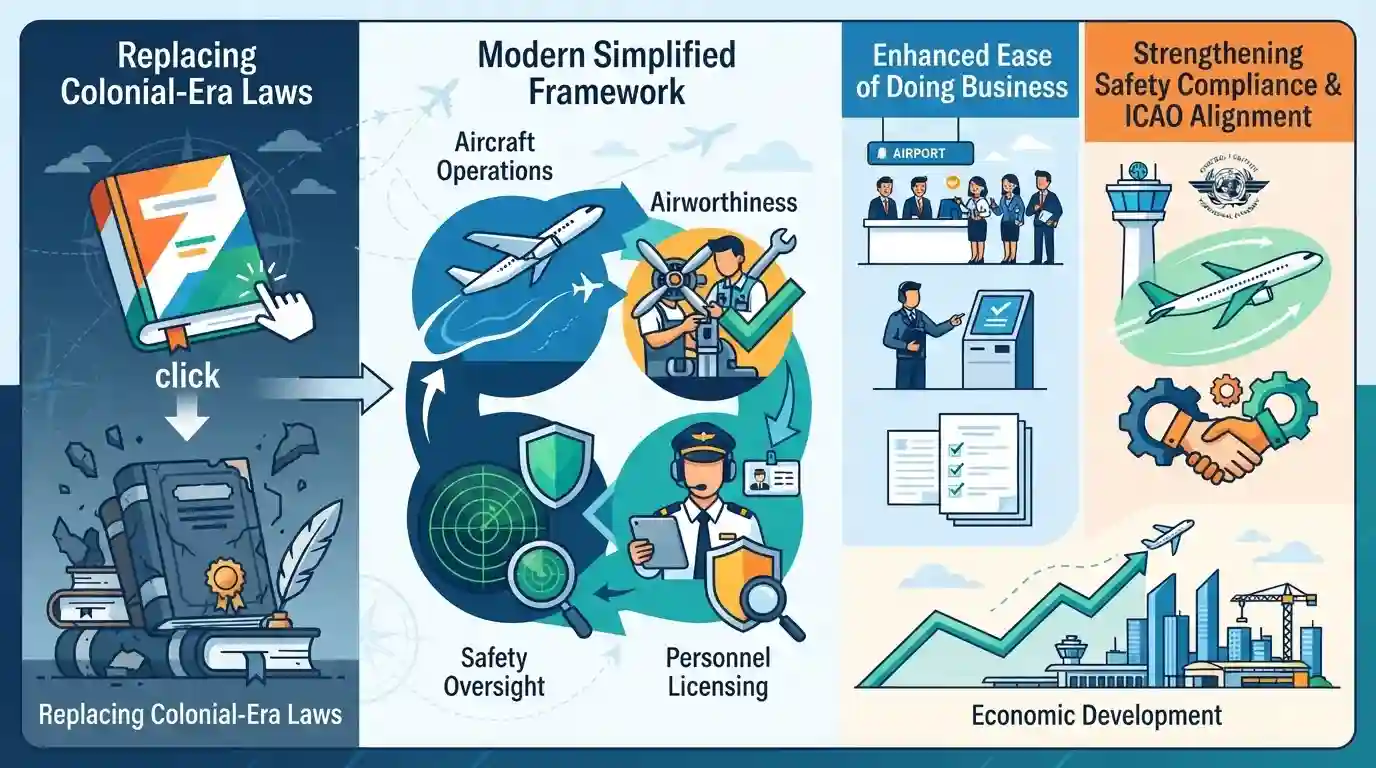
The Bharatiya Vayuyan Niyam 2026 represents a major overhaul of India's civil aviation regulations, replacing antiquated colonial-era laws with a modern, simplified framework. Aimed at enhancing ease of doing business, strengthening safety compliance, and aligning with International Civil Aviation Organization (ICAO) standards, the new rulebook governs aircraft operations, airworthiness, licensing, and safety oversight to support India's rapidly expanding aviation sector.
Key Points
- The Bharatiya Vayuyan Niyam 2026 replaces legacy colonial-era rules to modernize India's civil aviation regulatory framework.
- It provides a simplified, transparent, and ease-of-doing-business-friendly rulebook aligned with international standards (ICAO).
- The framework streamlines processes for aircraft registration, airworthiness, safety oversight, and licensing.
- It addresses contemporary technological developments and growth demands in India's booming aviation market.
Important Terms
Bharatiya Vayuyan Niyam 2026

A comprehensive rulebook notified by the Ministry of Civil Aviation under the Bharatiya Vayuyan Adhiniyam, 2024, replacing the colonial-era Aircraft Rules, 1937, to modernize India's civil aviation safety, licensing, and operational standards.
UPSC context
UPSC Prelims/Mains (GS Paper III - Infrastructure, Government Policies): Tests awareness of major regulatory overhauls replacing colonial-era laws in the aviation sector.
Aircraft Act 1934
The primary colonial-era legislation enacted in 1934 to regulate civil aviation, manufacture, possession, and operation of aircraft in British India, since replaced by the Bharatiya Vayuyan Adhiniyam, 2024.
UPSC context
UPSC Prelims (History/Polity/Governance): Important for questions on colonial legislation, statutory evolution, and the replacement of archaic laws in independent India.
Ministry of Civil Aviation
The apex central government ministry in India responsible for formulating national policies, regulation, and growth of civil aviation, overseeing bodies like the DGCA, BCAS, and AAIB.
UPSC context
UPSC Prelims/Mains (GS Paper II/III - Governance and Infrastructure): Evaluates institutional framework, policy implementation, and regulatory control in India's transport sector.
Directorate General of Civil Aviation
The statutory regulatory body under the Ministry of Civil Aviation responsible for civil aviation safety oversight, personnel licensing, airworthiness certification, and enforcement of safety regulations.
UPSC context
UPSC Prelims/Mains (GS Paper III - Infrastructure/Safety): Important for understanding safety oversight mechanisms, regulatory enforcement, and statutory bodies in Indian aviation.
Static Concepts Connected
What is the institutional structure and mandate of the International Civil Aviation Organization (ICAO)?
- Establishment: UN Specialized Agency created by the 1944 Chicago Convention to promote safe and orderly development of international civil aviation globally.
- Core Mandate: Sets international Standards and Recommended Practices (SARPs) covering air navigation, infrastructure, flight safety, and aviation security.
- Membership: Headquartered in Montreal, Canada; India is a permanent member state participating in its Universal Safety Oversight Audit Programme (USOAP).
Cross-Topic Patterns
Colonial Legal Overhauls and Delegated Legislation
Replacing colonial-era statutes like the 1934 Aircraft Act parallels parallel legal overhauls in criminal law (BNS) and colonial labor codes, testing administrative federalism and delegated legislation.

Expect questions linking the shift from the 1934 Aircraft Act to modern statutes with DGCA's statutory powers and ICAO compliance benchmarks.
Linked PYQs · 2
Linked PYQs · 2
- 2024MainsGS3
What is the need for expanding the regional air connectivity in India? In this context, discuss the government's UDAN Scheme and its achievements.
- 2026PrelimsGS1
Which of the following statements about insurance in aviation sector is/are correct ? 1. 'Aviation Hull Insurance' covers the physical aircraft, including the body, engine, and on-board equipment. 2. Under the Montreal Convention, adopted in 1999 by over 130 countries, including India, airlines are strictly liable to pay compensation to the family/nominee of every deceased passenger without requiring the family to prove fault. Select the answer using the code given below :
