IndiaAI Mission Launches Indigenous Foundation Models EKA-1 and Dhir
Source:PIB ↗
Why It Matters
The launch of indigenous foundation models marks a crucial milestone in India's quest for technological sovereignty, digital public infrastructure expansion, and customized AI solutions for local languages and societal needs.
Summary
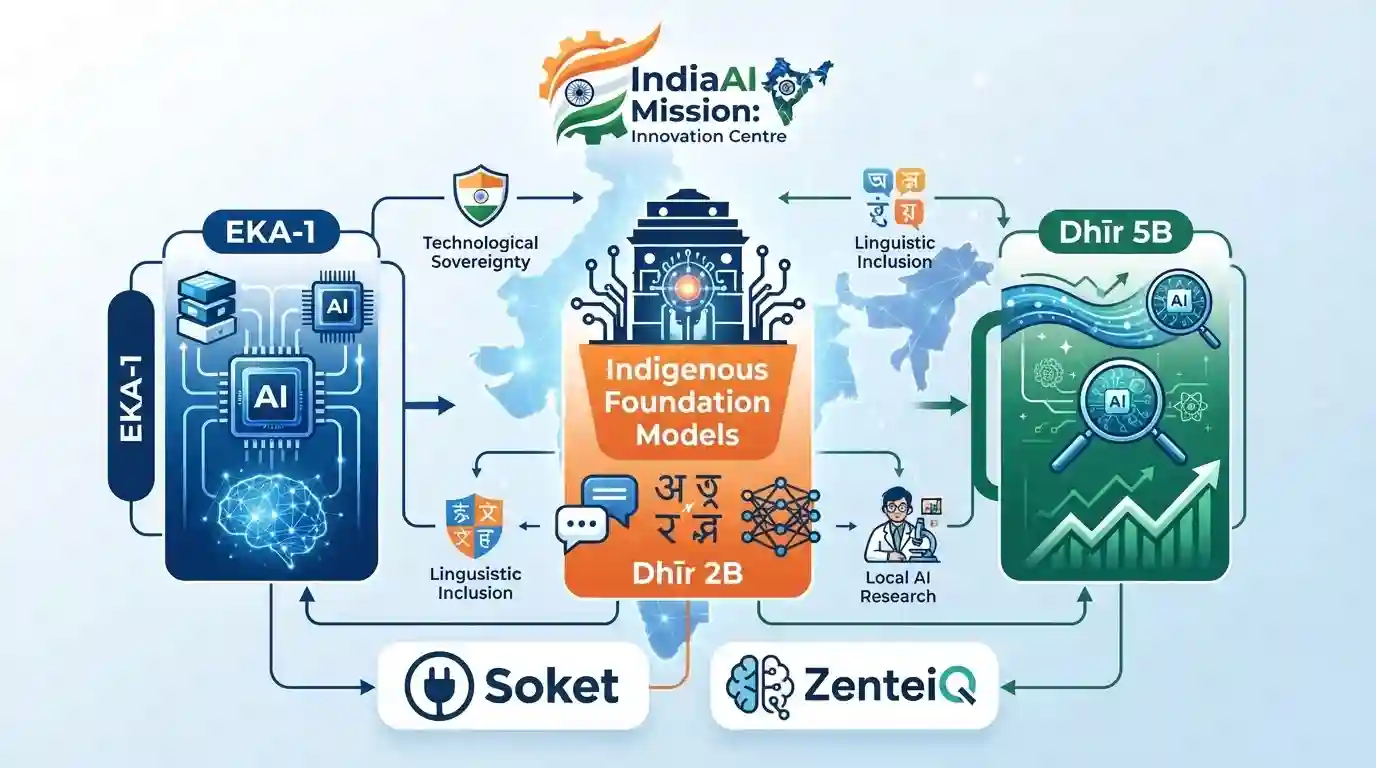
Under the IndiaAI Mission's Innovation Centre pillar, India has launched its first indigenous foundation models—EKA-1, Dhīr 2B, and Dhīr 5B. Developed by domestic startups Soket and ZenteiQ, these models are designed to bolster India's technological sovereignty, cater to linguistic needs, and drive local AI research.
Key Points
- The IndiaAI Mission released India's first indigenous foundational AI models: EKA-1 by Soket, and Dhīr 2B & Dhīr 5B by ZenteiQ.
- These models were launched under the IndiaAI Innovation Centre (IAIC) pillar, aimed at fostering indigenous AI research and sovereign computing capabilities.
- The initiative seeks to reduce dependence on foreign AI architectures, address regional and linguistic diversity, and support local data sovereignty.
- The IndiaAI Mission coordinates efforts across compute capacity, innovation, datasets, and safe and trusted AI deployment.
Important Terms
IndiaAI Mission

A comprehensive national initiative by the Ministry of Electronics and Information Technology (MeitY) with a ₹10,371.92 crore outlay to build domestic AI compute infrastructure, foster indigenous foundation models, and establish India as a global AI hub.
UPSC context
GS Paper III (Science & Technology - IT & Computers, Emerging Technologies). Tests awareness of national missions driving technological sovereignty and AI governance.
IndiaAI Innovation Centre
A key foundational pillar of the IndiaAI Mission dedicated to the research, creation, and deployment of indigenous Large Multimodal Models (LMMs) and domain-specific foundation models tailored for Indian languages and strategic sectors.
UPSC context
GS Paper III (S&T / AI). Tests knowledge of institutional mechanisms supporting homegrown research and development in critical technologies.
Soket Labs
An Indian startup that developed EKA-1, a 26.3-billion parameter open sparse hybrid indigenous foundation model designed for advanced reasoning, coding, math, and support for Indian and international languages.
UPSC context
GS Paper III (S&T / Innovation). Highlights the role of domestic startups and public-private partnerships in building India's technological autonomy.
ZenteiQ AI
An Indian tech firm that created Dhīr 2B and Dhīr 5B, lightweight, mobile-friendly mixture-of-experts foundation models designed to operate offline in air-gapped and low-connectivity environments.
UPSC context
GS Paper III (S&T / Emerging Tech). Relevant for questions on indigenous solutions for localized public service delivery and secure offline computing.
Ministry of Electronics and Information Technology (MeitY)
The nodal Union ministry responsible for formulating policies related to information technology, electronics, and internet diffusion, anchoring major national initiatives like the IndiaAI Mission.
UPSC context
GS Paper II/III (Governance / S&T). Tests understanding of institutional governance structures overseeing digital infrastructure and emerging technology policies in India.
Prelims Trap
The IndiaAI Mission is exclusively dedicated to developing indigenous foundational language models like EKA-1 and Dhīr.
Aspirants often assume the IndiaAI Mission is exclusively focused on LLMs, whereas foundational models are just one pillar among seven, including compute capacity and datasets.
Static Concepts Connected
What are the key pillars and financial outlay structure of the IndiaAI Mission?
- Total Outlay: Financial Outlay: Approved with a budget of over ₹10,371 crore for a duration of five years to build a comprehensive AI ecosystem.
- Seven Pillars: Core Pillars: Comprises seven pillars including IndiaAI Compute Capacity, Innovation Centre, Datasets Platform (AIKosh), Application Development Initiative, Future Skills, Startup Financing, and Safe & Trusted AI.
- Executing Agency: Nodal Ministry: Implemented by the Ministry of Electronics and Information Technology (MeitY) via a public-private partnership model.
Cross-Topic Patterns
Indigenous AI + Data Localization Standards
Sovereign AI initiatives intersect with data localization norms under the Digital Personal Data Protection Act, safeguarding critical citizen information from cross-border vulnerabilities.
AI Infrastructure + Semiconductor Mission Linkage
The IndiaAI Compute pillar mirrors semiconductor incentive schemes (ISM), securing hardware supply chains against geopolitical export controls on advanced GPUs.

Expect statement-based MCQs pairing IndiaAI pillars (Compute, Innovation Centre, AIKosh) with specific executing agencies or fund allocations.
Linked PYQs · 2
Linked PYQs · 2
- 2025MainsGS3
India aims to become a semiconductor manufacturing hub. What are the challenges faced by the semiconductor industry in India? Mention the salient features of the India Semiconductor Mission.
- 2023MainsGS3
Introduce the concept of Artificial Intelligence (AI). How does Al help clinical diagnosis? Do you perceive any threat to privacy of the individual in the use of Al in healthcare?
