Coastal and Inland Waterway Freight Share Target for 2047
Source:PIB ↗
Why It Matters
It highlights India's strategic policy shift towards sustainable multimodal transport and reducing logistics costs under the Maritime Amrit Kaal Vision 2047.
Summary
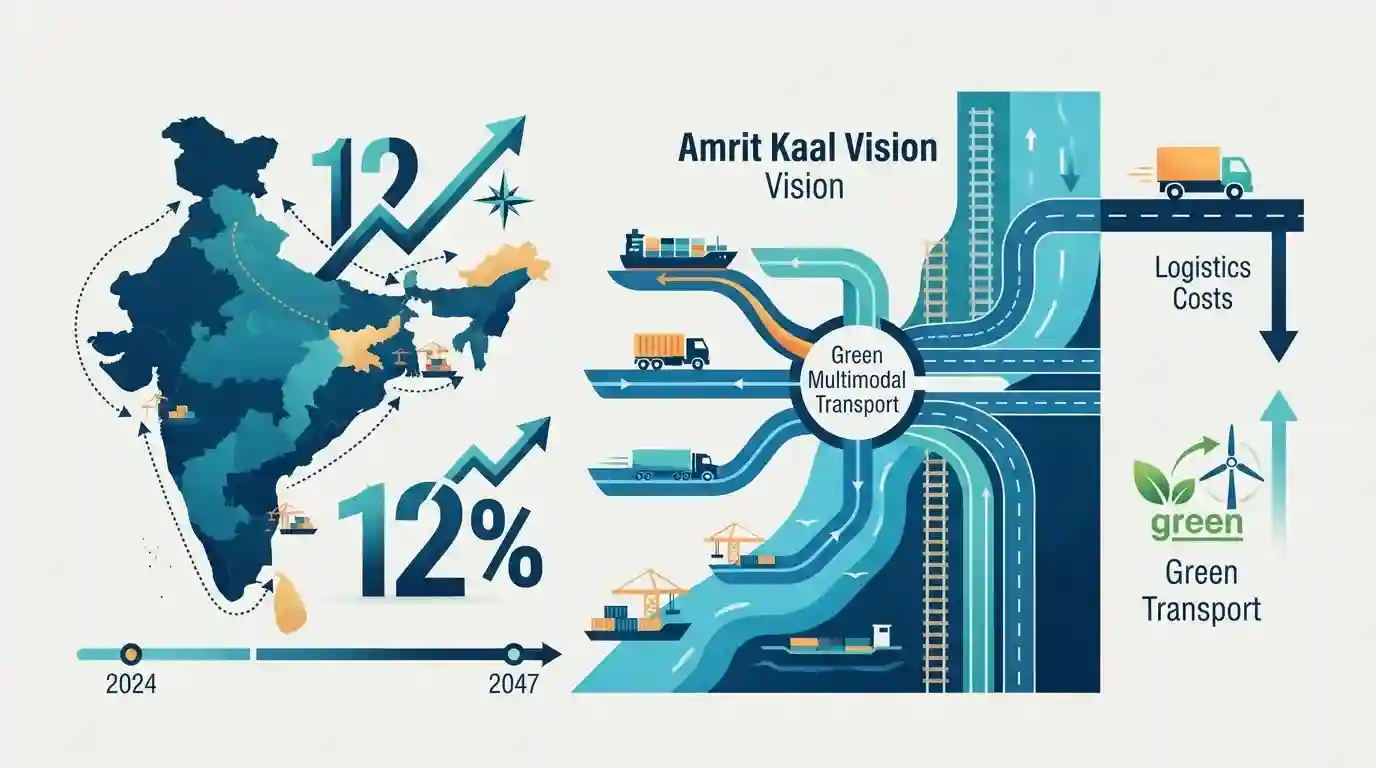
Union Minister Sarbananda Sonowal announced a strategic roadmap to double India's coastal and waterway freight share to 12% by 2047 under the Maritime Amrit Kaal Vision, aiming to curb logistics costs and promote green multimodal transport.
Key Points
- Union Minister Sarbananda Sonowal outlined plans to increase the share of coastal shipping and inland waterways freight from the current 6% to 12% by 2047.
- The initiative forms part of the broader Maritime Amrit Kaal Vision 2047 aimed at optimizing logistics costs and promoting green, sustainable transportation.
- Boosting modal share for waterways aims to reduce carbon emissions and decongest road and rail networks.
Important Terms
Maritime Amrit Kaal Vision 2047

A comprehensive strategic roadmap launched by the Indian government to revitalize the maritime sector, aiming to boost coastal and waterway freight share to 12% by 2047.
UPSC context
UPSC GS Paper III (Infrastructure, Economic Development): Evaluates India's long-term strategy for multimodal transport, logistics cost reduction, and green growth.
Sagarmala Programme
A flagship government initiative launched to promote port-led development, leveraging India's coastline and waterways to minimize logistics costs and enhance trade competitiveness.
UPSC context
UPSC GS Paper III (Infrastructure): Tests knowledge of major infrastructure schemes, port modernization, and multimodal connectivity.
Ministry of Ports, Shipping and Waterways
The nodal union ministry responsible for the formulation and administration of rules, regulations, and laws relating to ports, shipping, and inland water transport in India.
UPSC context
UPSC GS Paper II/III (Governance/Infrastructure): Tests institutional frameworks and ministerial mandates governing India's blue economy and transport sectors.
Static Concepts Connected
What are the key constitutional and legal provisions governing inland waterways in India?
- Constitutional Basis: Union List entry 24 gives Parliament exclusive legislative power over shipping and navigation on national waterways.
- National Waterways Act: The National Waterways Act, 2016 declared 111 waterways as National Waterways across India.
- Regulatory Body: Inland Waterways Authority of India (IWAI) acts as the statutory body for developing and regulating inland waterways.
Cross-Topic Patterns
Inland Waterways vs. Seventh Schedule Lists
Inland waterways are declared under the National Waterways Act. UPSC frequently tests the constitutional division of legislative powers (Union vs. State List) regarding water transport and fisheries.
Green Logistics and Net-Zero Targets
Shifting freight to waterways directly supports India's net-zero 2070 commitments by lowering logistics carbon emissions, tying infrastructure development to international climate pledges.

Expect statements combining modal share targets (12% by 2047) with Sagarmala and National Waterways Act provisions.
Linked PYQs · 3
Linked PYQs · 3
- 2026PrelimsGS1
Consider the following statements with reference to the Sagarmala Programme of the Government of India : I. The Sagarmala Programme seeks to achieve port-led economic growth through cost-effective and sustainable coastal infrastructure. II. The success of the Sagarmala Programme is reflected in significant growth in coastal and inland waterway shipping, along with improved global port rankings. III. Sagarmala 2.0 aims to position India as a global maritime innovation hub aligned with Atmanirbhar Bharat and Viksit Bharat 2047 visions. Which of the following relationships among the above statements is/are correct ? 1. Statement II validates the effectiveness of the strategies envisioned in statement I. 2. Statement III extends the objectives of statement I by embedding them into a future-oriented innovation framework. 3. Statement I contradicts statement III by focusing only on traditional infrastructure instead of modern innovation. Select the answer using the code given below :
- 2025MainsGS3
Why is maritime security vital to protect India's sea trade? Discuss maritime and coastal security challenges and the way forward.
- 2026PrelimsGS1
In what way(s) does the Vizhinjam International Seaport represent a structural shift in India's maritime trade and logistics policy? 1. By functioning exclusively as a domestic cargo hub to reduce reliance on coastal shipping and eliminate the need for foreign collaborations. 2. By focusing primarily on passenger cruise tourism and heritage shipping to increase Kerala's profile as a maritime heritage destination. 3. By leveraging its natural deep draft and strategic location to reduce dependence on foreign trans-shipment ports, enhance revenue retention, and reposition India in regional maritime trade. Select the answer using the code given below :
