Cyber-Enabled Cognitive Warfare and National Security Challenges
Source:PIB ↗
Why It Matters
Cognitive warfare represents a modern dimension of hybrid and grey-zone conflict where human perception and cyberspace are weaponized. Understanding this threat is crucial for UPSC aspirants studying internal security, cyber security challenges, and India's evolving defense preparedness against non-traditional threats.
Summary
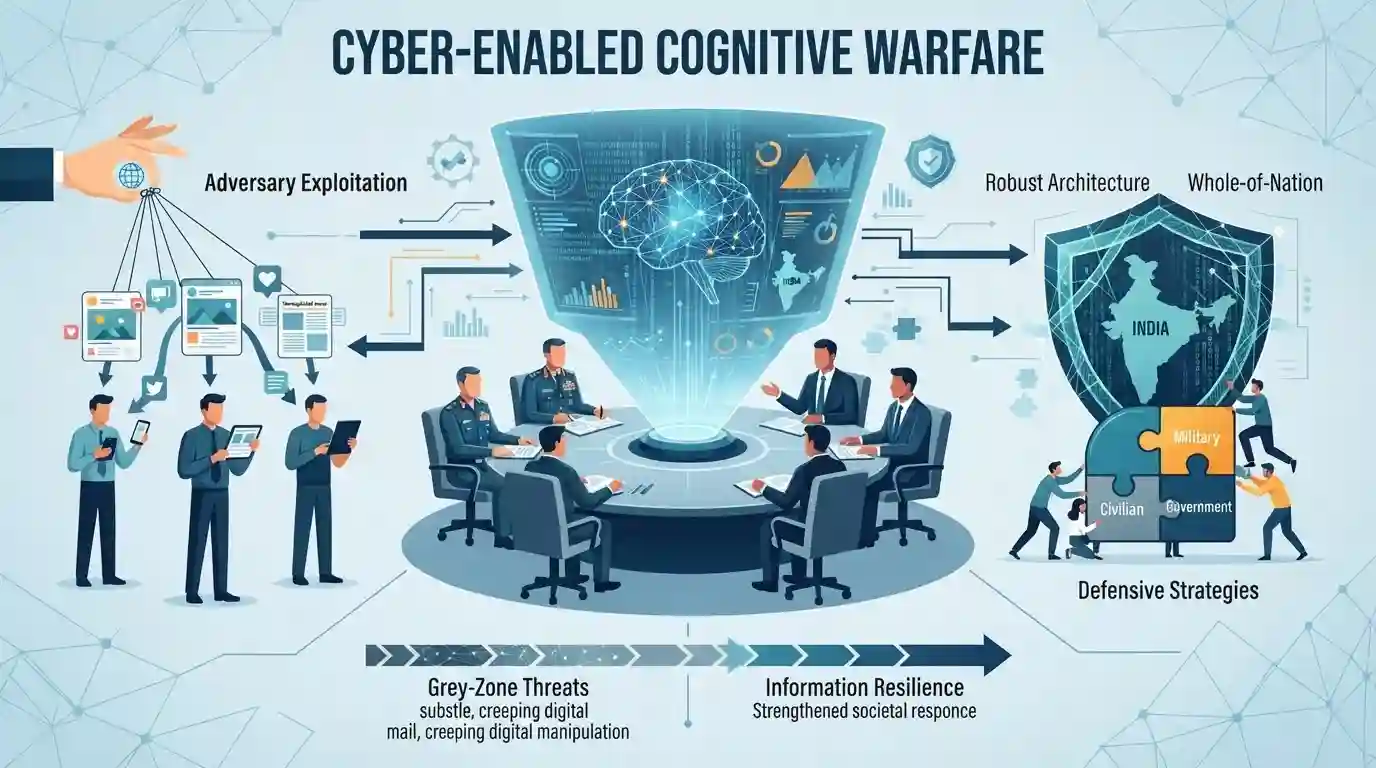
A seminar organized by CENJOWS and HQIDS in New Delhi focused on the rising threat of cyber-enabled cognitive warfare. The discussions centered on how modern adversaries exploit digital platforms and cyberspace to manipulate human psychology, alter public perception, and disrupt national security without conventional military engagement. The event underscored the necessity for India to build robust defensive architectures, enhance information resilience, and adopt a collaborative, whole-of-nation strategy to counter grey-zone and hybrid warfare challenges.
Key Points
- A seminar on Cyber-Enabled Cognitive Warfare was jointly conducted by the Centre for Joint Warfare Studies (CENJOWS) and Headquarters Integrated Defence Staff (HQIDS) in New Delhi.
- Cognitive warfare leverages cyberspace and social media to target human psychology, manipulate public perception, and influence decision-making processes.
- Discussions highlighted the blurring lines between peace and war, weaponization of information, and the threat to national security posed by grey-zone tactics.
- The seminar emphasized the urgent need for a comprehensive national defense framework, whole-of-nation approach, and resilience against hybrid threats and disinformation campaigns.
Important Terms
Centre for Joint Warfare Studies (CENJOWS)

A Ministry of Defence think tank established in 2007 that fosters joint military discourse, strategic innovation, and research on contemporary security challenges under the Headquarters Integrated Defence Staff.
UPSC context
UPSC GS Paper III (Security): Important security institutions, think tanks, and policy formulation for joint warfighting and national defence.
Headquarters Integrated Defence Staff (HQIDS)
An apex military organization established in 2001 to coordinate, integrate, and streamline joint planning, policy formulation, and operations across the Indian Army, Navy, and Air Force.
UPSC context
UPSC GS Paper III (Security): Structure of India's defence forces, military reform, theater commands, and inter-services coordination.
Cyber-Enabled Cognitive Warfare
An emerging domain of warfare that exploits cyberspace, digital platforms, and artificial intelligence to manipulate human psychology, alter public perception, and disrupt decision-making without conventional combat.
UPSC context
UPSC GS Paper III (Internal Security): New age security threats, grey-zone warfare, information warfare, and cyber security challenges.
Prelims Trap
CENJOWS is an independent academic research institute functioning under the Ministry of Science and Technology.
CENJOWS is a tri-service think tank functioning under the aegis of the Integrated Defence Staff, not an independent civilian ministry or academic university.
Static Concepts Connected
What are the key pillars of India's National Cyber Security Strategy and institutional defense architecture?
- Apex Body: NCSCoordination is headed by the National Cyber Security Coordinator under the National Security Council Secretariat (NSCS).
- Nodal Agency: CERT-In (Indian Computer Emergency Response Team) acts as the national nodal agency for responding to cybersecurity incidents under the IT Act, 2000.
- CII Protection: National Critical Information Infrastructure Protection Centre (NCIIPC) secures vital sectors like power, transport, and finance against cyber disruptions.
- Military Wing: Defense Cyber Agency (DCA) handles tri-services cyber warfare operations and military cyberspace defense.
Cross-Topic Patterns
Cognitive Warfare + AI Governance Frameworks
Cognitive warfare employs AI-generated deepfakes and mass disinformation campaigns, bridging internal security challenges with emerging technology governance under national AI missions.
Grey-Zone Warfare + Joint Doctrine Integration
Grey-zone tactics blur the boundary between conventional armed conflict and peacetime subversion, demanding doctrinal integration across external defense and internal intelligence agencies.

CENJOWS/HQIDS seminars on cognitive warfare & hybrid threats frequently translate into Prelims assertion-reasoning or Mains GS-3 security questions.
Linked PYQs · 3
Linked PYQs · 3
- 2022MainsGS3
What are the different elements of cyber security ? Keeping in view the challenges in cyber security, examine the extent to which India has successfully developed a comprehensive National Cyber Security Strategy.
- 2024MainsGS3
Social media and encrypting messaging services pose a serious security challenge. What measures have been adopted at various levels to address the security implications of social media? Also suggest any other remedies to address the problem.
- 2021MainsGS3
Keeping in view India's internal security, analyse the impact of cross-border cyber attacks. Also discuss defensive measures against these sophisticated attacks.
