Critical Minerals Ecosystem in India NITI Aayog Partnership
Source:PIB ↗
Why It Matters
Critical minerals are indispensable for India's transition to green energy, EV manufacturing, electronics, and defense. This partnership between NITI Aayog and TEXMiN addresses critical supply chain vulnerabilities, technological gaps in domestic exploration, and sustainable mining practices.
Summary
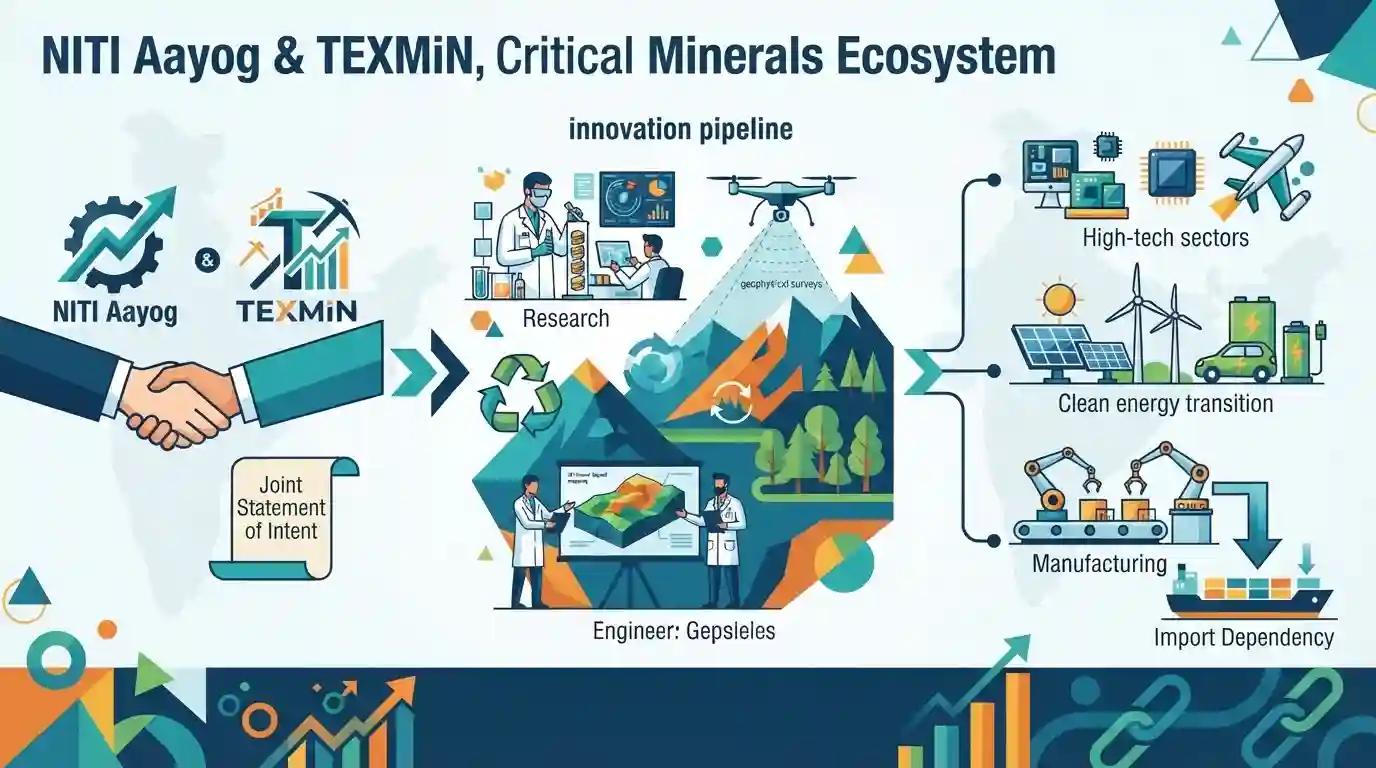
NITI Aayog and TEXMiN (Technology Innovation Center on Exploration and Mining at IIT ISM Dhanbad) have signed a Joint Statement of Intent to strengthen India's critical minerals ecosystem. The partnership aims to foster technological innovation, research, and sustainable exploration practices to secure supply chains for high-tech sectors, clean energy transition, and manufacturing, thereby reducing import dependencies.
Key Points
- NITI Aayog and TEXMiN have signed a Joint Statement of Intent (SoI) to boost India's critical minerals ecosystem.
- The collaboration focuses on technological advancements, exploration, and sustainable mining practices for critical minerals essential for clean energy and high-tech manufacturing.
- TEXMiN, hosted at IIT (ISM) Dhanbad, will leverage its expertise in mining and mineral exploration to support policy formulation and technological innovation.
- The initiative aims to reduce import dependence, enhance self-reliance, and secure raw material supply chains for strategic sectors like electronics, electric vehicles (EVs), and renewable energy.
Important Terms
NITI Aayog

The premier policy think tank of the Government of India providing strategic and technical input on economic development, cooperative federalism, and key national missions.
UPSC context
GS Paper II & III (Governance, Economic Development). Important for institutional structure, policy planning, and cooperative federalism in India.
TEXMiN (Technology Innovation Center on Exploration and Mining)
A technology innovation center and translation research park established at IIT (ISM) Dhanbad focused on mining automation, exploration technologies, and mineral value chain advancement under Mining 4.0.
UPSC context
GS Paper III (Science & Technology / Resources). Tests institutional innovation for indigenous critical mineral extraction and manufacturing independence.
IIT (Indian School of Mines) Dhanbad
A premier technological institution renowned for mining, petroleum, and earth sciences education, serving as a hub for advanced research and technical manpower development in India's mineral sector.
UPSC context
GS Paper III (Science & Technology / Infrastructure). Relevant for assessing R&D capabilities in natural resource exploration and mining technologies.
Prelims Trap
TEXMiN is a statutory regulatory body established under the Ministry of Mines to issue mining licenses.
TEXMiN is an academic/innovation hub under IIT ISM Dhanbad, not a statutory regulatory body or a newly created central ministry department.
Static Concepts Connected
What are Critical Minerals and why are they strategically vital for India?
- Definition: Elements essential for modern technologies, economies, or national security whose supply lines are vulnerable to disruption.
- Strategic Role: Crucial for clean energy technologies like wind turbines, solar panels, and electric vehicle batteries, as well as defense equipment.
- Vulnerability: India imports a significant majority of its requirements for lithium, cobalt, nickel, and rare earth elements, posing supply chain risks.
Cross-Topic Patterns
Critical Minerals + PLI Schemes for EV Ecosystem
The push for indigenous critical minerals directly feeds the production-linked incentive (PLI) schemes for advanced chemistry cell (ACC) batteries and EV manufacturing.
Technological Innovation + Strategic Mineral Security
Collaborations with R&D hubs like IIT ISM Dhanbad bridge the gap between academic research and national security imperatives in mineral security.

Critical minerals ecosystems, deep-tech mining partnerships, and import dependency reduction frequently appear in matching-list questions.
Linked PYQs · 1
Linked PYQs · 1
- 2025MainsGS3
Mineral resources are fundamental to the country's economy and these are exploited by mining. Why is mining considered an environmental hazard? Explain the remedial measures required to reduce the environmental hazard due to mining.
