Institutional Credit Roadmap for Rural Housing Under PMAY G
Source:PIB ↗
Why It Matters
This development highlights the shift toward leveraging formal financial channels and institutional credit to meet rural housing targets under flagship welfare schemes, directly linking financial inclusion with rural development.
Summary
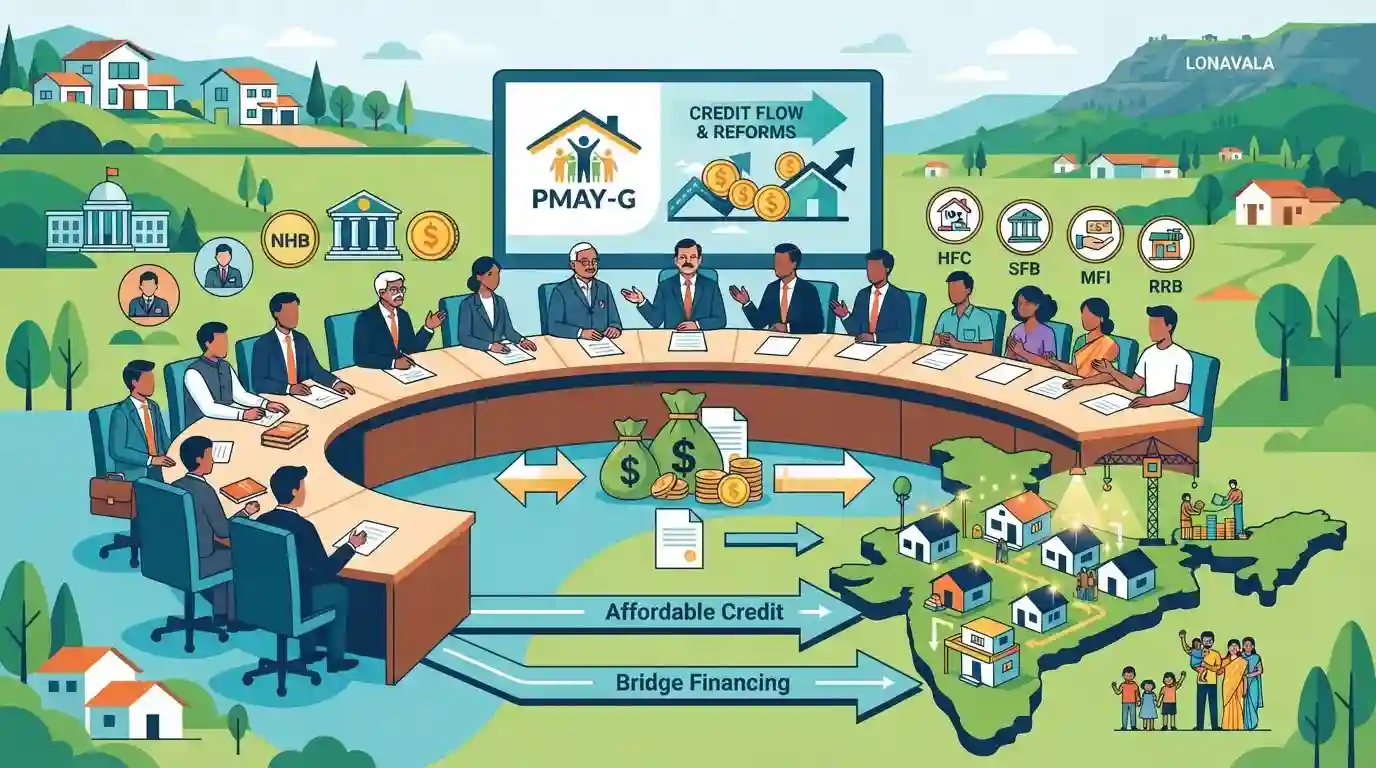
At the MoRD-NHB PMAY-G Reform Samvad held in Lonavala, lending institutions including HFCs, SFBs, MFIs, and RRBs deliberated on a roadmap to provide affordable institutional credit and bridge financing gaps for Pradhan Mantri Awas Yojana Gramin (PMAY-G) beneficiaries.
Key Points
- Lending institutions proposed institutional financing models for Pradhan Mantri Awas Yojana Gramin (PMAY-G) beneficiaries at the PMAY-G Reform Samvad in Lonavala.
- The consultation involved stakeholders like States, Housing Finance Companies (HFCs), Small Finance Banks (SFBs), Microfinance Institutions (MFIs), and Regional Rural Banks (RRBs).
- The initiative aims to bridge funding gaps for rural housing and facilitate affordable institutional credit access for rural populations.
Important Terms
Pradhan Mantri Awas Yojana Gramin (PMAY-G)

A flagship central sector scheme under the Ministry of Rural Development aiming to provide permanent pucca houses with basic amenities to eligible rural houseless households and those living in dilapidated houses.
UPSC context
UPSC Prelims/Mains (GS Paper II/III): Social welfare schemes, poverty alleviation, rural development, and inclusive growth targets.
National Housing Bank (NHB)
The apex statutory financial institution in India established in 1988 under an Act of Parliament, operating under the RBI to regulate and promote housing finance institutions and develop the housing market.
UPSC context
UPSC Prelims: Banking sector regulators, financial inclusion, and housing development schemes.
Ministry of Rural Development (MoRD)
The nodal central government ministry responsible for formulating policies and implementing programs for rural development, poverty alleviation, employment, and infrastructure in India.
UPSC context
UPSC Mains GS Paper II: Functions and responsibilities of Union and State governments, governance, and rural welfare administration.
Static Concepts Connected
How is beneficiary selection conducted under Pradhan Mantri Awas Yojana Gramin (PMAY-G)?
- SECC 2011 Data: Beneficiaries are identified using housing deprivation parameters from the Socio-Economic and Caste Census (SECC) 2011 data.
- Awaas+ Surveys: Awaas+ surveys are utilized to capture households left out or newly eligible under updated criteria.
- Gram Sabha Role: Every beneficiary list generated through digital surveys must undergo mandatory verification by the Gram Sabha at the village level.
Cross-Topic Patterns
Rural Housing Schemes + Scheme Convergence Patterns
PMAY-G convergence models with MGNREGA and Swachh Bharat Mission (Gramin) are frequently tested in GS Mains GS-II and Prelims matching sets.

PMAY-G SECC-2011/Awaas+ eligibility criteria paired with institutional credit integration makes a prime multi-statement prelims question.
Linked PYQs · 2
Linked PYQs · 2
- 2024PrelimsGS1
With reference to the Pradhan Mantri Jan Dhan Yojana (PMJDY), which of the following statements is/are correct? 1. The scheme aims to open bank accounts for unbanked households. 2. There is a minimum balance requirement for accounts opened under this scheme. 3. Beneficiaries get a Rupay Debit Card with an inbuilt accident insurance cover. Select the correct answer using the code given below.
- 2022MainsGS3
Is inclusive growth possible under market economy ? State the significance of financial inclusion in achieving economic growth in India.
