Traditional Knowledge Dissemination and Science Integration Conference
Source:PIB ↗
Why It Matters
Traditional knowledge protection and its integration with modern science are vital for preventing biopiracy, securing IPRs, and promoting sustainable innovation, directly aligning with UPSC GS3 syllabus requirements.
Summary
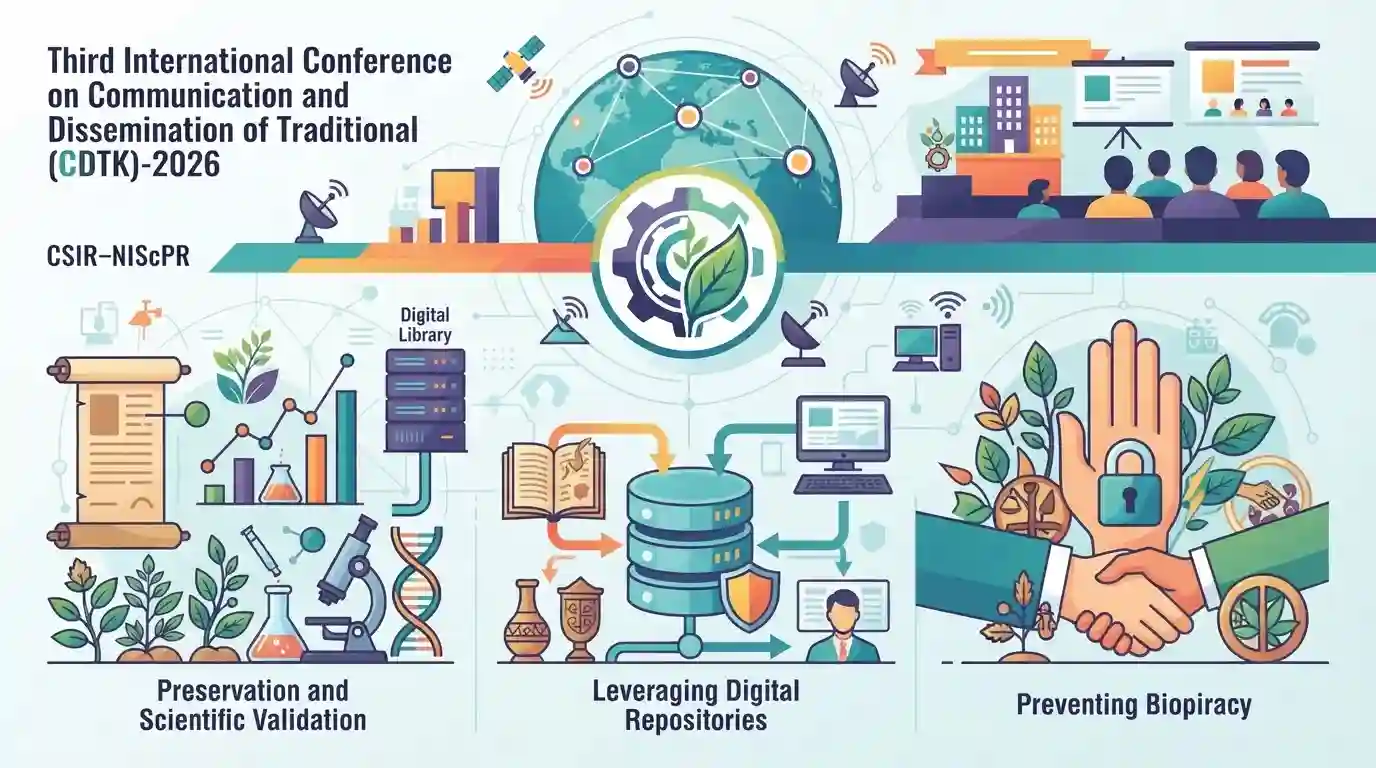
CSIR-NIScPR organized the third International Conference on Communication and Dissemination of Traditional Knowledge (CDTK)-2026 to discuss strategies for preserving, communicating, and scientifically validating indigenous knowledge systems. The event underscored the significance of preventing biopiracy, leveraging digital repositories like the Traditional Knowledge Digital Library (TKDL), and integrating ancient wisdom with contemporary scientific frameworks.
Key Points
- CSIR-NIScPR organized the third International Conference on Communication and Dissemination of Traditional Knowledge (CDTK)-2026.
- The conference focuses on preserving, documenting, and scientifically validating traditional knowledge to prevent biopiracy and erroneous patents.
- Emphasizes the integration of modern science with ancient wisdom for sustainable development, healthcare, and agriculture.
- Highlights the role of digital tools, communication strategies, and policy frameworks in disseminating traditional knowledge globally.
Important Terms
Traditional Knowledge Digital Library

A pioneering Indian digital repository established to prevent biopiracy by documenting traditional medicinal knowledge and making it accessible to international patent offices in multiple foreign languages.
UPSC context
UPSC GS Paper III (Intellectual Property Rights, Science and Technology): Tests understanding of patent laws, biopiracy prevention, and protection of indigenous heritage.
CSIR-NIScPR
A constituent laboratory of the Council of Scientific and Industrial Research focused on science communication, policy research, and disseminating traditional and contemporary scientific knowledge.
UPSC context
UPSC GS Paper III (Science & Technology): Tests awareness of public research institutions, science outreach initiatives, and promotion of indigenous knowledge systems.
Static Concepts Connected
What is the institutional framework and legal significance of the Traditional Knowledge Digital Library (TKDL)?
- Joint Initiative: Established in 2001 by the Council of Scientific and Industrial Research (CSIR) and the Ministry of AYUSH.
- Prior Art Database: Functions as a repository to prevent biopiracy and wrongful patenting of Indian traditional medicinal systems in international patent offices.
- Language Access: Translates ancient texts from vernacular scripts into five international languages (English, German, French, Japanese, Spanish) for patent examiners.
- Legal Anchor: Aligns with Section 3(p) of the Indian Patents Act, which bars patenting of traditional knowledge or aggregation of known properties.
Cross-Topic Patterns
TKDL & TRIPS: Intellectual Property Rights and Prior Art
The TKDL acts as a prior art database preventing biopiracy, directly intersecting with TRIPS Agreement flexibility and patentability criteria under Section 3(p) of the Indian Patents Act.

UPSC frequently tests the institutional mandate of TKDL (jointly set up by CSIR & AYUSH) and its role as prior art against biopiracy.
Linked PYQs · 3
Linked PYQs · 3
- 2019MainsGS3
How is the Government of India protecting traditional knowledge of medicine from patenting by pharmaceutical companies?
- 2015MainsGS3
India's Traditional Knowledge Digital Library (TKDL), which has a database containing formatted information on more than 2 million medicinal formulations is proving a powerful weapon in the country's fight against erroneous patents. Discuss the pros and cons of making this database publicly available under open-source licensing.
- 2023PrelimsGS1
Consider the following statements: 1. In India, the Biodiversity Management Committees are key to the realization of the objectives of the Nagoya Protocol. 2. The Biodiversity Management Committees have important functions in determining access and benefit sharing, including the power to levy collection fees on the access of biological resources within its jurisdiction. Which of the statements given above is/are correct?
