INS Sudarshini Completes Lokayan Maritime Expedition
Source:PIB ↗
Why It Matters
It highlights India's maritime diplomacy, sail training capabilities of the Indian Navy, and strategic outreach in the Indo-Pacific region.
Summary
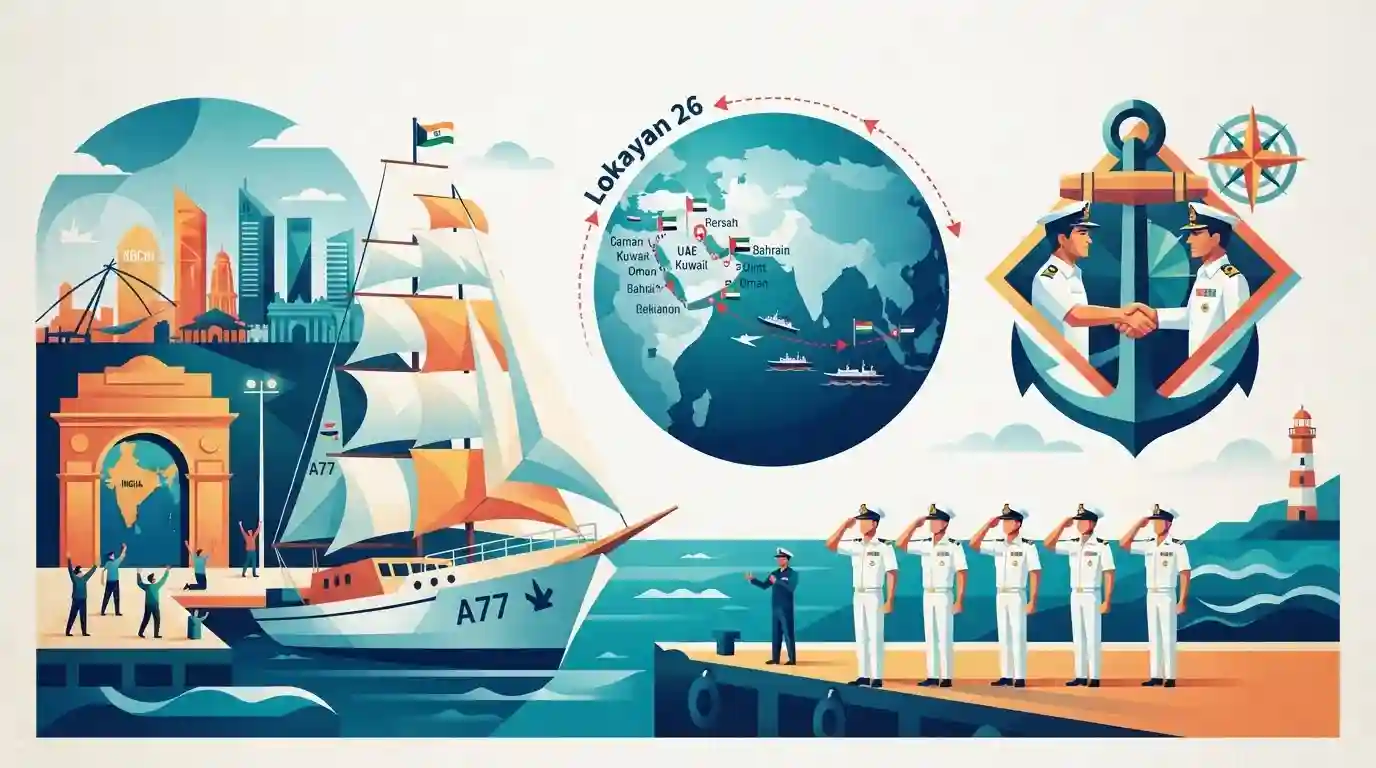
The Indian Navy welcomed INS Sudarshini back to Kochi upon the successful completion of Lokayan 26. The deployment served as a major initiative in maritime diplomacy, sail training, and strengthening international friendships and bilateral maritime cooperation.
Key Points
- INS Sudarshini successfully completed Lokayan 26, returning to Kochi.
- Lokayan expeditions promote maritime diplomacy, foster international goodwill, and train naval personnel in traditional seamanship.
- The mission highlights India's rich maritime heritage and strengthens bilateral ties with friendly foreign nations along the route.
Important Terms
Lokayan 26

A major 10-month transoceanic deployment by the Indian Navy sail training ship INS Sudarshini, covering over 22,000 nautical miles and 17 port calls across 11 countries to promote maritime diplomacy and sail training.
UPSC context
GS Paper III (Security and Defence) - Highlights maritime diplomacy, international cooperation, and naval training exercises.
Indian Navy
The naval branch of the Indian Armed Forces responsible for safeguarding the nation's maritime borders, projecting power, and conducting diplomatic outreach through sail training and port visits.
UPSC context
GS Paper III (Security and Defence) - Tests knowledge on India's defense preparedness, maritime security architecture, and naval diplomacy.
Static Concepts Connected
What is the strategic significance of sail training ships in the Indian Navy and their role in naval diplomacy?
- Core Training: Sail training ships like INS Sudarshini impart traditional seamanship, navigation, and endurance to officer cadets.
- Soft Power Diplomacy: They serve as floating ambassadors of goodwill during international port calls, projecting soft power.
- Strategic Alignment: Such deployments reinforce India's Indo-Pacific vision of MAHASAGAR and maritime engagement with friendly nations.
Cross-Topic Patterns
Naval Diplomacy vs. Hard Power Security
Sail training expeditions like Lokayan act as soft-power instruments, complementing hard-power naval exercises like MILAN and Indo-Pacific deployments under MAHASAGAR.

Expect match-the-following or statement questions linking Indian Navy sail training ships (INS Tarangini, Sudarshini) to MAHASAGAR vision.
Linked PYQs · 3
Linked PYQs · 3
- 2026PrelimsGS1
Consider the following statements with reference to the Sagarmala Programme of the Government of India : I. The Sagarmala Programme seeks to achieve port-led economic growth through cost-effective and sustainable coastal infrastructure. II. The success of the Sagarmala Programme is reflected in significant growth in coastal and inland waterway shipping, along with improved global port rankings. III. Sagarmala 2.0 aims to position India as a global maritime innovation hub aligned with Atmanirbhar Bharat and Viksit Bharat 2047 visions. Which of the following relationships among the above statements is/are correct ? 1. Statement II validates the effectiveness of the strategies envisioned in statement I. 2. Statement III extends the objectives of statement I by embedding them into a future-oriented innovation framework. 3. Statement I contradicts statement III by focusing only on traditional infrastructure instead of modern innovation. Select the answer using the code given below :
- 2024MainsGS2
Discuss the geopolitical and geostrategic importance of Maldives for India with a focus on global trade and energy flows. Further also discuss how this relationship affects India's maritime security and regional stability amidst international competition ?
- 2022MainsGS3
What are the maritime security challenges in India ? Discuss the organisational, technical and procedural initiatives taken to improve the maritime security.
