India Renewable Energy Growth and Clean Transition Summit 2026
Source:PIB ↗
Why It Matters
This article covers major policy benchmarks, installed capacity milestones (310 GW non-fossil fuel), and new financial outlays (Pradhan Mantri Surya Sarovar Yojana and Green Energy Corridor Phase-III) vital for India's net-zero transition, making it essential reading for questions on India's energy security and sustainable infrastructure.
Summary
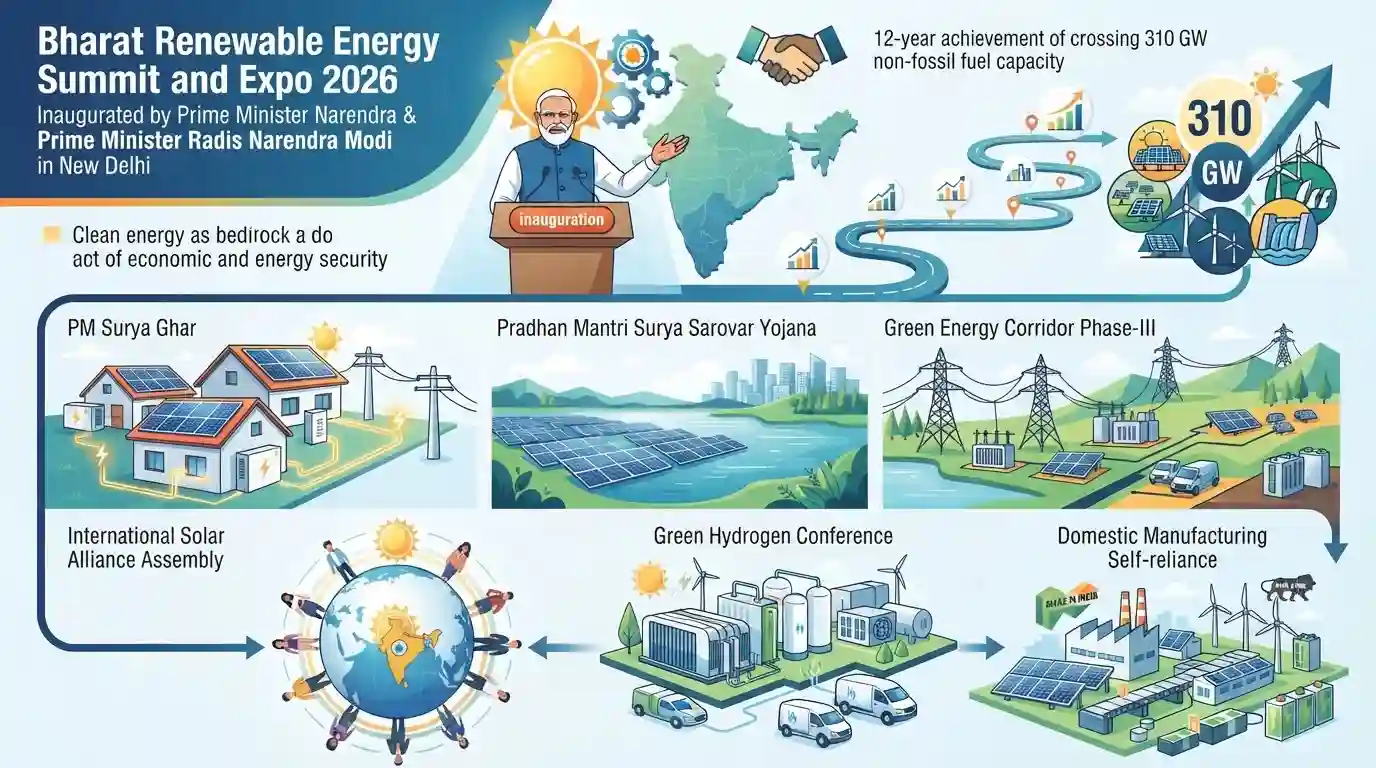
Prime Minister Narendra Modi inaugurated the Bharat Renewable Energy Summit and Expo 2026 in New Delhi, emphasizing clean energy as the bedrock of future economic and energy security. Highlighting achievements over the past 12 years, officials noted that India's non-fossil fuel installed capacity has crossed 310 GW, propelled by major initiatives like PM Surya Ghar, the newly approved Pradhan Mantri Surya Sarovar Yojana for floating solar, and Green Energy Corridor Phase-III. The summit also aligned with the International Solar Alliance Assembly and the Green Hydrogen Conference, underlining India's leadership in global energy transition and domestic manufacturing self-reliance.
Key Points
- Prime Minister Narendra Modi inaugurated the Bharat Renewable Energy Summit and Expo 2026 at Bharat Mandapam, New Delhi, coinciding with the 9th Assembly of the International Solar Alliance and the 4th Conference on Green Hydrogen.
- India's non-fossil fuel installed capacity has reached 310 GW (over 110 GW added in two years), with solar capacity expanding significantly to 171 GW.
- Key announcements include the approval of the Pradhan Mantri Surya Sarovar Yojana (5,000 MW floating solar capacity) and Green Energy Corridor Phase-III with an investment of ₹1.86 lakh crore.
- India achieved notable manufacturing growth, scaling solar module manufacturing capacity to 225 GW and maintaining globally competitive low costs for green hydrogen and green ammonia.
Prelims Trap
Pradhan Mantri Surya Sarovar Yojana targets rooftop solar installations for 10 million households across India.
Aspirants may confuse PM Surya Sarovar Yojana (which focuses on floating solar on inland water bodies) with PM Surya Ghar Muft Bijli Yojana (which focuses on rooftop solar for households).
Static Concepts Connected
What are the core objectives and institutional features of the International Solar Alliance (ISA)?
- Founding context: First treaty-based international intergovernmental organization headquartered in Gurugram, India, launched at COP21 in Paris.
- Financial target: Aims to mobilize $1 trillion of investments by 2030 for massive deployment of solar energy technologies.
- Membership scope: Originally focused on countries lying fully or partially between the Tropics of Cancer and Capricorn (Sunbelt nations), later expanded globally to all UN member states.
Cross-Topic Patterns
Floating Solar + Inland Waterways Policy
Floating solar installations leverage water bodies to reduce land acquisition conflicts, directly linking renewable energy expansion with India's Inland Waterways and National Water Policy priorities.
Green Energy Corridors + Sovereign Green Bonds
The Green Energy Corridor grid-integration projects bridge climate goals with infrastructure financing models like Viability Gap Funding (VGF) and sovereign green bonds.

Expect matching questions pairing renewable schemes (PM Surya Ghar, Surya Sarovar, GEC-III) with their specific capacity and transmission goals.
Linked PYQs · 3
Linked PYQs · 3
- 2025PrelimsGS1
Consider the following statements about 'PM Surya Ghar Muft Bijli Yojana': I. It targets installation of one crore solar rooftop panels in the residential sector. II. The Ministry of New and Renewable Energy aims to impart training on installation, operation, maintenance and repairs of solar rooftop systems at grassroot levels. III. It aims to create more than three lakhs skilled manpower through fresh skilling, and up-skilling, under scheme component of capacity building. Which of the statements given above are correct?
- 2022PrelimsGS1
Consider the following statements: 1. Gujarat has the largest solar park in India. 2. Kerala has a fully solar powered International Airport. 3. Goa has the largest floating solar photovoltaic project in India. Which of the statements given above is/are correct?
- 2026PrelimsGS1
Consider the following statements with reference to India's response to climate change : I. India's Long-Term Low Emission Development Strategy (LT-LEDS) is a crucial tool for achieving net-zero emissions by 2070. II. India's 4th Biennial Update Report (BUR-4) submitted in December, 2024 recorded around 8% decrease in Greenhouse gas emissions in 2020 over 2019. III. Climate-resilient development necessarily depends on quick and short-term achievement of emission reduction targets. Which of the following relationships among the above statements is/are correct ? 1. Statement I is empirically supported by statement II. 2. Statement III contradicts the approach implicit in statement I. 3. Statement I and statement III together establish the premise of long-term sustainability. Select the answer using the code given below :
