Centres of Excellence-Skills Empanelment by MSDE
Source:PIB ↗
Why It Matters
Understanding institutional measures for human resource development and advanced vocational training is critical for addressing India's demographic dividend and skill gaps.
Summary
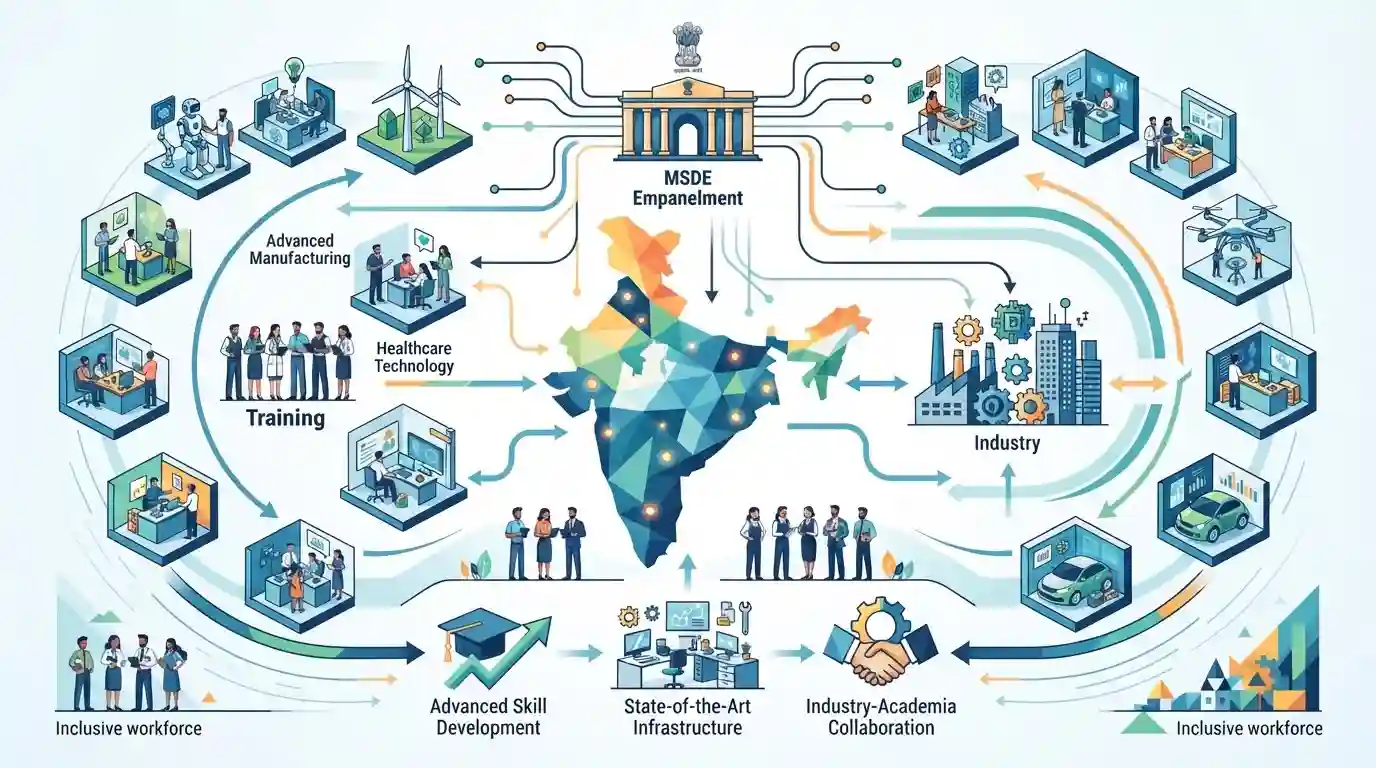
The Ministry of Skill Development and Entrepreneurship (MSDE) has officially empanelled 19 institutions as Centres of Excellence-Skills (CoE-Skills) to bolster advanced skill development, encourage state-of-the-art training infrastructure, and bridge industry-academia gaps in emerging sectors across India.
Key Points
- The Ministry of Skill Development and Entrepreneurship (MSDE) has empanelled 19 institutions as Centres of Excellence-Skills (CoE-Skills).
- These centres aim to bridge the skill gap, promote advanced vocational education, and align training programs with emerging industry demands and technology.
- The initiative focuses on scaling up quality skilling infrastructure and fostering innovation across key sectors.
Important Terms
Ministry of Skill Development and Entrepreneurship

The nodal ministry of the Government of India responsible for coordinating all skill development efforts, aligning demand and supply of skilled manpower, vocational and technical training, and entrepreneurship.
UPSC context
UPSC Prelims/Mains (GS Paper II/III): Human Resource Development, employment policies, demographic dividend, and skill-based governance.
Centres of Excellence-Skills (CoE-Skills)
Permanent, advanced, and industry-responsive institutions recognized by MSDE to deliver high-quality, globally benchmarked training in emerging sectors and bridge the industry-academia gap.
UPSC context
UPSC Mains GS Paper III (Inclusive Growth, Employment, Skill Development) and Prelims: Institutional frameworks for advanced technical training.
Prelims Trap
CoE-Skills empanelment framework is a project-specific, short-term scheme tied to annual budgetary allocations.
Aspirants often assume CoE-Skills empanelment is tied to a specific short-term government scheme, whereas the framework is deliberately scheme-agnostic and permanent.
Static Concepts Connected
What are the key institutional mechanisms and bodies governing skill development in India?
- Ministry Role:: MSDE apex body created in 2014 to coordinate all skill development efforts across the country.
- NSDC Mandate:: NSDC Public-private partnership (PPP) model funding vocational training and building capacity.
- Regulatory Body:: NCVET Regulating vocational education and training through standardized qualifications and awarding bodies.
Cross-Topic Patterns
Vocational Skilling + NEP 2020 integration
Centres of Excellence for skills directly support the National Education Policy (NEP) 2020 mandate of vocationalising higher education and integrating skill credit frameworks with mainstream academic degrees.
Skill Development + International Mobility Partnerships
Foreign language training and advanced technical certifications within CoE-Skills directly operationalize India's bilateral migration and mobility partnership agreements with EU and Gulf nations.

CoE-Skills empanelment via Green Channel & outcome-linked metrics will likely feature in a statement-based prelims question.
Linked PYQs · 2
Linked PYQs · 2
- 2015MainsGS3
Success of 'Make in India' programme depends on the success of 'Skill India' programme and radical labour reforms." Discuss with logical arguments.
- 2018PrelimsGS1
With reference to Pradhan Mantri Kaushal Vikas Yojana, consider the following statements: 1. It is the flagship scheme of the Ministry of Labour and Employment. 2. It, among other things, will also impart training in soft skills, entrepreneurship, financial and digital literacy. 3. It aims to align the competencies of the unregulated workforce of the country to the National Skill Qualification Framework. Which of the statements given above is/are correct?
