National Conference on Gender Data and Statistics for Policy Insights
Source:PIB ↗
Why It Matters
Gender statistics are critical for evidence-based policymaking, tracking welfare delivery, and achieving gender equality under Sustainable Development Goals (SDGs).
Summary
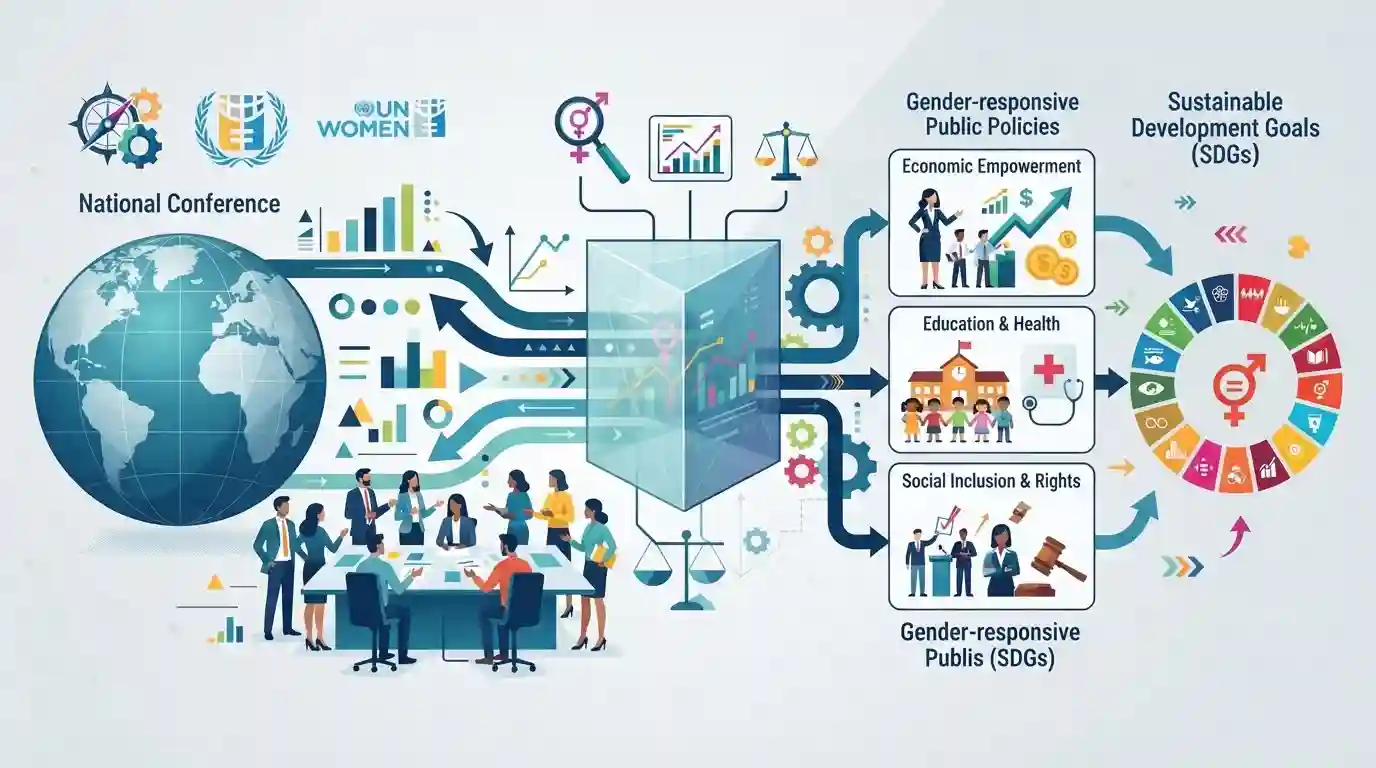
The National Conference on Gender Data and Statistics, co-hosted by MoSPI and UN Women, focused on leveraging empirical data and robust statistical metrics to shape gender-responsive public policies and fulfill Sustainable Development Goals (SDGs).
Key Points
- The National Conference on Gender Data and Statistics emphasized bridging the gap between evidence and policy design for effective women empowerment.
- Highlighted the critical role of robust, disaggregated gender statistics in monitoring the Sustainable Development Goals (SDGs) and national welfare schemes.
- Collaborative effort by the Ministry of Statistics and Programme Implementation (MoSPI) and UN Women to strengthen administrative data systems and statistical capacity.
Important Terms
Sustainable Development Goals (SDGs)

A set of 17 global goals adopted by the UN to end poverty, protect the planet, and ensure prosperity for all by 2030, featuring specific gender equality targets.
UPSC context
Important for GS Paper II (International Relations, Social Justice) and GS Paper III (Inclusive Growth, Development issues). Tests global policy frameworks.
Ministry of Statistics and Programme Implementation (MoSPI)
The nodal central ministry responsible for coordination of statistical activities in India, formulating national data policies, and conducting large-scale socio-economic surveys.
UPSC context
Important for GS Paper II (Governance, Government policies and interventions) and GS Paper III (Economy, Data systems). Tests understanding of official data infrastructure.
UN Women
The United Nations entity dedicated to gender equality and the empowerment of women, working globally to set standards and formulate effective policies.
UPSC context
Important for GS Paper II (International Organizations, Social Justice, Women empowerment). Tests knowledge of specialized UN bodies and multilateral cooperation.
Prelims Trap
MoSPI exclusively focuses on macroeconomic growth and industrial index production without any mandate for social or gender statistics.
Aspirants often assume MoSPI is solely responsible for national economic surveys, missing its foundational role in social statistics, gender metrics, and SDG monitoring frameworks.
Static Concepts Connected
What are the key institutional mechanisms for Gender Budgeting and statistical tracking in India?
- MoSPI Role: MoSPI compiles 'Women and Men in India' periodically to provide sex-disaggregated data across health, education, and employment sectors.
- Gender Budgeting Statement: Introduced in Union Budget 2005-06, it comprises Part A (women-specific allocations with 100% outlay) and Part B (pro-women allocations with at least 30% outlay).
- Gender Cells: Mandated across central ministries and departments to establish Gender Cells for integrating gender perspectives into policy formulation and expenditure review.
Cross-Topic Patterns
Gender Statistics + Gender Budgeting Integration
Gender data integration connects SDG tracking under MoSPI with parliamentary committee oversight on women's empowerment budgets (Gender Budgeting Statement).

MoSPI publications like 'Women and Men in India' combined with SDG tracking make high-yield statements for prelims matching schemes/reports.
Linked PYQs · 3
Linked PYQs · 3
- 2025MainsGS2
Women's social capital complements in advancing empowerment and gender equity. Explain.
- 2021MainsGS2
“Though women in post-Independent India have excelled in various fields, the social attitude towards women and feminist movement has been patriarchal." Apart from women education and women empowerment schemes, what interventions can help change this milieu?
- 2026PrelimsGS1
Which of the following statements with respect to the Revamped Rashtriya Gram Swaraj Abhiyan (RGSA) is/are correct? 1. The period of its implementation is 1st April, 2021 to 31st March, 2026. 2. The key objective of the Revamped RGSA is to develop the governance capabilities of the Panchayati Raj Institutions to deliver on the Sustainable Development Goals. 3. The share of the Central funding for the Revamped RGSA is 100% for all States and Union Territories. Select the answer using the code given below:
