India Biosphere Reserves Framework Conservation and Management
Source:PIB ↗
Why It Matters
Crucial for UPSC Prelims (factual mapping of biosphere reserves, zones, international recognitions) and Mains GS3 (biodiversity conservation, sustainable development, and community participation).
Summary
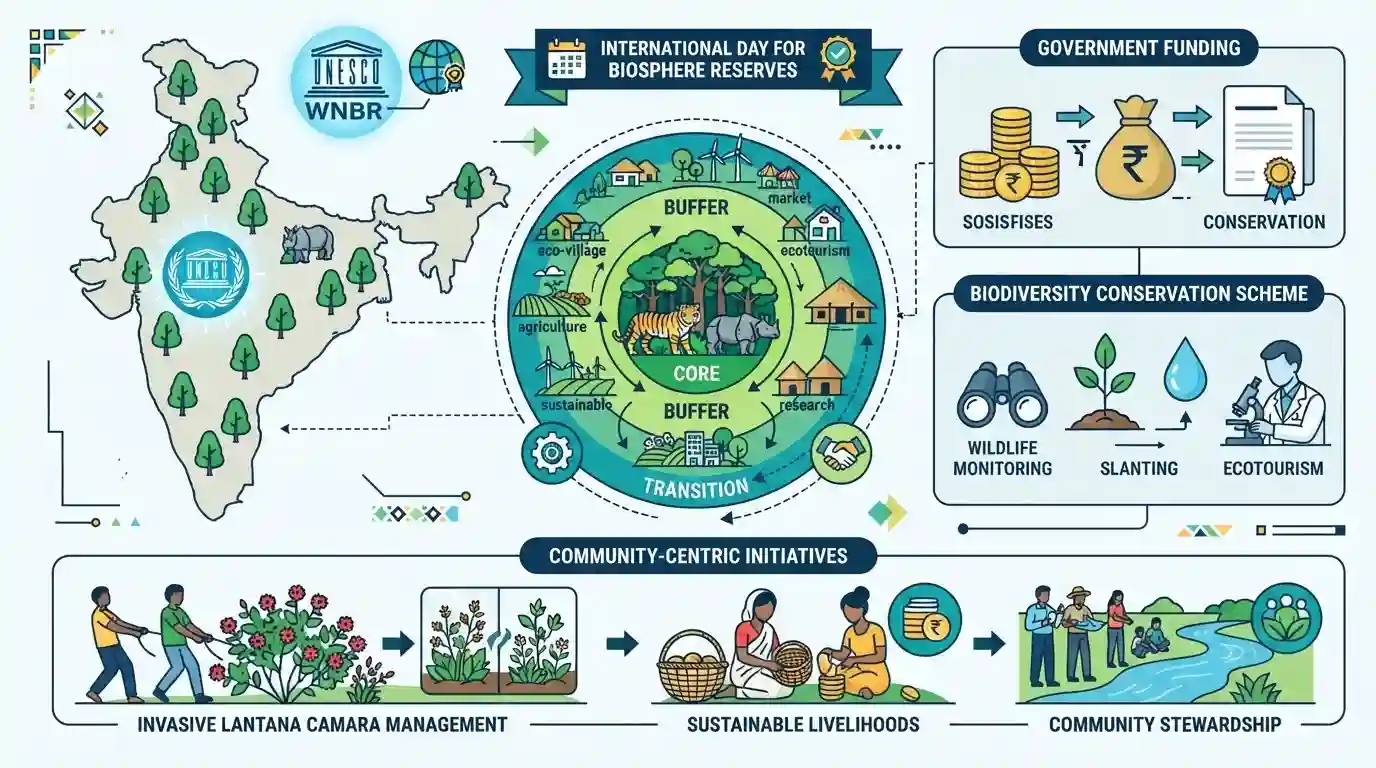
An official backgrounder detailing India's network of 18 Biosphere Reserves (with 13 under UNESCO's WNBR) in celebration of the International Day for Biosphere Reserves. It highlights the concept of biosphere reserves, their tripartite zonation model (core, buffer, transition), government funding frameworks via the 'Biodiversity Conservation' scheme, and successful community-centric conservation initiatives like managing invasive Lantana camara.
Key Points
- India has 18 notified Biosphere Reserves, out of which 13 are recognized under UNESCO's World Network of Biosphere Reserves (WNBR), representing the highest number in South Asia.
- Biosphere reserves function through a tripartite zonation model comprising core areas, buffer zones, and transition areas to balance strict ecological protection with sustainable local livelihoods.
- The Ministry of Environment, Forest and Climate Change administers the 'Biodiversity Conservation' scheme under the umbrella 'Conservation of Natural Resources and Ecosystems' scheme, providing funding on a cost-sharing basis (60:40 for general states and 90:10 for North Eastern and Himalayan states).
- Community-led conservation models, such as utilizing invasive Lantana camara vines for indigenous handicrafts in the Nilgiri Biosphere Reserve, demonstrate effective integration of ecological management and livelihood generation.
Important Terms
Biodiversity Conservation Scheme

A Centrally Sponsored Scheme administered by the MoEFCC providing financial assistance to states for the management, protection, and development of designated biosphere reserves across India.
UPSC context
UPSC Prelims & Mains (GS Paper III): Important government schemes for environmental conservation and funding mechanisms.
Man and the Biosphere (MAB) Programme
An intergovernmental scientific program launched by UNESCO in 1971 to set scientific benchmarks for improving the interactions between humans and the natural environment globally.
UPSC context
UPSC Prelims & Mains (GS Paper III): International environmental programs, UNESCO recognitions, and sustainable development.
Ministry of Environment, Forest and Climate Change (MoEFCC)
The apex nodal ministry in the executive branch of the Union Government of India responsible for planning, promoting, and overseeing environmental and forestry policies.
UPSC context
UPSC Prelims & Mains (GS Paper II & III): Core institutional machinery for environmental governance and statutory implementation in India.
UNESCO
The United Nations Educational, Scientific and Cultural Organization, a specialized agency that oversees the World Network of Biosphere Reserves (WNBR).
UPSC context
UPSC Prelims: International organizations, conventions, and global conservation designations like WNBR.
Prelims Trap
All 18 notified Biosphere Reserves in India are recognized under UNESCO's World Network of Biosphere Reserves (WNBR).
All 18 notified Biosphere Reserves in India are NOT automatically part of UNESCO's World Network of Biosphere Reserves; only 13 are included in the WNBR.
Static Concepts Connected
What are the three core zones of a Biosphere Reserve under the MAB Programme?
- Core Zone:: Strictly protected area for conserving biodiversity, ecosystems, and genetic resources with minimal human interference.
- Buffer Zone:: Surrounds or adjoins the core zone, where research, ecotourism, and educational activities are permitted.
- Transition Area:: Outermost part allowing sustainable resource management, agriculture, settlements, and local community collaboration.
Cross-Topic Patterns
Protected Areas + Scheduled Areas Governance
Biosphere reserves test the intersection of strict environmental laws (Wildlife Protection Act) and decentralized developmental governance under Schedule V and VI.
WNBR Listings + International Environmental Diplomacy
UNESCO WNBR listings evaluate India's soft power in global environmental diplomacy alongside Ramsar wetlands and Natural World Heritage Sites.

BR zonation models (core vs. buffer vs. transition) and UNESCO WNBR criteria are prime candidates for matching-list prelims questions.
Linked PYQs · 2
Linked PYQs · 2
- 2026PrelimsGS1
Which of the following statements in relation to NIRANTAR (National Institute for Research and Application of Natural Resources to Transform, Adapt and Build Resilience), a platform of institutions under the Ministry of Environment, Forest and Climate Change, is/are correct ? 1. Ecosystem Survey and Analysis is a vertical under this platform, the lead institute of which is Botanical Survey of India, Kolkata. 2. Research and Management of Ecosystem Service is a vertical under this platform, the lead institute of which is Central Zoo Authority, New Delhi. 3. Capacity Development Support is a vertical under this platform, the lead institute of which is Indian Institute of Forest Management, Bhopal. Select the answer using the code given below :
- 2019PrelimsGS1
Which of the following are in Agasthyamala Biosphere Reserve?
