AIIMS Rajkot Advanced Radiotherapy Facility and Cancer Care
Source:PIB ↗
Why It Matters
This article is relevant for understanding India's progress in expanding specialized tertiary healthcare infrastructure, addressing the burden of non-communicable diseases like cancer, and improving affordable access to advanced medical treatments.
Summary
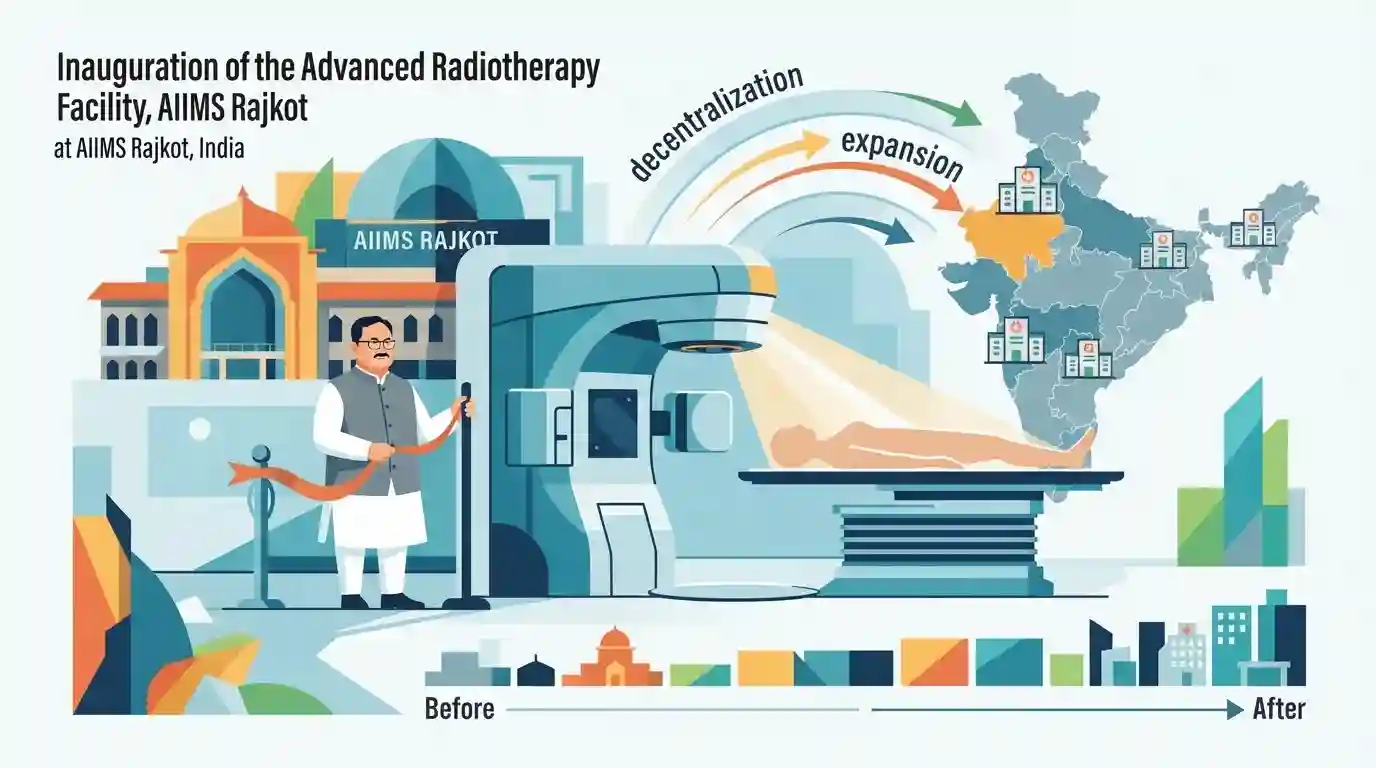
Union Health Minister J.P. Nadda inaugurated the Advanced Radiotherapy Facility at AIIMS Rajkot, underlining efforts to improve oncology services and decentralize high-end medical care infrastructure in India under public healthcare development frameworks.
Key Points
- Union Health Minister inaugurated an Advanced Radiotherapy Facility at AIIMS Rajkot to enhance specialized cancer care infrastructure.
- The initiative highlights the government's commitment to decentralizing tertiary healthcare and making advanced medical technologies accessible and affordable.
- Addresses the rising burden of non-communicable diseases (NCDs), particularly cancer, by strengthening regional healthcare hubs.
Important Terms
AIIMS Rajkot

A premier public tertiary care medical institute in Gujarat, established under PMSSY to decentralize high-end medical care and provide specialized oncology and radiotherapy services to regional populations.
UPSC context
UPSC Mains GS Paper II (Health Infrastructure, Social Sector Development). Tests understanding of regional healthcare decentralization and specialized medical facilities.
Ministry of Health and Family Welfare
The central government ministry responsible for formulating, implementing, and monitoring public health policies, medical education frameworks, and flagship health welfare schemes across India.
UPSC context
UPSC Mains GS Paper II (Governance and Institutional Mechanisms). Crucial for questions regarding central governance of public health and welfare delivery.
Prelims Trap
AIIMS institutions are established and funded exclusively by respective state governments where they are located.
Aspirants often assume AIIMS institutions are funded entirely through state budgets, whereas central sector schemes like PMSSY fund their establishment.
Static Concepts Connected
What are the primary objectives and funding mechanisms of the Pradhan Mantri Swasthya Suraksha Yojana (PMSSY)?
- Primary Goal: Correction of regional imbalances in affordable/reliable tertiary healthcare services.
- Medical Education: Augmentation of facilities for quality medical education in the country.
- Funding Model: Fully funded by the Central Government as a Central Sector Scheme.
Cross-Topic Patterns
AIIMS Expansion and Regional Health Balance
The decentralization of AIIMS networks connects public health infrastructure expansion with cooperative federalism and regional balance under the PMSSY framework.
Epidemiological Transition and NCD Burdens
Rising cancer burdens highlight the epidemiological transition from communicable to non-communicable diseases, altering health budget allocations and social sector priorities.

PMSSY objectives, AIIMS mandate, and NCD epidemiological shifts frequently appear in prelims matching or assertion-reason questions.
Linked PYQs · 3
Linked PYQs · 3
- 2024MainsGS2
In a crucial domain like the public healthcare system the Indian State should play a vital role to contain the adverse impact of marketisation of the system. Suggest some measures through which the State can enhance the reach of public healthcare at the grassroots level.
- 2021MainsGS2
“Besides being a moral imperative of a Welfare State, primary health structure is a necessary precondition for sustainable development.” Analyze.
- 2018MainsGS2
Appropriate local community-level healthcare intervention is a prerequisite to achieve 'Health for All' in India. Explain.
